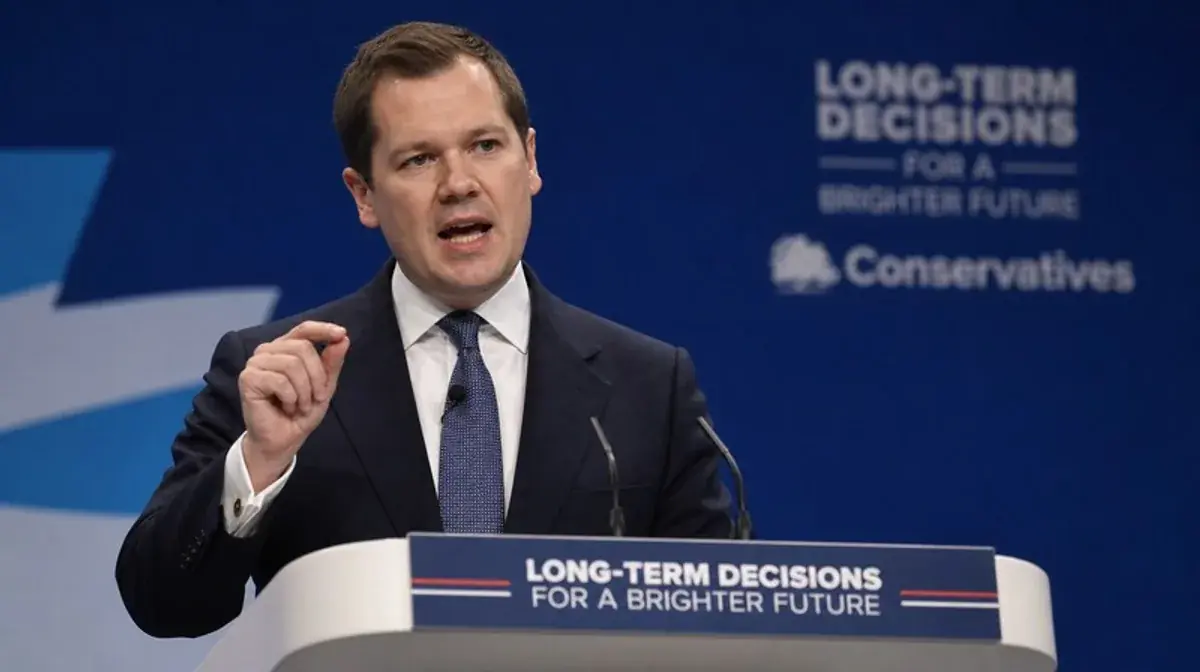
Sunday morning political shows exist precisely for moments like this. Trevor Phillips, hosting his long-running Sky News programme, put a single, simple, deliberately provocative question to Reform UK frontman Robert Jenrick: is Nigel Farage becoming more of a liability than an asset to his own party? Jenrick\'s answer, and the eleven minutes of increasingly heated exchange that followed, is one of the more revealing interviews of the entire finances saga — not because Jenrick conceded anything, but because of exactly how he chose not to.
The interview also opened on a genuinely substantive policy dispute — over deporting a convicted grooming gang perpetrator, Shabir Ahmed, to Pakistan — before pivoting into the finances row, giving a useful window into how Reform tries to use hardline policy positioning to insulate itself from character questions about its leader.
“Don\'t Be Silly, Trevor”
When Phillips put the liability question directly, Jenrick\'s first response was dismissive rather than substantive: “Don\'t be silly, Trevor.” Pressed on why it was a silly question given four consecutive by-election losses for Reform and Farage\'s conspicuously low public profile during the height of the finances story, Jenrick pivoted to Farage\'s international travel — including a recent meeting with the US vice president — as evidence of continued relevance rather than retreat. It is a defence that works on its own terms but does not actually engage with the specific claim that Farage has gone quiet on UK broadcast media specifically, having reportedly declined numerous interview requests from BBC Newsnight alone.
The Cottrell Question He Wouldn\'t Fully Answer
The sharpest section of the interview came when Phillips raised a Sunday Times report that George Cottrell — a longtime Farage associate convicted of money laundering in the United States — has been paying for aspects of Farage\'s personal security. Jenrick\'s answer relied on a specific and carefully chosen phrase: Cottrell “has no formal role within Reform whatsoever” and “supported Nigel before he became a member of parliament.” Phillips noted, accurately, that this did not actually answer whether Cottrell was currently paying for security, only that he had no official party role — a distinction Jenrick did not close.
Phillips then turned the argument back on Reform\'s own attack lines against the incoming Labour leadership, pointing out that Reform has spent weeks criticising the lack of scrutiny facing Andy Burnham while resisting exactly the same scrutiny of Farage\'s own associations. Jenrick\'s response — that the media is “fixated” on Farage and should focus on issues voters actually care about — drew a sharp rebuttal: Jenrick himself had, moments earlier, predicted Farage would be the next prime minister, which by definition makes his character and associations a legitimate subject of exactly the scrutiny Jenrick was trying to wave away.
The Broader Deportation Argument
Before the finances discussion, Jenrick used the Shabir Ahmed case to argue that both Labour and Conservative governments lacked the political will to use aid and visa leverage to force foreign governments to accept the return of convicted criminals, contrasting this with what he said would be a Reform government\'s willingness to pause aid and visas to Pakistan specifically until deportations were accepted. It is a case study in how Reform consistently tries to reframe scrutiny of its own leadership back onto immigration policy — ground where the party polls most strongly and where Jenrick is on considerably firmer footing than when defending Farage\'s personal finances.
What This Means Going Forward
Interviews like this matter less for what gets conceded on air — almost nothing, in Jenrick\'s case — and more for what they reveal about a party\'s strategic instincts under pressure. Reform\'s consistent playbook throughout the finances story has been deflection to policy, minimisation of specific factual questions, and framing all scrutiny as establishment bias. That strategy has worked well enough to keep Reform UK ahead in the voting intention tracker so far. Whether it continues to work depends heavily on whether the parliamentary standards commissioner\'s eventual findings give critics a concrete, undeniable fact to attach to the pattern Phillips was probing for — rather than the pattern of evasive answers alone.