Green Party
Voting Intention Trend
▲ Nearly 4x since 2024 GE — historic surge| Date | Green VI | Context |
|---|---|---|
| July 2024 | 4% | 4 seats won — best result since the party first won a seat in 2010 |
| Oct 2024 | 5% | Early benefit from Labour disappointment among young voters |
| Feb 2025 | 7% | Continued growth as Labour's left flank loses support |
| Oct 2025 | 11% | Accelerating surge as Labour continues to collapse |
| Feb 2026 | 13% | Greens overtake Lib Dems in multiple polls |
| May 2026 | 15% | Highest ever — nearly 4x 2024 GE result, clear 4th in national polls |
About the Green Party
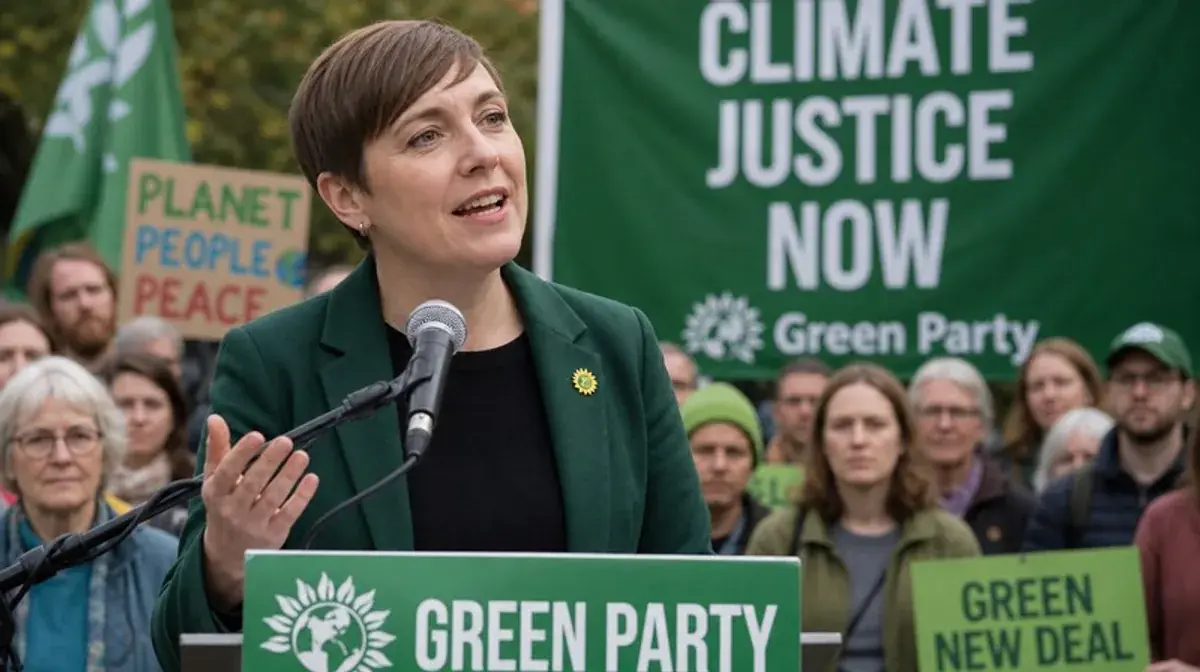
The Green Party of England and Wales is experiencing its strongest sustained polling in its history. Under co-leaders Carla Denyer and Adrian Ramsay, the party won 4 Westminster seats at the July 2024 General Election — including Carla Denyer's victory in Bristol Central — on 4% of the vote, their best ever Westminster result.
By May 2026, the Greens are polling at 15% nationally — nearly four times their General Election vote share. This extraordinary surge reflects Labour's historic collapse from 33% to 18%, with progressive voters flooding to the Greens. Voting intention polling now places the Greens above the Liberal Democrats on 13% and well above their own historical peak, establishing them as a major force in British politics for the first time.
The Green surge has been driven primarily by younger voters, particularly those aged 18–34, who supported Keir Starmer's Labour in 2024 but have since become disillusioned with the pace of change on climate policy, welfare reform, and housing. The age-based polling analysis shows the Greens performing strongest among this cohort, with some polls placing them first among under-25s.
The Greens face the same structural challenge as all smaller parties under First Past the Post: translating a high national vote share into seats requires geographical concentration. Their strongest areas remain university cities and progressive urban constituencies. According to Wikipedia's entry on the Green Party of England and Wales, the party holds its strongest position in Bristol, Brighton, Sheffield, and Norwich — university cities with large concentrations of young, graduate, and environmentally conscious voters.
The party's co-leadership model — with Carla Denyer representing the more urban, activist wing and Adrian Ramsay representing a more rural, pragmatic strand of Green politics — has helped the party appeal across a broader geographic range than in previous electoral cycles. Both leaders have emphasised the party's commitment to combining climate action with a strong social justice agenda, including rent controls, a wealth tax, and increased funding for mental health services. Green representatives have also been increasingly willing to take on Reform UK directly on character grounds: on a BBC panel over Nigel Farage's undeclared donations, the party's Hannah Spencer argued the story was a pattern rather than a one-off mistake.
On the economy, the Greens advocate a Green New Deal that would simultaneously address the climate emergency and create hundreds of thousands of new jobs in clean energy, insulation, and sustainable transport. On the NHS, the party supports significant increases in funding and calls for integrated health and social care. These positions place them clearly to the left of Labour's current government programme, making them the natural home for voters who wanted more radical change.
The central question facing the Greens ahead of the 2029 General Election is whether their current polling translates into a meaningful increase in seats. A uniform swing model based on 15% Green support would produce somewhere between 10 and 20 seats, but the First Past the Post system tends to reward geographical concentration — and the Greens' support, while growing, remains relatively spread out.
Key Issues the Greens Lead On
Climate & Environment
The Greens are the party most trusted on climate change. Their policy platform calls for a Green New Deal and a zero-carbon economy by 2030, far ahead of the main parties.
Public Ownership
The Greens advocate renationalising utilities and railways — a position popular with left-wing voters who feel Labour has not gone far enough on public services.
Wealth Inequality
A wealth tax and higher taxes on investment income are core Green policies, attracting voters who believe Labour has moved too far to the centre on economic redistribution.
Green Surge — Video Analysis
Video: The breakdown of the Labour vote and the beneficiaries of that collapse — including the Green Party's surge to 15% among progressive, younger and urban voters.
Who Votes Green?
Green Party voters in Britain skew strongly young, are disproportionately university-educated, and are concentrated in urban centres and university towns. The party draws well among renters, younger women, and those who prioritise climate policy above other issues. Many Green voters are former Labour supporters who feel the party has moved too far toward the centre. The regional polling breakdown shows the Greens at their strongest in London, Bristol, Sheffield, Brighton and other university cities. In May 2026, the party is polling in double digits across all English regions — a remarkable development compared to their historically patchy regional support. The satisfaction rating polls consistently show Greens voters among the most likely to report dissatisfaction with the Labour government's performance.
Frequently Asked Questions
What is Green Party polling in 2026?
The Green Party polls at 15% nationally in May 2026 — nearly four times their 4% result at the July 2024 General Election. This places them clearly in fourth place, ahead of the Liberal Democrats at 13%. The surge is the strongest sustained polling in the party's history and reflects Labour's collapse from 33% to 18%. The full picture is in the voting intention tracker.
Who are the Green Party co-leaders?
The Green Party is co-led by Carla Denyer and Adrian Ramsay. Denyer won Bristol Central at the 2024 General Election on 38% of the vote — the party's most high-profile seat gain and a symbol of the Green surge in progressive urban seats. Ramsay won South Norfolk. Denyer has a net approval of +8 in leader approval polls — the only UK party leader currently in positive territory — making her an increasingly prominent national figure.
Why are the Greens surging in the polls?
The surge is driven primarily by Labour's collapse among younger and more progressive voters. Voters aged 18–34 who backed Keir Starmer's Labour in 2024 became disillusioned with the pace of change on climate, the NHS, housing and welfare reform. Some surveys now place the Greens first among under-25s. Labour's cuts to winter fuel payments and the two-child benefit cap have also pushed left-leaning voters toward the Greens and away from centrist Labour.
How many seats could the Greens win at the 2029 General Election?
A uniform swing model on 15% Green support suggests between 10 and 25 seats at the 2029 General Election. First Past the Post heavily penalises parties with geographically spread support, so the actual result depends on how concentrated the Green vote is in winnable targets. The strongest prospects are university cities: Bristol, Brighton, Sheffield, Norwich and York. Even a result of 8–12 seats would represent a transformative moment for British Green politics.
What are the Green Party’s main policies in 2026?
The Greens’ main policies include a Green New Deal targeting zero carbon by 2030, renationalising water and railways, a wealth tax on assets over £10 million, rent controls, 100,000 new social homes per year, scrapping the two-child benefit limit, free NHS mental health services, and proportional representation. These positions are consistently to the left of Labour’s governing programme, making the Greens the natural home for voters who wanted more radical change in 2024. See the Green Party manifesto page for full detail.
Are the Greens in government anywhere in the UK?
The Green Party controls Bristol City Council and is the official opposition or a significant force on several others including Brighton & Hove. They hold 4 Westminster seats (Bristol Central, Brighton Pavilion, Waveney Valley, North Herefordshire) and 7 Holyrood seats in Scotland. Their local government base provides the organisational infrastructure that supports their target seat strategy for the 2029 General Election.
Explore More
Green Party Leadership
Caroline Lucas to Carla Denyer — how the co-leadership model built the Green surge to 15%.
Green Party Manifesto 2024
“Real Hope. Real Change.” — all 10 pledges, 4 seats won, co-leaders and 2029 outlook.
Who Votes Green?
Full demographic breakdown — the young, female, graduate coalition behind the Green surge to 15%.
All Parties
Compare the Greens with Labour, Conservatives, Reform UK, Lib Dems and the SNP.
Voting Intention Tracker
Full polling history including the Green Party rise since the 2024 General Election.
General Election 2029
How many seats could the Greens win in 2029? MRP projections and seat analysis.