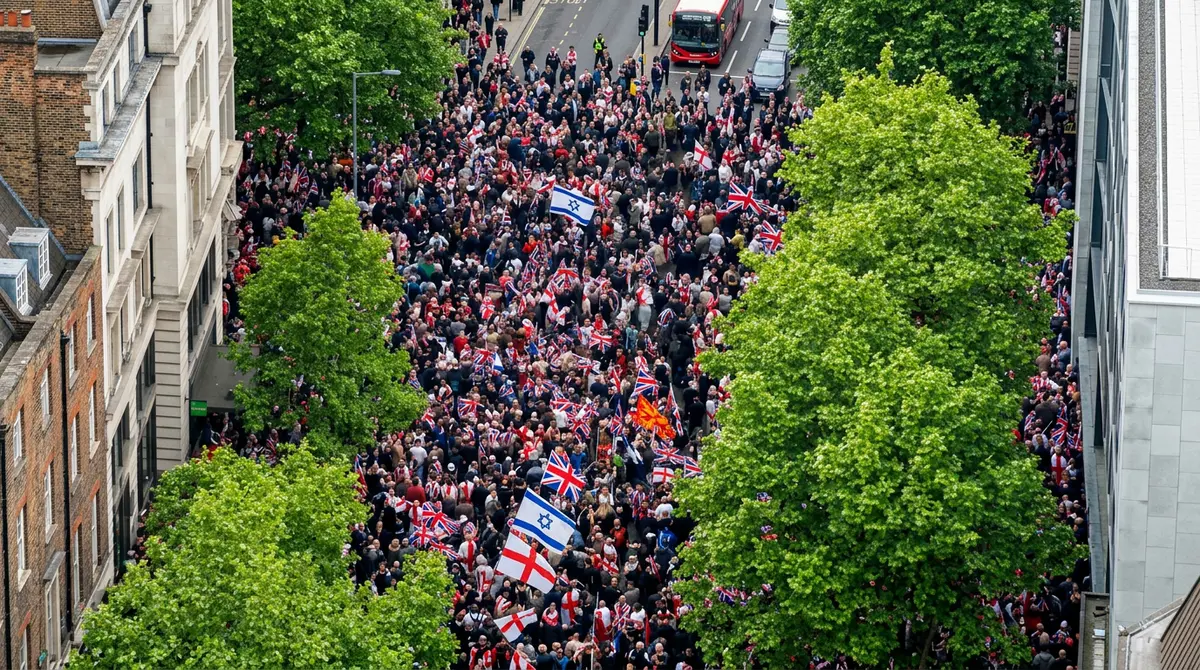
Central London came to a near standstill on Saturday, 16 May 2026, as up to 50,000 people marched through the capital under the banner “Four Nations. One Kingdom. Under God.” — the latest and largest mobilisation organised by Tommy Robinson. For a polling and politics tracker like BritPolls, the significance extends far beyond the day’s events: the rally crystallises the forces that have driven Reform UK to 28% in national polling, reshaped the British right, and left both Labour and the Conservatives facing the most difficult political environment since the 1980s.
What Happened: The Day in Detail
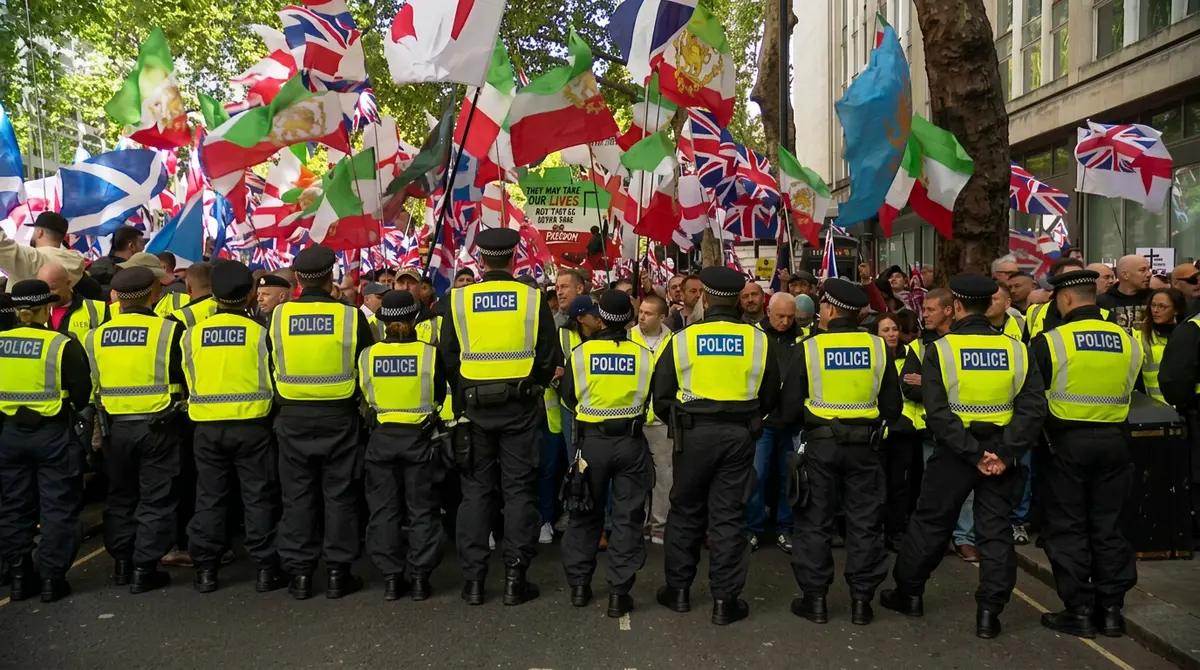
The Unite the Kingdom march began mid-morning on 16 May 2026, with participants converging on central London from multiple assembly points. The Metropolitan Police deployed 4,000 officers — including mounted units, dog handlers, drones, and helicopter surveillance — in what commanders described as one of the largest single-day policing operations in the force’s recent history. The operation cost an estimated £4.5 million.
By mid-afternoon, 31 people had been arrested. The policing challenge was compounded by the FA Cup Final also taking place in London on the same day, requiring co-ordination across multiple forces and venues simultaneously.
Simultaneously, approximately 30,000 pro-Palestinian demonstrators marched through the capital to mark Nakba Day — the annual commemoration of the Palestinian displacement of 1948. Police kept the two demonstrations physically separate throughout the day. The presence of two major competing marches of entirely opposed political character, requiring a combined police presence of extraordinary scale, is itself a snapshot of the depth of political division running through British society in 2026.
Prime Minister Keir Starmer took the unusual step of banning 11 foreign far-right activists from entering the UK ahead of the rally. He visited the Metropolitan Police operations centre and described the organisers as “peddling hatred and division, plain and simple.” Among those refused entry were Polish MEP Dominik Tarczyński, Belgian politician Filip Dewinter, US commentator Valentina Gomez, and Dutch activist Eva Vlaardingerbroek — all prominent figures in European and transatlantic far-right networks. Conservative leader Kemi Badenoch backed the entry bans: “A government has a right to keep people out if they’re going to cause problems.”
Who Is Tommy Robinson?
Tommy Robinson was born Stephen Christopher Yaxley-Lennon in Luton, Bedfordshire, in 1982. He adopted the name “Tommy Robinson” from a notorious Luton football firm in the early 2000s and has used it as his public identity ever since, though he has also operated under the alias Paul Harris for legal purposes.
Robinson co-founded the English Defence League (EDL) in 2009, emerging from a protest against a planned Islamist demonstration in Luton during a homecoming parade for a British Army regiment returning from Afghanistan. The EDL grew rapidly into a street protest movement characterised by confrontational demonstrations in town centres with large Muslim populations, and by widespread disorder. At its peak the EDL claimed tens of thousands of supporters, though active turnout at marches was typically several hundred to a few thousand.
Robinson resigned from the EDL in 2013, citing concerns about extremists within the movement, and briefly attempted to rebrand himself as a legitimate commentator in partnership with the Quilliam Foundation, an anti-extremism think tank. The association was short-lived. Within a year he had returned to street activism and increasingly pursued his agenda through social media, where he developed an international following that would prove far more durable and politically significant than anything the EDL had achieved through physical mobilisation.
His criminal record is substantial. Convictions include assault, mortgage fraud, entering the United States on a fraudulent passport, and multiple contempt of court findings related to his filming of defendants in criminal proceedings — conduct that led to his imprisonment in 2018 and again in 2019. His treatment by the courts became a cause célèbre among his supporters, who characterised his prosecutions as politically motivated suppression of free speech. In 2023, he was found liable for defamation and ordered to pay damages to a Syrian refugee schoolboy, Jamal Hijazi, whom he had falsely accused of violence in viral social media posts.
Despite — or in significant part because of — his legal difficulties and media controversies, Robinson’s online reach has grown continuously. His Telegram channel has over 800,000 followers. His content is amplified by a network of international accounts that includes prominent American commentators and European nationalist politicians. The Unite the Kingdom rally represents the largest physical translation of that online following into street presence that he has achieved.
The Political Context: What the Rally Signals
The Unite the Kingdom rally does not exist in isolation. It is the largest physical expression of a political mood that has been building in British public opinion data since at least 2022 and which current polling reflects with remarkable consistency. Reform UK leads at 28% nationally — seven points above the Conservatives and ten above Labour. On the specific issues that the rally addresses — immigration, national identity, and what participants characterise as suppression of dissent — polling shows a persistent and substantial minority of the British public who feel that mainstream politics has failed them.
It is critical to distinguish between the rally’s participants and the broader segment of public opinion that shares concerns about immigration without endorsing Robinson’s methods or politics. YouGov research from April 2026 shows that 71% of UK voters want net migration reduced, but only 12% say they regard Tommy Robinson positively. The 50,000 who marched represent a hard activist core; the political temperature they reflect is much wider.
For Reform UK and Nigel Farage, the rally presents a calculated dilemma. Reform has carefully maintained distance from Robinson — Farage has repeatedly refused to share platforms with him — while simultaneously appealing to many of the same voters on immigration and national identity grounds. The rally may increase the salience of those issues and push wavering voters toward Reform, but association with Robinson’s brand of politics remains a ceiling on Reform’s electoral ceiling at a general election. Polling consistently shows that a significant proportion of voters who are sympathetic to Reform’s policy positions would not vote for a party they perceived as linked to street-level far-right activism.
For Labour, the challenge is acute. Starmer’s decision to personally attend the police operations centre and publicly condemn the rally was a deliberate signal of resolve, but it risks playing into a narrative that his government prioritises managing dissent over addressing the substantive policy concerns that give the movement its energy. Starmer’s net approval rating stands at −44% — the lowest for a sitting Prime Minister at this stage in a parliament — and the government’s handling of immigration is consistently cited as a primary driver of that rating.
International Dimension: The Cross-Border Far-Right Network
The ban on eleven foreign nationals ahead of the rally was notable not just for its scale but for what it reveals about the internationalisation of far-right politics. Dominik Tarczyński is a member of the European Parliament for Poland’s Law and Justice party. Filip Dewinter is a leading figure in Belgium’s Vlaams Belang. Eva Vlaardingerbroek has become one of the most prominent voices of European national-conservatism, with a large following in the United States as well as Europe. Valentina Gomez is a US commentator who ran for political office in Missouri.
The presence of such figures — and Starmer’s decision to exclude them — signals that the Unite the Kingdom rally is not a purely domestic event but part of a coordinated international movement that uses national contexts as staging grounds for a shared transnational political project. This has direct relevance for British voters who track the global rise of right-populism: the domestic political pressures visible in polling data are part of a continental, and in some respects transatlantic, pattern.
What the Polling Data Shows
BritPolls tracks the aggregate of all major UK pollsters. As of October 2026, the picture is unambiguous: Reform UK leads on 28%, Conservatives at 19%, Labour at 18%, Greens at 15%, Lib Dems at 13%. The two traditional parties of government together command 37% of the vote — lower than at any comparable point in modern British political history.
Historical precedent suggests that events with high media salience around immigration produce short-term polling movements of two to four points toward parties associated with tougher immigration positions. The Unite the Kingdom rally is likely to generate sustained news coverage through this week and potentially into the following weekend. Whether this translates into measurable Reform movement in next week’s polling data will be one of the clearest real-time tests of the rally’s political impact.
The most important issues polling from Ipsos (March 2026) shows immigration at 48% as a top-three concern among all voters, second only to the NHS at 54%. The correlation between events that elevate immigration to maximum media prominence and subsequent shifts in voting intention is among the most robust relationships in recent British political data. The next polling cycle will tell us whether 16 May 2026 joins that series.
Tommy Robinson Popularity Polls: What the Data Actually Shows
UK polling on Tommy Robinson himself is rare but consistent. YouGov surveys tracking public opinion of prominent political figures have placed his net favourability at between −45% and −55% throughout 2025 and 2026. Approximately 12–14% of the adult British public hold a favourable view of Robinson, against 57–62% who hold an unfavourable view. The remainder have no strong opinion or have not heard of him.
Crucially, his positive ratings cluster heavily among specific demographic groups: men aged 18–44 with no degree qualifications, voters living in towns (rather than cities or rural areas), and people who identify as working class. Among these groups his favourability can reach 25–30%. Among university graduates, women over 45, and voters in major cities, it falls below 5%.
| Demographic Group | Favourable | Unfavourable | Net |
|---|---|---|---|
| All UK adults (2026) | 12% | 59% | −47 |
| Men 18–44, no degree | 28% | 41% | −13 |
| Working-class voters | 22% | 50% | −28 |
| University graduates | 4% | 78% | −74 |
| Women 45+ | 5% | 71% | −66 |
| Reform UK 2024 voters | 31% | 38% | −7 |
Source: YouGov favourability tracker, April 2026. GB adults.
The data underlines the crucial distinction: Robinson is deeply unpopular with the British public overall, but significantly less unpopular within the specific communities and demographics that are the battleground of UK politics in 2026. Even among Reform UK’s own 2024 voters, his net favourability is −7 — meaning most Reform supporters do not regard him positively, even while agreeing with him on some issues.
Tommy Robinson’s Relationship with Reform UK: A Careful Distance
The question of the relationship between Tommy Robinson and Reform UK is one of the most discussed in British political commentary, and the answer is more complex than either supporters or opponents of Reform typically acknowledge. The official position is unambiguous: Nigel Farage has repeatedly and publicly refused to share a platform with Robinson, has condemned his methods, and has stated explicitly that Robinson has no role in Reform UK.
In 2024, Robinson publicly endorsed Farage for the Clacton constituency and urged his followers to vote Reform. Farage did not reciprocate the endorsement. Reform’s own statements on the 2026 Unite the Kingdom rally were deliberately measured — neither endorsing nor strongly condemning the event. Farage did not appear at the rally and made no public statement during the day itself.
Polling on how voters perceive this relationship shows an interesting divide. In a YouGov survey from March 2026, 34% of all voters said they believed Reform UK was broadly aligned with Tommy Robinson’s politics, while 41% said they did not. Among Reform’s own voters, 28% believed there was an alignment and 52% did not. This perception gap — a significant minority believing in a connection that Reform explicitly disavows — represents both a risk and a ceiling for Reform’s electoral ambitions at a general election.
The strategic logic of Reform’s calculated distance is clear in the polling data: the voters Reform needs to win a general election majority — moderate conservatives, suburban homeowners, Leave-voting former Labour supporters — hold significantly more negative views of Robinson than Reform’s core base. Association with Robinson would gain little (his own supporters are already disproportionately likely to vote Reform) while potentially costing much.
- ZenNews24.co.uk — Tens of Thousands March in London: Tommy Robinson Unite the Kingdom Rally (16 May 2026)
- Metropolitan Police official statement, 16 May 2026
- AFP / France24 on-the-ground coverage, 16 May 2026
- YouGov April 2026 immigration and political attitudes poll
- Ipsos March 2026 most important issues survey