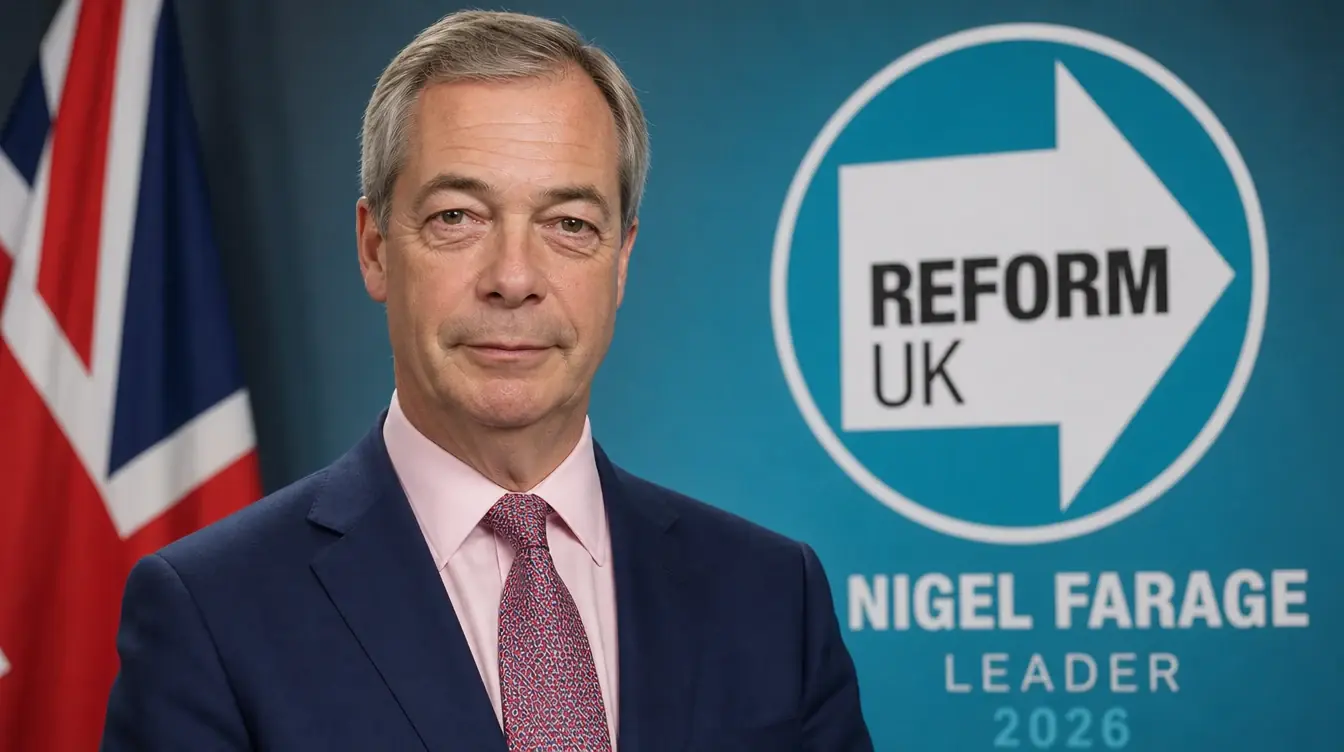
Rory Stewart was on his annual silent retreat the exact week Nigel Farage chose to announce his resignation, which meant Alastair Campbell recorded an emergency Rest Is Politics Question Time from Washington DC alongside journalist Mehdi Hasan instead — a pairing that produced a noticeably sharper, more combative analysis than the show\'s usual register. Both hosts had one eye on a television in the background as Farage delivered his statement live, and the episode that followed is one of the more useful attempts to place the Clacton resignation in a genuinely international context.
Hasan\'s vantage point from Washington, where he has covered the Trump era closely, gives this particular reaction a comparative edge that most UK-based coverage of the story lacked.
“Flooding the Zone”
Hasan\'s opening diagnosis was unambiguous: “This is classic distraction and deflection. Nigel Farage worships at the altar of Donald Trump,” he said, invoking former Trump strategist Steve Bannon\'s famous description of “flooding the zone” with new controversies to bury old ones. His argument was that Farage, watching Trump successfully weather scandal after scandal in the United States by simply generating new headlines faster than old ones could be processed, is now attempting the same technique in a British political culture that has not yet been tested at the same scale.
Has the UK Reached “Trump Fatigue” Levels of Scandal Immunity?
The most substantive exchange concerned whether this strategy actually works in Britain the way it appears to in America. Campbell referenced reporting from a documentary series on who funds Reform UK, in which a journalist who had spent extensive time in Clacton found that local voters were broadly aware of the financial questions around Farage but that this awareness “wasn\'t necessarily shifting them” away from supporting him. Hasan drew the comparison directly to Donald Trump reportedly making $2.2 billion in a single year without any evident dent in his core support, wondering aloud whether shame and accountability still function as meaningful political constraints on either side of the Atlantic, or whether that mechanism has simply broken down for a certain kind of populist politician.
Learn From the Right, Says Hasan
Hasan pushed Campbell on a genuinely uncomfortable point for a former Labour communications chief: that centre-left and centre-left-adjacent leaders, from Starmer to Joe Biden, have “never quite understood who their enemies are” in the way successful populist-right operations do, and that defeating that kind of politics requires borrowing some of its clarity about identifying and confronting an opponent rather than simply hoping fact-based rebuttal is sufficient. Campbell\'s response was more measured but broadly conceded the point, arguing Starmer had walked into an economic and media landscape that was “genuinely much tougher” than his team expected, and that fighting fire with fire, at least rhetorically, may be a genuine requirement for whoever leads Labour next rather than an optional tactic.
Even the Right Is Moving Right of Farage
One of the episode\'s more counterintuitive observations was Hasan\'s point that the political centre of gravity on the British right has moved so far that Farage himself is now facing pressure from further-right challengers like Rupert Low, who Hasan argued has positioned himself as insufficiently right-wing even for some current Reform supporters. It is a reminder that Farage\'s current difficulties are not simply about the finances story in isolation, but about managing a coalition that increasingly includes people who think he has not gone far enough, alongside a broader public that increasingly thinks he has gone too far.
What This Means Going Forward
The genuinely open question this episode raises — whether British voters will eventually punish Farage for the finances story the way Hasan and Campbell both, cautiously, expect, or whether the UK is drifting toward the same scandal-resistant politics they see in Washington — will not be settled by any single by-election result. But the Clacton contest, and the eventual standards commissioner ruling, will provide the first real test of which prediction is closer to correct, at a moment when Reform UK\'s lead in the voting intention tracker remains, so far, remarkably undented by the controversy surrounding its leader.