When Nigel Farage’s Reform UK took 14.3% of the vote at the July 2024 general election, winning five seats, most analysts considered it a strong protest result but a structural ceiling. Twenty-two months later, the party is polling at 28% — outright first in most voting intention trackers, ahead of Conservatives (19%) and Labour (18%). How did it happen?
The GE2024 Baseline and Early Momentum
Reform entered the 2024 campaign polling at around 10–12% in most surveys. Farage’s late decision to stand in Clacton — announced in June 2024 — injected immediate energy. The party finished on 4.1 million votes, the third-highest total of any party by vote share, yet converted that into just five Commons seats due to the first-past-the-post system.
By October 2024, YouGov was recording Reform at 17%, driven primarily by voters who felt neither Labour nor the Conservatives had addressed their concerns on immigration and living costs. The party’s structural base — older, non-graduate, Leave-voting men in the Midlands and North — was growing rather than contracting.
Month-by-Month: The Climb to 28%
The trajectory since the general election breaks into three phases. In the first phase (August–December 2024), Reform averaged 17–19% as Labour’s honeymoon period kept the two main parties ahead. The second phase (January–September 2025) saw Reform consolidate at 20–22% as Labour’s winter fuel cut proved deeply unpopular and Conservative voters continued drifting rightward under Kemi Badenoch’s leadership.
The third and most significant phase began in October 2025. Net migration figures for the year to June 2025 came in at 728,000 — barely changed from the record 906,000 in 2023 — and Reform’s numbers jumped four points in a fortnight. By January 2026 the party was consistently above 24%. May 2026 polls from Techne, Savanta and YouGov all show the party at 27–28%, with Reform outright first in the composite average.
Which Voters Switched — and From Where
Cross-breaks in recent polling reveal the composition of Reform’s expanded coalition. Roughly 35% of current Reform voters backed the Conservatives in 2019, a further 20% voted Labour in 2024, and around 12% did not vote in 2024 at all. The immigration issue is the single strongest predictor of Reform identification: among voters who say immigration is the most important issue facing Britain, Reform leads Labour by over 30 points.
Geographically, the party’s biggest gains have been in the East Midlands, Yorkshire, and the North East — areas that voted heavily Leave in 2016 and feel economically left behind. Polling sub-samples suggest Reform is now competitive or ahead in dozens of seats Labour currently holds with small majorities.
Farage’s Return as a Factor
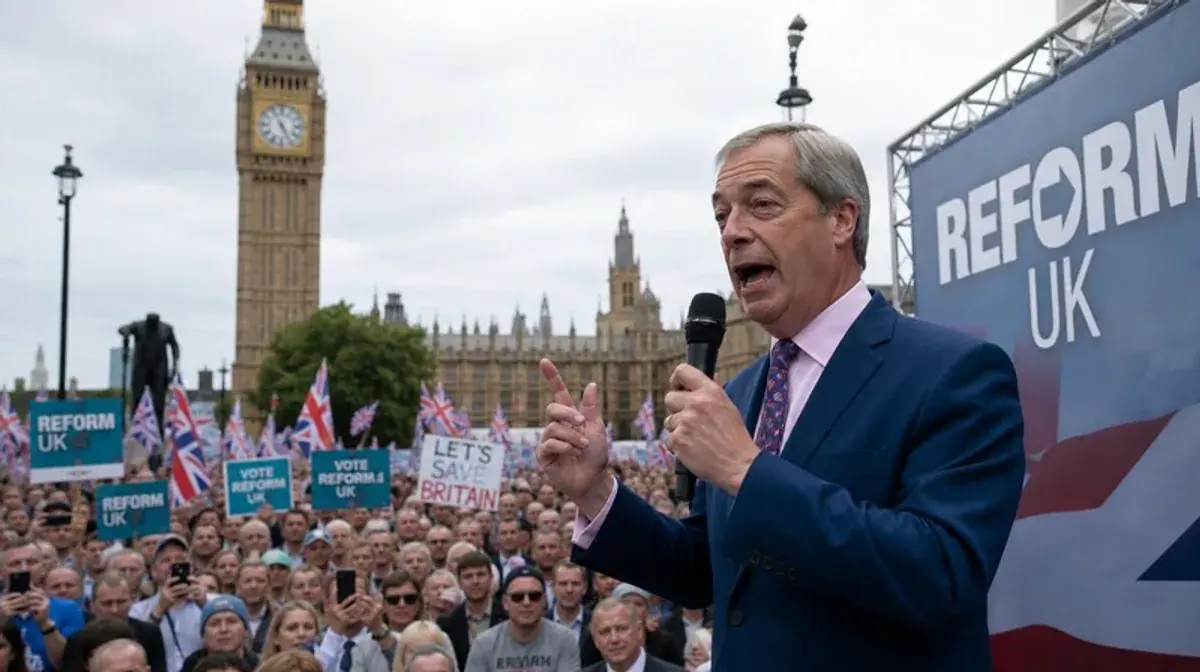
Farage’s formal assumption of the leadership in September 2024 was immediately reflected in polling. His net favourability among Reform voters is +78%; even among the general public his recognisability gives him an asymmetric media advantage no other opposition figure can match. Several focus groups conducted in early 2026 found that many voters who expressed reservations about Reform nonetheless named Farage as the political figure they found most convincing on border control.
The FPTP Ceiling: Why 28% May Not Mean 28% of Seats
The fundamental structural constraint on Reform remains the first-past-the-post electoral system. In 2024, the party won 14.3% of votes for five seats; Labour won 33.7% for 412. MRP seat projections currently circulating suggest that 28% of the national vote could translate to between 70 and 110 seats in a best-case scenario for Reform, compared to Labour’s projected 250–300 on 18%.
The reason: Reform’s vote is geographically dispersed. The party runs well everywhere but dominates nowhere in the way Labour dominates urban cores or the SNP dominates Scottish constituencies. Unless it can pile up votes in specific target seats, high national share will again be punished by the system.
What Happens Next
Three variables will determine whether Reform’s polling lead proves durable. First, whether net migration falls meaningfully before the 2029 election. Second, whether the Conservative Party under Badenoch can reclaim right-of-centre voters or continues to bleed to Reform. Third, whether Reform can build the local infrastructure — councillors, organisers, name recognition in specific seats — to convert share into seats. The May 2026 local elections provided some early evidence: Reform UK made substantial council gains, beginning to look like a governing proposition at the local level. A fourth, more immediate test arrived in July 2026 when Farage’s resignation and Clacton by-election gambit dominated a full week of Westminster coverage without, so far, visibly denting the party’s lead.