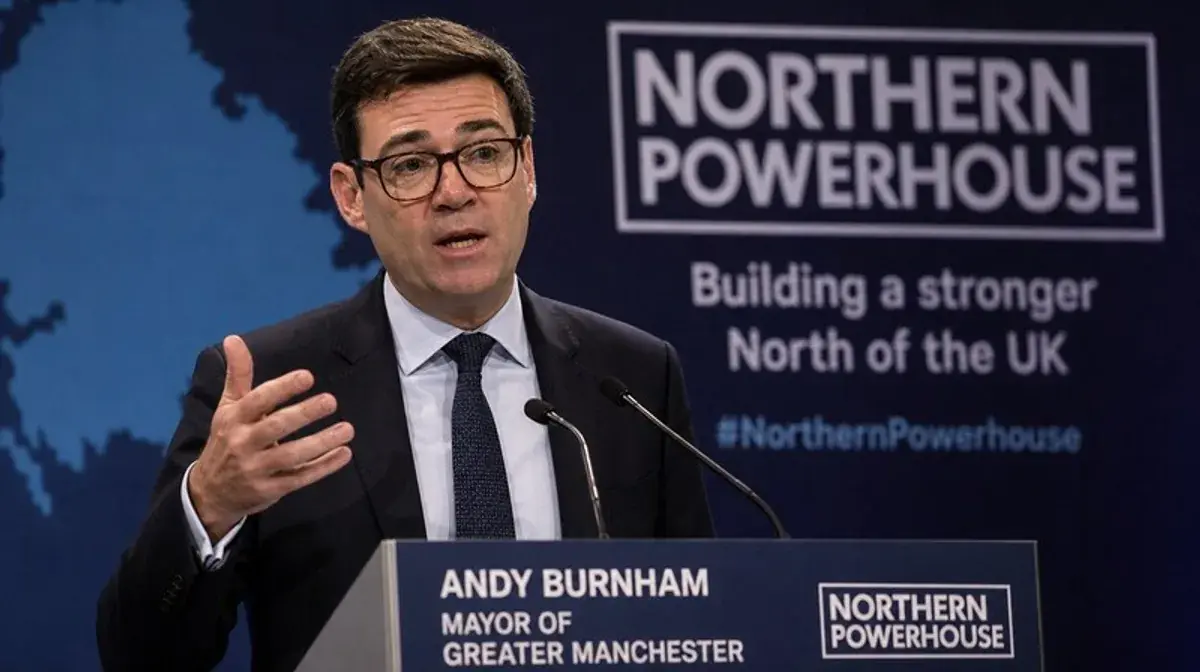
Two weeks after winning the Makerfield by-election on his way to almost certainly becoming Britain’s next prime minister, Andy Burnham sat down with Andrew Marr for his first broadcast interview since the result — and the tone was noticeably different from anything Keir Starmer offered in two years in Downing Street. Where Starmer’s early messaging leaned on caution and warnings that things would get worse before they got better, Burnham opened with a direct appeal to a country he says has simply given up on politics delivering anything at all.
This interview matters well beyond the usual leadership-transition colour piece. Burnham used it to lay out, in more concrete terms than his Manchester speech days earlier, exactly what he intends to do differently — on tax, on Westminster culture, on devolution, and on the £15 billion in additional defence spending he is inheriting with barely any notice. It is essential viewing for understanding what a Burnham premiership might actually look like in practice, not just rhetorically.
“An End to Trickle-Down Economics”
Burnham was explicit that this is “a last chance to change, particularly for the Labour Party” — and, he added, for British politics more broadly. Pressed on what that actually means in policy terms, he did not hedge: “It is an end to trickle-down economics, which did not trickle down very much at all,” he said, pointing to the water industry as his central example, where he argues shareholders have consistently been protected from losses while bills rise and infrastructure investment lags. He was equally blunt about the political direction underneath that language: “What I am putting forward here is a very different approach when it comes to the political direction that is not up for negotiation.”
On tax specifically, Burnham confirmed he intends to stick to Labour’s 2024 manifesto commitments not to raise income tax, national insurance or VAT — but signalled real movement elsewhere. His clearest concrete policy was a proposal to raise business rates on large warehouses and out-of-town developments in order to fund a 20% cut in business rates for pubs, cafes, restaurants and hairdressers, describing this as a deliberate attempt to reward businesses that “bring people together” on the high street over online and logistics-driven retail.
Number 10 North and a Different Westminster Culture
The most eye-catching structural proposal was “Number 10 North” — a plan to base a genuine extension of the Downing Street operation at a proposed government digital campus near Manchester Piccadilly, with Burnham himself pledging to spend meaningful time there rather than treating it as a symbolic outpost. The explicit goal, he said, is to prove that power is “more balanced” across the country rather than concentrated entirely in Whitehall, which he separately described as “the last street of an empire” — centralised in form but, in his view, actually too weak in practice to deliver basic services reliably.
He also promised a change in how the parliamentary whip is used, saying he does not believe it should be deployed “to punish people who have a vote on a matter of conscience” — a pointed, if implicit, criticism of how discipline was handled under Starmer, and a signal that Burnham intends to try to rebuild a sense of common purpose among Labour MPs who, in his words, returned to a Westminster that “does feel a more fragmented place, unhappier in many ways” than the one he left when he became Greater Manchester mayor.
The £15 Billion Question He Didn’t Choose
Marr pressed Burnham hard on the defence investment plan he is inheriting, which requires finding an extra £15 billion in funding — a commitment made before he takes office. Asked whether he saw this as effectively a hand grenade lobbed at him on the way out of Downing Street, Burnham declined the framing, but did not dodge the substance: “I will take my responsibilities fully to fund the defence investment plan,” he said, calling it something “the country has to face up to very seriously” given a changing threat environment. It is likely to be one of the first genuine tests of whether his promised fiscal discipline — he pointed repeatedly to balanced budgets during his time running Greater Manchester and NHS finances earlier in his career — can coexist with both the spending pledges in his own platform and commitments made by his predecessor.
What This Means Going Forward
Burnham is deliberately building an expectation gap with the Starmer years: more devolved power, more inclusive cabinet-building, less top-down message discipline, and a more optimistic public tone. Whether that survives contact with the same institutional weaknesses that McSweeney identified as having sunk Starmer — a slow, centralised state, tight fiscal room, and a hostile media and political environment — is the central question of the next several months. His own polling honeymoon, if he gets one, will likely be short: Reform UK’s lead in the voting intention tracker has held for the better part of two years, and Burnham will need to show concrete delivery quickly if he wants a genuinely different story from the one his predecessor told.