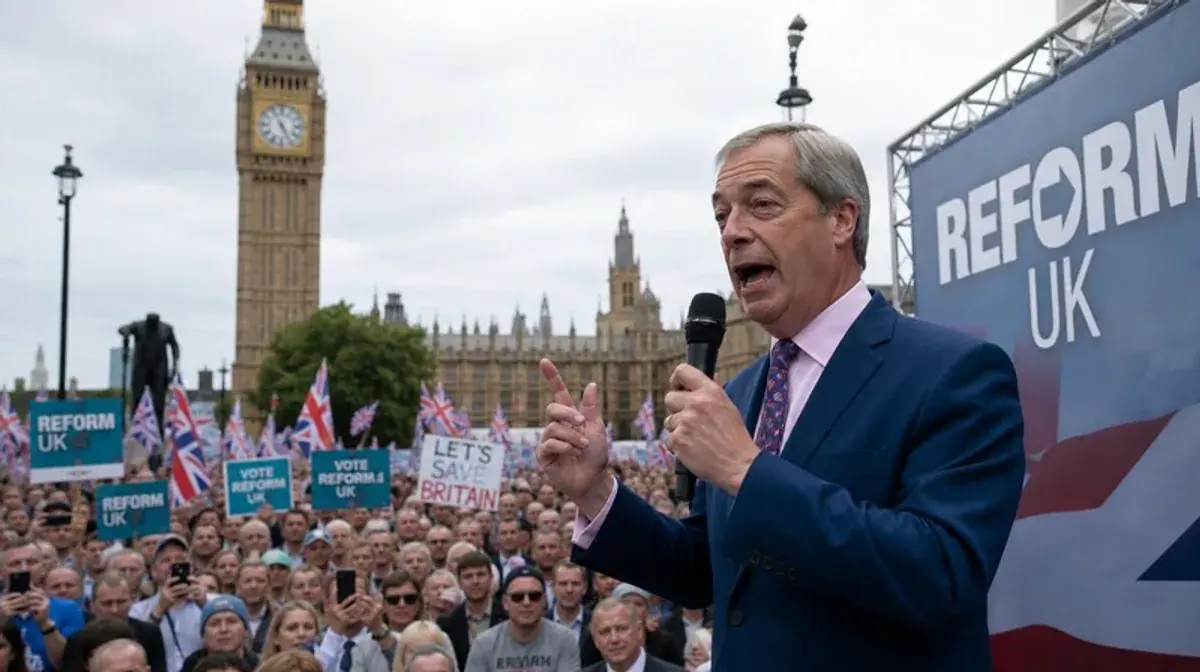
Most coverage of the Nigel Farage finances story has, understandably, focused on the headline numbers: a reported £5 million personal gift, benefits in kind from a convicted fraudster, and a by-election that most of Westminster views as an attempt to change the subject. What tends to get lost is the actual argument underneath — the competing frameworks that Farage’s defenders and critics use to justify wildly different conclusions from the same facts. A BBC Politics panel featuring Reform UK councillor Laila Cunningham, the Green Party’s Hannah Spencer and journalist Fraser Nelson laid that argument out in unusually sharp detail, and it is worth pulling apart in full.
The panel convened in the immediate aftermath of Farage’s decision to resign his Clacton seat and force a by-election, framed by all three parties — and, crucially, by Reform UK’s own representative — as a referendum on whether voters still trust him, even as the underlying standards investigation remains unresolved.
Cunningham’s Defence: “Stand a Candidate or Let the Process Run”
Cunningham’s core argument was procedural rather than substantive: whatever anyone thinks of Farage personally, he has “put his political future in the hands of the electorate,” and if his critics genuinely believe he has done wrong, the correct response is either to field a candidate against him in Clacton or to let the parliamentary standards process reach its own conclusion — not to do both at once by refusing to contest the seat while simultaneously continuing to attack him in public. It is a line designed to put Labour, the Conservatives and the Liberal Democrats on the back foot for their decision not to stand candidates, and on the panel it partly worked: none of the other guests had a clean answer for why non-participation and continued criticism should coexist.
Spencer’s Rebuttal: A Pattern, Not an Error
Hannah Spencer’s response reframed the question entirely. Her argument was that this is not a single disputed gift but a pattern: alongside the £5 million donation from Thailand-based businessman Christopher Harborne, Farage is also reported to have received benefits in kind — security, social media staffing, accommodation — from George Cottrell, a longtime associate who has previously served time for money laundering offences in the United States. None of this, Spencer argued, was disclosed when Farage became an MP in 2024, despite parliamentary rules requiring disclosure of any benefit received in the twelve months beforehand where a reasonable observer might see it as capable of influencing a member’s conduct. “This is not about a mistake anyone can make,” she said. “It’s an enormous sum of money.”
The panel’s most pointed exchange came when Spencer pressed Cunningham directly on whether she was comfortable with a would-be prime minister maintaining a close relationship with a convicted fraudster. Cunningham’s answer — that Cottrell had served his sentence and was “completely reformed” — drew immediate pushback that the same standard of forgiveness was not being extended to Labour donors or figures with comparable controversies, a charge of selective scrutiny that Fraser Nelson, representing a more sceptical press perspective, largely agreed with in principle while still defending the underlying journalism as legitimate public-interest reporting.
The Media Ethics Sub-Argument
A separate, sharper argument broke out over press conduct itself, after Farage accused the Times of endangering his adult daughter by publishing an image of the property she lives in as part of an investigation into his undeclared assets. Nelson defended the underlying investigative work as consistent with a long tradition of British journalism scrutinising the finances of powerful people, while Spencer and Cunningham found unexpected common ground in questioning whether publishing identifying details about a politician’s adult child served any real public interest, regardless of one’s view of Farage himself.
What This Means Going Forward
This panel matters because it is one of the few places where the Farage finances story was actually argued on its merits rather than simply reported as a horse race. The unresolved question — whether voters treat undisclosed gifts and associations with convicted criminals as disqualifying, or simply as noise that does not move their vote — will be tested directly in Clacton in the coming weeks, and its outcome will shape how much political capital Labour, the Conservatives and the Greens are willing to spend attacking Farage on character grounds versus focusing on policy contrasts instead.