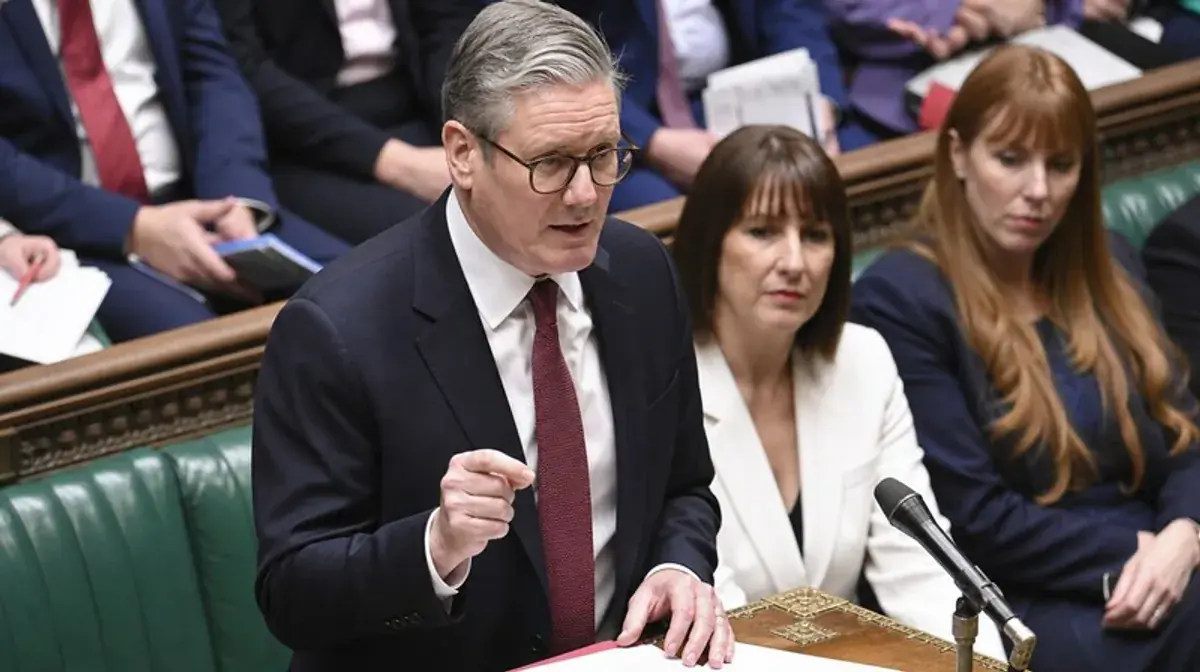
Prime Minister’s Questions is normally the one fixed weekly moment where every party leader is expected to be present. This week’s session was anything but normal. Keir Starmer was in Turkey for a NATO summit, leaving Deputy Prime Minister David Lammy to face the dispatch box. Kemi Badenoch was absent too, with Sir James Cleverly deputising for the Conservatives, and Ed Davey was replaced by his deputy Daisy Cooper for the Liberal Democrats. But the most conspicuous absence of all was Nigel Farage, who chose this exact week to resign his Clacton seat and trigger a by-election — a decision that dominated the session even though the man himself was not there to defend it.
BBC Politics captured the full exchange, and it is a useful snapshot of how Westminster as a whole — not just Labour — is choosing to frame Farage’s move: not as an act of democratic accountability, but as an attempt to get ahead of a parliamentary standards investigation before it can conclude.
The “Clacton Clause” Demand
The sharpest exchange of the session came from the Conservative benches. Sir James Cleverly pressed the government to urge the Speaker to delay accepting Farage’s resignation until the parliamentary standards investigation into his finances is complete, so that “the good people of Clacton have all the facts before they cast their votes.” Failing that, he called for what he termed a “Clacton clause” — a mechanism to ensure the standards investigation continues even after Farage formally ceases to be an MP, rather than lapsing the moment he resigns his seat.
The underlying issue is straightforward, if the politics around it are not: MPs must declare gifts or benefits received in the twelve months before their election unless they are purely personal. Farage is reported to have received a £5 million gift from a Thailand-based donor in spring 2024, several months before he was elected in July 2024, and did not register it. He maintains he has broken no rules and that the gift was personal. The parliamentary commissioner for standards has yet to rule.
Lammy’s Response: “Up to His Neck”
Responding for the government, David Lammy did not mince words, telling the chamber that the Reform UK leader was “trying to distract from the fact that he’s up to his neck” in the ongoing controversy over his donations and benefits. It was a striking moment: a government deputy leader using his one set-piece weekly slot not to defend his own record, but to go on the attack against an MP who was not even present to respond — a reflection of just how thoroughly the Farage story has come to dominate the political news cycle in recent days, eclipsing almost everything else in Westminster, including the government’s own imminent leadership transition.
A Story That Crosses Party Lines
What is notable about this DPMQs exchange is how little disagreement there was between the parties on the substance, even as they disagreed sharply on tone. Labour, the Conservatives and the Liberal Democrats have all, in their own ways, converged on the position that Farage’s by-election is a tactical manoeuvre rather than a genuine act of accountability — and, tellingly, none of the three main opposition parties ultimately chose to field a candidate against him in Clacton, a decision that has itself become almost as contentious as the resignation that triggered it.
What This Means Going Forward
For Reform UK, which has led the last 350 consecutive opinion polls according to the party’s own figures, the risk is less about losing the Clacton seat — Farage remains heavily favoured against Count Binface, currently his only declared opponent — and more about whether the finance story metastasises into a broader question about the character and judgment of a man who could plausibly be prime minister within three years. For the government, the DPMQs session was as much about deflecting attention from its own leadership transition as it was about genuinely holding Farage to account. Both stories will keep running in parallel through the summer, and the outcome of the standards investigation, whenever it lands, will shape how each side’s attacks are remembered.