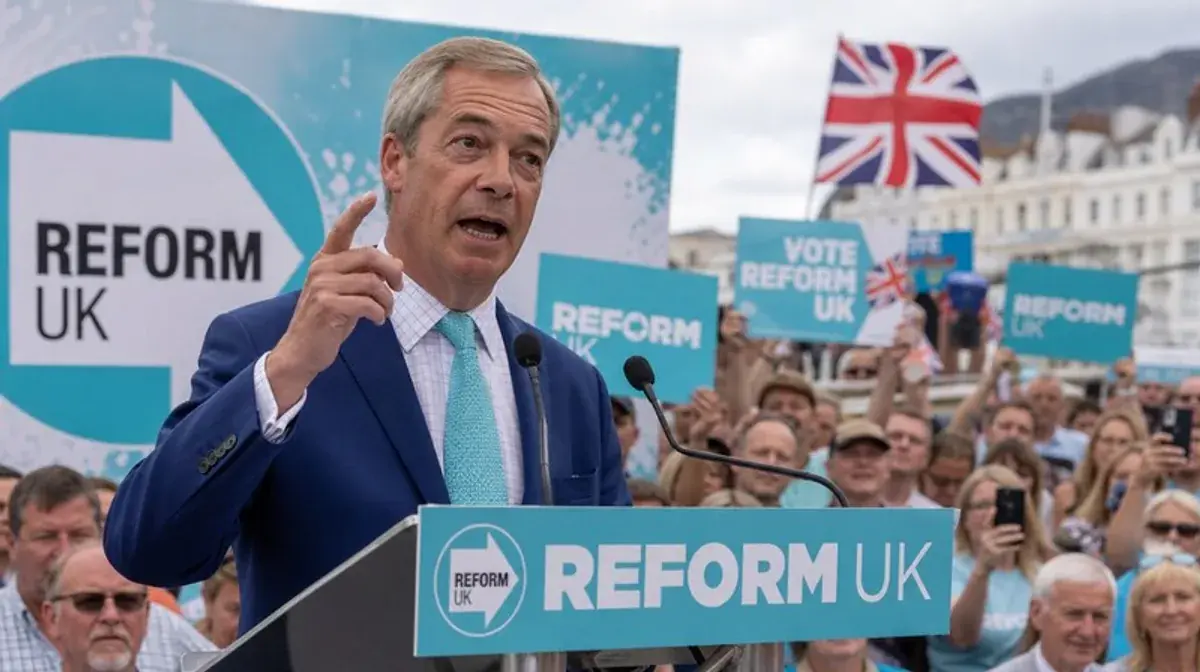
Reform UK has risen from 14.3% at the July 2024 General Election to an average of 27% in the May 2026 polls — a sustained rise of 13 percentage points in under two years. This page tracks every major poll from July 2024 to the present, explains the methodology differences between pollsters, and places Reform UK’s rise in historical context.
Reform UK Polling Month-by-Month: July 2024 to May 2026
| Month | Reform UK | Labour | Conservative | Key Driver |
|---|---|---|---|---|
| Jul 2024 | 14% | 34% | 23% | General Election result. Farage wins Clacton. |
| Aug 2024 | 16% | 32% | 21% | English city riots; immigration back top of agenda |
| Oct 2024 | 18% | 28% | 21% | Labour autumn budget; winter fuel cut sparks fury |
| Dec 2024 | 21% | 25% | 20% | NHS winter crisis; Starmer approval collapses to -29 |
| Jan 2025 | 22% | 23% | 20% | Reform draws level with Labour; first poll lead emerges |
| Mar 2025 | 24% | 21% | 19% | Reform first in most polls; Runcorn by-election win |
| Jun 2025 | 25% | 20% | 18% | Green Party surge attracts Labour voters; Reform consolidates |
| Sep 2025 | 26% | 19% | 18% | Conference season; Farage media dominance continues |
| Jan 2026 | 26% | 18% | 18% | Economy stagnant; Reform steady at top |
| May 2026 | 27% | 17% | 18% | Local elections: Reform wins 12 councils, 1,050+ seats |
Poll-of-polls averages. Data sources: YouGov, Ipsos, Survation, More in Common, Opinium, Techne, Find Out Now. See full May 2026 pollster breakdown.
The Five Phases of Reform UK’s Rise
Phase 1: General Election (Jul 2024) — 14%
Reform UK’s 14.3% at the July 2024 General Election was already a record for the party in any of its incarnations. Five seats, including Nigel Farage’s personal victory in Clacton, gave the party a parliamentary presence for the first time. But 14% massively understated the depth of the party’s underlying support due to tactical voting and FPTP dynamics: the party received approximately 4.1 million votes.
Phase 2: Labour Honeymoon Collapse (Aug–Oct 2024) — 16–18%
Within weeks of the election, Labour’s honeymoon period ended abruptly. English city riots in August 2024, centred on anti-immigration sentiment, put immigration and national identity back at the top of the political agenda — exactly Reform UK’s territory. The autumn budget, with its winter fuel payment cut, created a significant backlash among older voters who skew Reform-friendly. By October, Reform was at 18%.
Phase 3: Drawn Level (Nov 2024–Feb 2025) — 19–22%
The winter of 2024–25 saw Reform UK draw level with Labour in the polls. Keir Starmer’s net approval fell to -31% by January 2025. A series of by-elections showed Reform UK performing strongly in its target geography. In January 2025, the first polls placing Reform in first position above Labour appeared — a historic shift that had been unthinkable just six months earlier.
Phase 4: Sustained Lead Established (Mar 2025–Jan 2026) — 23–26%
The Runcorn Halton by-election in March 2025, which Reform won with a significant swing from Labour, demonstrated that the party’s polling support could translate into actual votes in direct contests. Through the rest of 2025, Reform consolidated its lead and reached 26% by September. There was no single event that drove the party above 23%; instead it was the accumulated weight of Labour’s underperformance on every key issue.
Phase 5: Local Election Validation (May 2026) — 27%
The May 2026 local elections were the first major test of whether Reform UK’s polling support translated into real votes at scale. The results confirmed it: Reform won 28% of the national equivalent vote share, took control of 12 councils, and won over 1,000 seats. Post-election polling showed a modest bump to 27–28% in the poll-of-polls, with some individual pollsters showing 29–30%.
Where Is Reform UK Polling Most Strongly?
Reform UK’s support is geographically concentrated. Regional polling shows the party performing significantly above its national average in:
- East of England — 34%+ in some county-level polls
- East Midlands — 30%+ in post-industrial towns like Doncaster, Mansfield, Chesterfield
- Yorkshire and the Humber — 28–32% depending on pollster and area
- North East England — 28–30%, particularly in coastal and post-mining communities
- South East coastal — 28–32% in Kent, Essex, and East Sussex
Reform polls weakest in London (approximately 12–15%), Scotland (where SNP dominates), and major university cities. This geography is important for understanding how the party’s 27% national support might translate into seats under FPTP: concentrated regional support in the right constituencies could yield significantly more seats than a more evenly distributed 27%.
Frequently Asked Questions
What is Reform UK polling at in May 2026?
Reform UK is polling at 25–30% in May 2026, with a poll-of-polls average of 27%. All pollsters place Reform UK first — the only variation is the precise figure. YouGov tends to show 25–28%, while Techne and More in Common show 29–30%.
Has Reform UK ever polled this high before?
No. 27% is far beyond anything Reform UK or its predecessors (UKIP, Brexit Party) ever achieved in sustained national polling. UKIP peaked at approximately 18–19% in 2014–15 before collapsing. Reform UK’s current position is genuinely unprecedented for a party outside the two traditional governing parties.
Could Reform UK’s polling fall before 2029?
Yes. Historical precedent shows that insurgent polling surges often partial deflate before a general election as voters consider electability and tactical voting. However, Reform has now won real local elections, built a council presence, and Farage remains in Parliament. The structural conditions sustaining their support — Labour’s weakness, Conservative decline, immigration as a dominant issue — are unlikely to reverse quickly. Most MRP models treat 20–25% as a realistic floor for Reform at a 2029 election. See MRP projections → • Marginal seats → • 2029 General Election forecast.