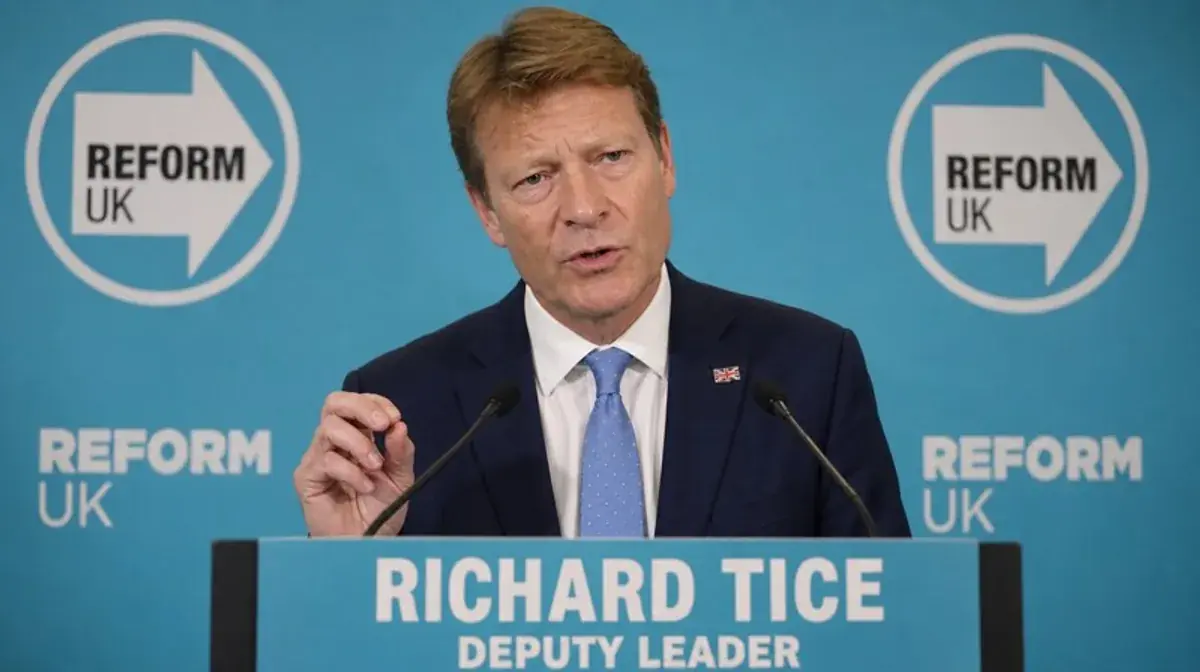
A day after the Clacton by-election was called, GB News revisited the story with a studio conversation between Reform UK deputy leader Richard Tice and the channel\'s political editor Christopher Hope that ran longer, and covered more genuinely disputed ground, than the initial breaking coverage. It is worth watching in full precisely because Hope, operating within a channel closely tied to Nigel Farage commercially, still pushed harder on specific factual questions than most of Reform\'s critics elsewhere managed in the same week.
The exchange ranges from parliamentary procedure through to a direct, unresolved challenge over voluntary financial disclosure — and ends with Tice making a claim about Andy Burnham\'s democratic legitimacy that is worth examining on its own terms.
The Procedural Wrinkle Nobody Else Was Discussing
Hope raised a technical but potentially significant point: MPs cannot simply resign under UK parliamentary procedure. They must instead be appointed to a nominal paid crown office — a step that requires sign-off from the government. That creates a real, if unlikely, scenario in which ministers could choose to delay processing Farage\'s resignation specifically until after the parliamentary standards investigation concludes, timing his eventual by-election to coincide with maximum reputational damage rather than the moment of Farage\'s own choosing. Tice dismissed this as implausible, but did not dispute that the mechanism exists or that the government holds the relevant discretion.
“Publish It Now and It All Goes Away”
The most substantive exchange came when Hope challenged Tice directly: if Farage has genuinely disclosed everything the rules require, why not simply publish every payment of any size received in the twelve months before the July 2024 election, removing all ambiguity at a stroke? “Come clean,” Hope said. “Publish every single payment... publish it now and it all goes away.” Tice\'s response fell back on the legal technicality — that the £5 million gift did not need to be published under the rules as they stood — rather than explaining why voluntary transparency, at essentially no cost if the party\'s account is accurate, remains off the table. It is the same gap GB News\' own earlier breaking coverage had already surfaced, and Reform has still not closed it.
The Cost Argument, Cutting Both Ways
Tice raised the roughly £230,000 cost of running a by-election, noting Farage has personally offered to cover it — only for the Electoral Commission to reportedly rule that MPs cannot simply pay for their own by-elections. Hope turned the same cost argument back on Reform, pointing out that the earlier Makerfield by-election, engineered specifically to install Andy Burnham as an MP ahead of his leadership bid, carried an identical price tag, meaning the two forced contests together could cost taxpayers close to half a million pounds in a matter of weeks — a point Tice did not meaningfully rebut beyond repeating that Makerfield was a “staged” contest, which Hope had already challenged as inaccurate in the earlier segment.
A Direct Challenge to Burnham\'s Legitimacy
Tice closed with a broader argument that will likely recur throughout the summer: that Andy Burnham, on the verge of becoming prime minister without a general election, has “no democratic legitimacy whatsoever,” and pointed to the fact that Burnham has barely been tested publicly on defence or foreign policy despite his imminent elevation. It is a genuinely fair process critique — leadership transitions between elections are a recurring feature of the UK system, and Reform is not wrong that Burnham has faced comparatively little sustained scrutiny relative to the volume currently directed at Farage.
What This Means Going Forward
The disclosure gap Hope identified — the difference between complying with minimum legal requirements and offering full voluntary transparency — is likely to remain the single most durable line of attack against Farage precisely because it does not depend on the outcome of any investigation. As long as Reform continues to rely on the narrower legal defence rather than closing that gap directly, critics across the political spectrum, including some within sympathetic outlets, will keep returning to it.