Explainer
How the UK Government Works: Parliament, PM & Cabinet
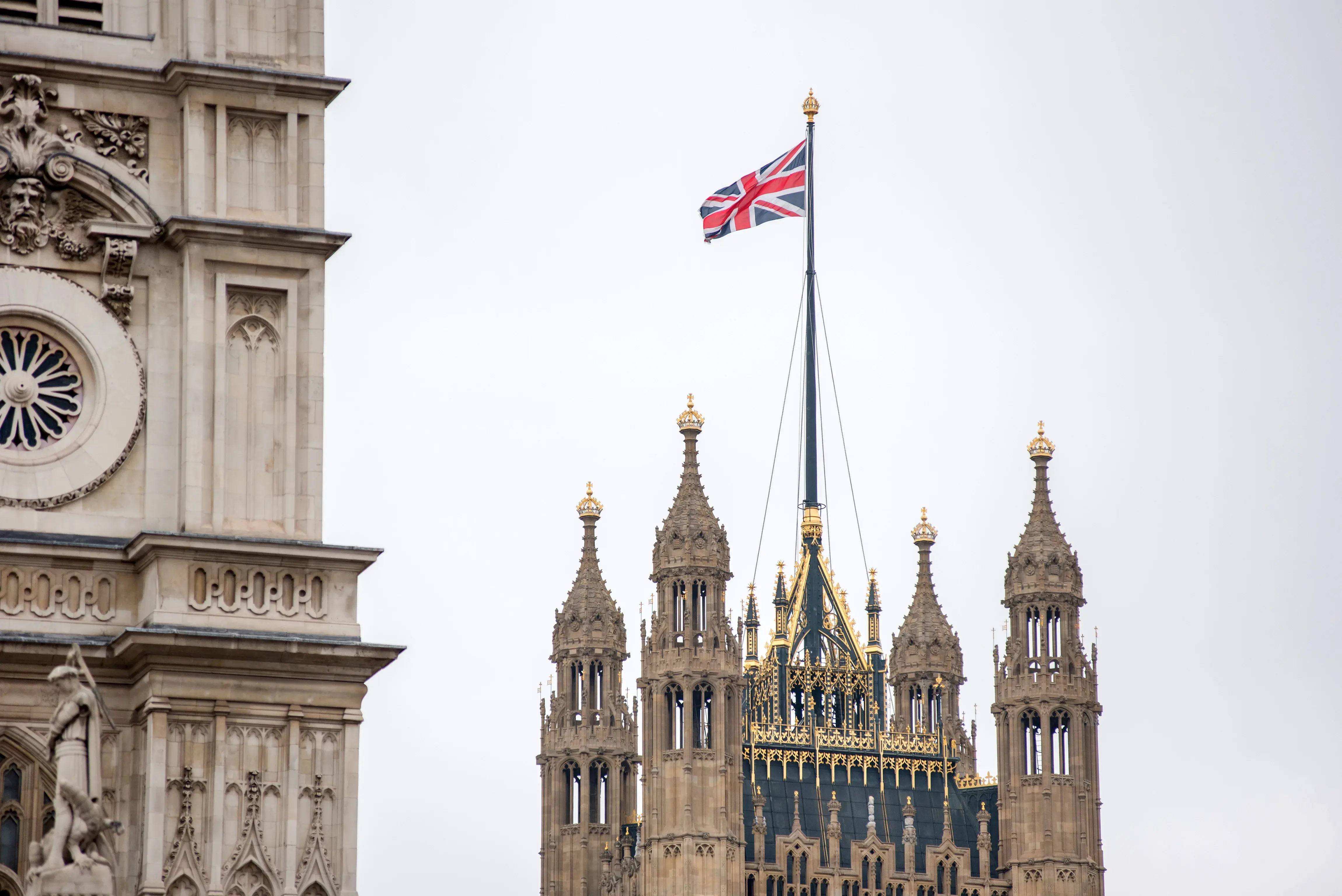
The United Kingdom operates as a constitutional monarchy and parliamentary democracy. Power is distributed across Parliament, the Prime Minister, and the Cabinet — with opinion polls influencing every decision about when and how that power is exercised.
Structure of UK Government: The Key Elements
The structure of the UK government comprises three branches of national government — the Executive, the Legislature, and the Judiciary — plus a layered territorial hierarchy that distributes power between Westminster and devolved administrations. Understanding these structures is essential context for interpreting British political polling data.
| Branch / Layer | Who | Function |
|---|---|---|
| Executive | Prime Minister + Cabinet | Sets and implements government policy; manages departments; advises the King |
| Legislature | House of Commons + House of Lords | Debates, amends and passes laws; scrutinises the executive; controls public spending |
| Judiciary | Supreme Court + courts system | Interprets law; reviews the legality of government decisions; independent of executive and legislature |
| Devolved Governments | Scottish Parliament, Senedd, NI Assembly | Govern devolved areas (health, education, housing) in Scotland, Wales, and Northern Ireland |
| Head of State | HM The King | Constitutional role: grants Royal Assent, opens Parliament, appoints PM; acts on ministerial advice |
Hierarchy of UK Government: Who Has Power?
The hierarchy of the UK government places constitutional authority at the apex — formally the Crown-in-Parliament — but practical executive power in the hands of the Prime Minister and Cabinet. Below the national government, power flows through a four-tier territorial structure. In practice, the Prime Minister who commands a working Commons majority is the most powerful actor in the UK government hierarchy at any given moment.
- The Crown-in-Parliament — Formally the highest constitutional authority. In practice: Westminster legislation, Royal Assent, parliamentary supremacy
- The Prime Minister — Head of government; controls Cabinet, legislative agenda, election timing; commands 10 Downing Street and the civil service
- Cabinet — Collective decision-making body of senior ministers; bound by collective responsibility; typically 20-22 members
- Government departments — Treasury, Home Office, FCDO, DHSC, MHCLG etc.; each led by a Secretary of State
- Devolved administrations — Scottish Government, Welsh Government, NI Executive; autonomous within their devolved competences
- English regional and mayoral bodies — Metro Mayors (London, Manchester, Birmingham etc.) and Combined Authorities
- Local government — District, borough and county councils; planning, social care, waste, local roads
The hierarchy matters for polling because decisions at different levels of the government structure affect different voters. Local council decisions affect 100% of residents. Devolved decisions affect Scotland (5.5m), Wales (3.2m), Northern Ireland (1.9m). Westminster decisions affect the whole UK (67m). This is why national polls and devolved/regional polls sometimes tell very different stories.
Levels of UK Government
The UK does not have a single layer of government. Power is distributed across four distinct levels, each with different responsibilities and democratic accountability:
| Level | Body | Area Covered | Key Responsibilities |
|---|---|---|---|
| 1. UK Government | Parliament + Cabinet (Westminster) | Whole of UK | Defence, foreign policy, macroeconomics, immigration, social security, UK-wide legislation |
| 2. Devolved Governments | Scottish Parliament, Senedd (Wales), NI Assembly | Scotland, Wales, Northern Ireland | Health, education, housing, policing (Scotland/NI), environment — varies by nation |
| 3. Regional / Mayoral | Combined Authorities & Metro Mayors (England) | City regions (London, Manchester, Birmingham etc.) | Transport, economic development, housing strategy, police & crime (London, Greater Manchester) |
| 4. Local Government | District, Borough & County Councils | Local areas | Planning, social care, waste, parks, libraries, licensing, local roads |
England is the most complex case: it has no single devolved parliament and relies on Westminster for most legislation, but has extensive mayoral and combined authority arrangements in major cities. The 2026 local elections, in which Reform UK won 677 council seats, illustrate how the local level is now fully integrated into national political calculations.
The structure of Parliament
Parliament sits at the heart of the UK constitution. It has three components:
- House of Commons: 650 elected MPs, the primary legislative chamber with democratic legitimacy
- House of Lords: Approximately 800 life peers, bishops, and hereditary peers; revises legislation but cannot ultimately block the Commons
- The Crown: The monarch formally opens Parliament and grants Royal Assent to bills, though these are constitutional formalities
The Commons is elected via First Past the Post across 650 constituencies. The party or coalition commanding a majority of MPs forms the government.
The Prime Minister
The Prime Minister is the head of government, not to be confused with the Head of State (the monarch). The PM holds office by virtue of commanding the confidence of the House of Commons — in practice, leading the largest party or a coalition with majority support.
Key PM powers include:
- Appointing and dismissing Cabinet ministers
- Setting the government’s legislative agenda
- Advising the King on the dissolution of Parliament and calling elections
- Representing the UK in international negotiations and at summits
- Chairing Cabinet and determining collective government policy
The PM’s authority rests on parliamentary arithmetic. A PM with a majority of 100+ has enormous power. A PM governing with a majority of five or ten is perpetually vulnerable to rebellion.
Cabinet and collective responsibility
The Cabinet consists of senior ministers who head government departments: the Chancellor of the Exchequer, the Home Secretary, Foreign Secretary, and around 20 others. Cabinet decisions are bound by collective responsibility — once a decision is taken, all ministers must publicly support it or resign.
This convention is occasionally suspended. The 2016 EU referendum allowed ministers to campaign on either side. But in normal times, it enforces discipline and presents a united front to Parliament and the public.
Below Cabinet rank, there are Ministers of State and Parliamentary Under-Secretaries who assist departmental heads. In total, over 100 MPs hold government positions — these are known as the payroll vote and are expected to vote with the government on every division.
How a bill becomes law
Legislation in the UK follows a structured parliamentary process:
- First Reading: Formal introduction of the bill; no debate
- Second Reading: Debate on the general principles; first meaningful vote
- Committee Stage: Line-by-line scrutiny; amendments proposed and voted on
- Report Stage: Further amendments considered by the full chamber
- Third Reading: Final debate and vote on the amended bill
- Lords stages: The bill repeats this process in the House of Lords
- Ping-pong: If the Lords amend a bill, it returns to the Commons; this continues until both chambers agree
- Royal Assent: Formal approval by the monarch; the bill becomes an Act of Parliament
The Lords can delay but not permanently block most legislation. Under the Parliament Acts of 1911 and 1949, the Commons can pass a bill without Lords consent if it passes in two successive parliamentary sessions.
Dissolution and calling elections
The Fixed-term Parliaments Act 2011 was repealed by the Dissolution and Calling of Parliament Act 2022, restoring prerogative power to the Prime Minister. The PM now advises the King to dissolve Parliament, triggering a general election within 25 working days.
The maximum parliamentary term is five years from the date of the first sitting after the previous election. In practice, Prime Ministers choose election timing strategically — calling elections when polling looks favourable and delaying when it does not.
This is why poll leads matter so directly to governing calculations. Rishi Sunak delayed calling the 2024 election until July, hoping the polls would narrow. They did not. Keir Starmer must call a general election by January 2030 at the latest; current projections based on polling suggest he will aim for 2028 or 2029.
The role of the opposition
The Leader of the Opposition heads His Majesty’s Official Opposition and forms a Shadow Cabinet that mirrors government departments. The opposition’s role is to scrutinise, challenge, and present a credible alternative government.
Opposition days allow non-government motions to be debated. Prime Minister’s Questions (PMQs) every Wednesday is the most visible confrontation between government and opposition, widely covered by media and closely watched by pollsters assessing which leader is “winning the news cycle.”
Why polls matter for governance
Opinion polls are not just predictors of elections — they actively shape government behaviour:
- Election timing: A PM studies poll leads before advising dissolution. Trailing in polls delays elections
- Policy priorities: High public concern about an issue forces it onto the legislative agenda
- Leadership challenges: Poor polls within a governing party trigger internal pressure for a leadership change
- Budget decisions: Chancellors time popular measures to coincide with election approaches
- International signalling: A PM polling badly at home has reduced authority in international negotiations
Understanding how the government works is essential context for interpreting polling data. A 10-point poll lead means something very different for a government with a 150-seat majority than for one propped up by a confidence-and-supply arrangement. See our guide to hung parliaments for more.
Key constitutional conventions
Much of the UK constitution is unwritten and operates through convention rather than statute:
- Confidence: The government must maintain the confidence of the Commons; a lost confidence vote triggers a resignation or election
- Ministerial responsibility: Ministers are accountable to Parliament for their departments and are expected to resign if they seriously mislead Parliament
- The Salisbury Convention: The Lords do not block manifesto commitments passed by an elected government with a majority
- The Sewel Convention: Westminster does not normally legislate on devolved matters without the consent of devolved legislatures
Frequently Asked Questions
What is the role of Parliament in the UK?
Parliament is the supreme legislative authority. It consists of the House of Commons (650 elected MPs), the House of Lords, and the Crown. Parliament passes laws, scrutinises government, and controls public finances.
Who is the Prime Minister and what do they do?
The Prime Minister is the head of government, holding office by commanding a majority in the Commons. They chair Cabinet, set policy, control the legislative agenda, and advise the King on elections.
How does a bill become law in the UK?
A bill passes through First, Second, and Third Readings in both Commons and Lords, then receives Royal Assent. The Commons can override Lords rejections under the Parliament Acts.
When must a UK general election be called?
The PM can advise the King to dissolve Parliament at any time; an election must follow within 25 working days. The maximum parliamentary term is five years.
Why do opinion polls matter for governance?
Polls shape election timing, policy priorities, leadership challenges, and budget decisions. A PM trailing in polls delays elections; a strong poll lead may prompt an early election call to secure a fresh mandate.
How does Parliament hold the government to account?
Through Prime Minister’s Questions (PMQs) every Wednesday, departmental questions, select committees (cross-party groups of MPs that can compel ministers and officials to appear and publish critical reports), Opposition Days, written questions, and — ultimately — confidence votes that can bring down a government. The Public Accounts Committee is among the most powerful, scrutinising government spending efficiency across all departments.