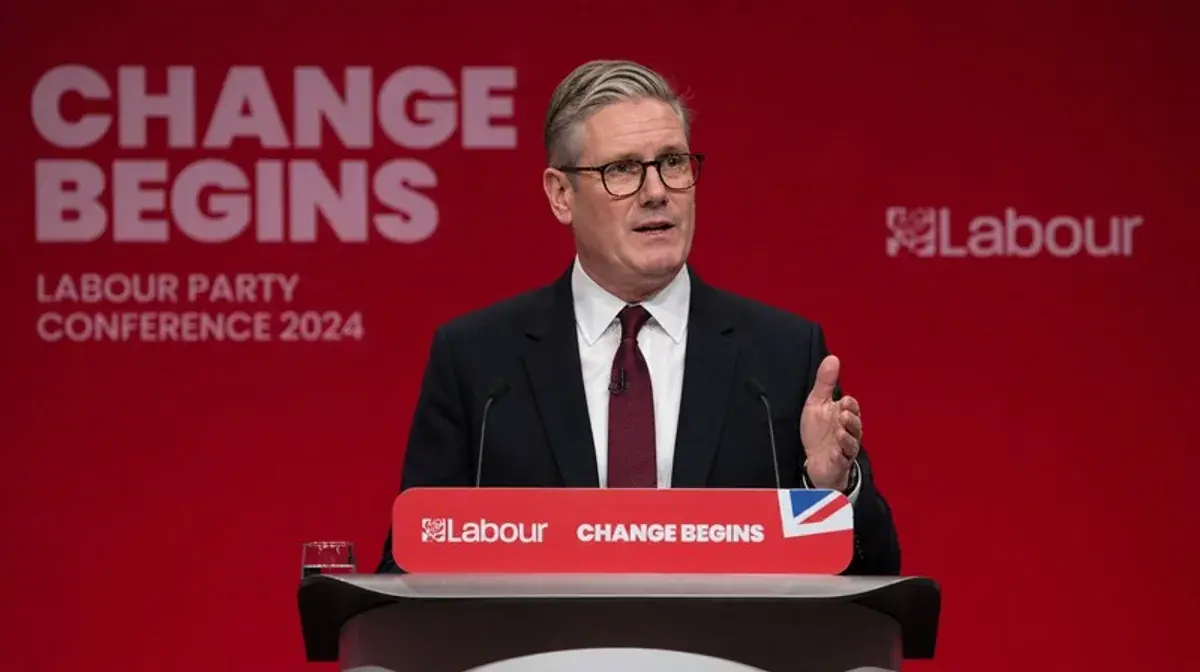
There is a certain symmetry in Keir Starmer\'s final major overseas appearance as prime minister taking place at a NATO summit — he began his premiership on the international stage at a NATO summit in Washington two years earlier, and now closes it at one in Turkey. Sky News caught him for what amounted to an exit interview conducted between the formal sessions, and Starmer used it both to defend his domestic record and to deliver one of his most direct on-camera attacks yet on Nigel Farage, whose Clacton by-election announcement had broken just as the prime minister\'s delegation arrived in Ankara.
The interview covers a remarkable amount of ground for a few minutes on a rope line: Donald Trump\'s public criticism of Starmer over defence spending and the Chagos Islands, the collapsing Iran ceasefire, and a direct question about whether Starmer regrets not giving his own MPs more room before the pressure to resign became overwhelming.
“Run Himself Into a Cul-de-Sac”
Asked directly about the Clacton resignation, Starmer did not hesitate: “I think Nigel Farage has been utterly exposed in this complete stunt that he was trying to set up. He\'s run himself into a cul-de-sac.” His explanation was consistent with the line taken by Deputy PM David Lammy at DPMQs the same week — that Farage is “up to his neck” in unresolved questions about his finances and “doesn\'t want to answer questions” from the media, from parliament, or from journalists directly. It is notable that Starmer chose to use one of his final major broadcast moments as prime minister attacking a political opponent rather than focusing exclusively on his own legacy — a sign of just how much oxygen the Farage story is consuming even at the very top of British politics.
Trump, Rutte and the Defence Spending Row
On the substance of the NATO summit itself, Starmer was pressed on Donald Trump\'s public claim that the UK would not have committed an extra £15 billion in defence spending without pressure from Washington, and on NATO Secretary General Mark Rutte\'s comment suggesting Trump deserved credit for that increase. Starmer\'s response leaned on the topline numbers: defence spending has risen twice during his two years in office, reaching a planned £300 billion over four years — “the biggest sustained increase for half a century.” He was careful to frame the summit itself as a success on its own terms, emphasising unity among NATO members over disagreements about credit-taking.
Asked whether Trump had been different toward him in private compared to his public criticism, Starmer insisted the two men have “always got on as two individuals,” describing the transatlantic relationship as a working partnership he was “glad” to have maintained — a diplomatic answer that avoided directly engaging with the substance of Trump\'s criticism.
A Careful, Managed Exit
Asked whether this bittersweet final summit felt like a fitting bookend, Starmer rejected the framing outright, choosing instead to list a self-assessed scorecard: a stabilised economy, NHS waiting lists falling at their fastest rate in 17 years, reduced child poverty, and an “materially better” international reputation than when he took office. On the question of whether his own parliamentary party had rushed his departure, he was equally controlled, describing the process as one where Labour MPs had “answered” the question of who should lead the party into the next election, and that he accepted that verdict “in good grace.”
What This Means Going Forward
This interview functions as Starmer\'s own closing argument on his premiership, delivered before the history books — and before Morgan McSweeney\'s more self-critical account — get to shape the narrative first. The gap between Starmer\'s own list of achievements and the brutal collapse in his personal approval rating and Labour\'s voting intention numbers over the same period is the central puzzle of his time in office: genuine policy delivery on several measurable fronts, combined with a political and communications failure severe enough to end his premiership after less than two years. As Labour transitions to Andy Burnham, that gap between record and perception is exactly what the incoming leadership will be trying to close.