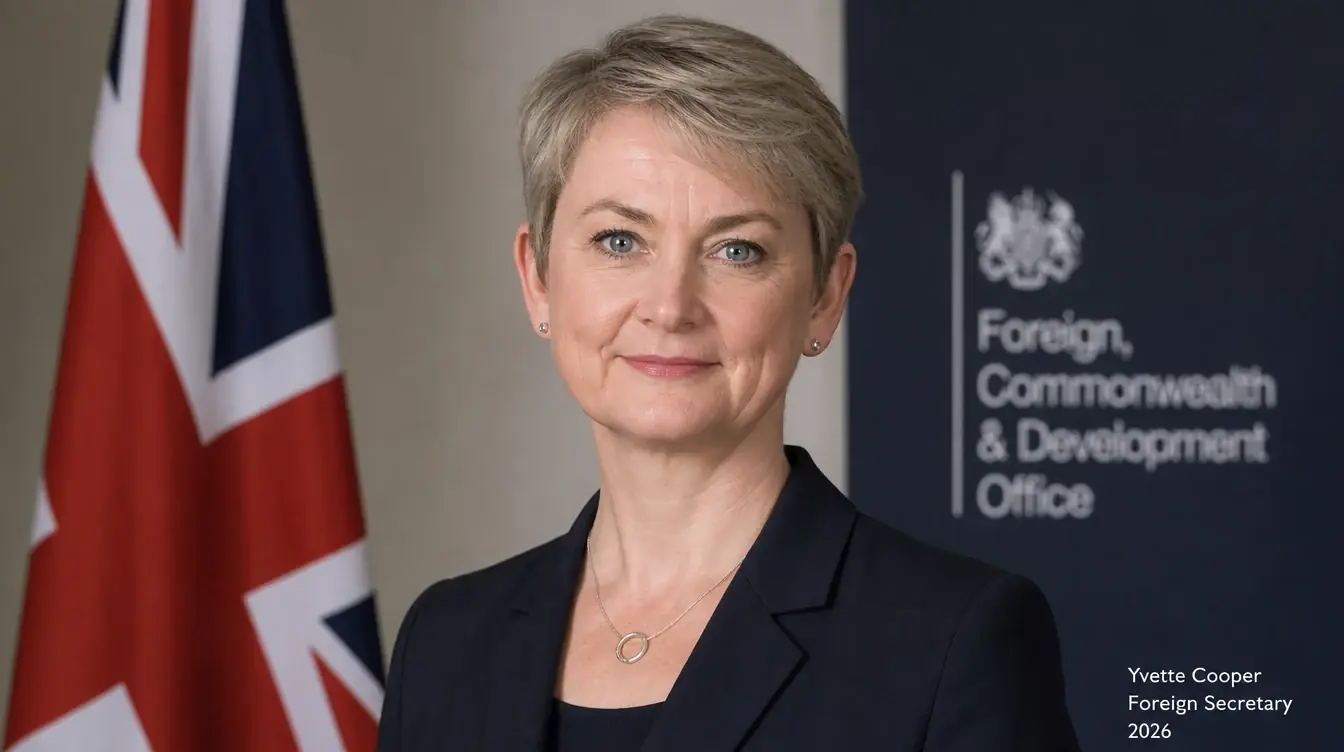
Yvette Cooper moved from Home Secretary to Foreign Secretary in a Cabinet reshuffle in early 2026, a transition that improved her personal polling position almost immediately. As Home Secretary, immigration statistics were an albatross around her departmental brief; as Foreign Secretary, she operates in a policy space that generates less intense voter anger. Her net approval of approximately −8% makes her one of the better-rated senior Cabinet figures in a government that is struggling across most metrics. But foreign policy polling reveals deeper tensions about Britain’s role in the world that will shape her political environment for years to come.
Cooper’s Approval as Foreign Secretary: The Numbers
Yvette Cooper’s −8% net approval as Foreign Secretary reflects a polling environment in which foreign policy generates less immediate voter emotion than the NHS, cost of living, or immigration. Among voters who have a view of her performance in the Foreign Secretary role, 31% approve and 39% disapprove, with 30% saying they do not know enough to judge. The high “don’t know” figure is typical for Foreign Secretaries: the role has lower day-to-day domestic salience than the Home Office, Treasury, or Health Department.
The improvement from her Home Secretary period, where approval was running at approximately −19% on the back of immigration statistics, is politically meaningful. It suggests that Cooper’s personal political reputation is not permanently damaged by the immigration polling that accumulated during her Home Office tenure. The role of Foreign Secretary allows her to be the public face of British engagement with Ukraine, the EU reset, and the diplomatic management of the Trump administration — all of which generate more sympathetic media coverage than monthly net migration figures.
Within the Labour Cabinet, Cooper’s −8% places her second only to Ed Miliband (−5%) among senior figures. By contrast, Keir Starmer is at −44%, Rachel Reeves at −22%, and Angela Rayner at −25%. The Labour two-year verdict sets out the full ministerial approval picture in detail.
The UK-EU Reset: Popular in Principle, Constrained in Practice
Labour entered government committed to a “reset” in UK-EU relations that would improve trade and cooperation without reversing Brexit in any politically toxic way. Two years in, the polling picture on the EU relationship is characterised by a gap between broad support for the principle and voter sensitivity to specific mechanisms. YouGov polling from February 2026 found that 54% of voters support improving UK-EU relations, a figure that includes a majority (52%) of voters who supported the Conservatives in 2019 but have not switched to Reform.
However, support drops sharply when specific mechanisms are mentioned. Only 38% support any form of freedom of movement, even a limited or sector-specific version. Only 44% support closer regulatory alignment with EU standards, though this rises to 58% when framed as “reducing trade barriers” rather than “harmonising with EU rules.” The single market is the most politically charged specific question: 44% oppose rejoining, 36% support it, and 20% are unsure. The framing matters enormously, which creates both an opportunity and a risk for Cooper’s diplomatic positioning.
Among Reform UK voters, EU-related polling is uniformly negative: 81% oppose any closer relationship with the EU, 73% oppose the reset as currently framed, and 88% oppose freedom of movement in any form. This creates an electoral dynamic in which the government’s EU diplomacy is applauded by the 36% of voters who are broadly pro-European but potentially used as a mobilisation issue by Reform against the government in areas with high Reform support. Cooper’s challenge is to advance the reset substantively enough to deliver economic benefits while not generating the kind of “betraying Brexit” headlines that Reform can use as recruiting material.
Ukraine: Support for Aid Holds but War Fatigue Is Real
UK public support for Ukraine has been among the most resilient attitudes in British polling since the Russian invasion in February 2022. The peak approval for military aid in early 2022 was 74% — an unusually high figure in a policy area that typically generates more ambivalence. By early 2026, that figure has fallen to 61%, still a clear majority but reflecting a real trend of gradual disengagement.
The decline in support for military aid is driven by two distinct voter groups with different motivations. The first is genuine war fatigue: voters who supported Ukraine strongly in 2022 but who, after four years of conflict with no clear resolution, are becoming uncertain about whether continued investment of British money and weapons is the right approach. This group tends to be older, Conservative-leaning, and motivated more by fiscal concern than by any sympathy for Russia. The second group consists of younger, left-leaning voters who have become more critical of Western foreign policy generally and who do not clearly distinguish between Ukraine aid and what they see as broader Western military adventurism.
Support for a negotiated settlement has grown from 28% to 44% over the same period, though crucially the detail matters: when asked whether they would accept a settlement that required Ukraine to cede territory, only 22% say yes; 61% say they would support a settlement only if Ukraine’s sovereignty and territorial integrity were respected. The nuance is that war fatigue is real but it is not pro-Russian; it is more accurately described as “resolution fatigue” — a desire for the conflict to end on terms that do not reward Russia rather than a view that Britain should disengage.
Cooper’s management of this polling environment has been broadly well-received. Her visits to Kyiv, her role in coordinating European support packages, and her communication of the UK’s Ukraine commitment have not generated the negative headlines that would be expected if public patience were running out. The 61% who still support military aid remain a stable political base for the current policy, and the government’s approach of combining continued support with an openness to diplomatic engagement has polled at 52% positive reception in YouGov testing.
NATO Spending and Defence: Growing Public Support Amid Geopolitical Anxiety
The geopolitical context of 2025 and 2026 has driven a measurable increase in public support for defence spending that cuts across normal political alignments. Polling from March 2026 shows 62% of UK voters support meeting or exceeding the NATO 2% GDP spending target, up from 51% in early 2024 before the Trump administration began questioning the reliability of US security guarantees to European allies. Among Conservative voters the figure is 78%; among Labour voters 54%; and even among Lib Dem voters, traditionally the most sceptical of defence spending increases, it reaches 48%.
The shift in public opinion on defence is the single most notable foreign policy polling development since Labour took office. It creates an unusual opportunity for the government: increases in defence spending, which would normally be politically contested on cost-of-living grounds, now poll positively with significant majorities across the political spectrum. Cooper, as Foreign Secretary, is positioned to be the public face of a NATO-centric foreign policy that has genuine popular support rather than the kind of narrow technocratic backing that most foreign policy positions attract.
The nuance is in the trade-off question. When voters are asked whether they would support increasing defence spending if it meant reduced spending on public services, support falls sharply: 42% yes, 44% no, 14% unsure. The broader defence spending support is genuine but it is not unconditional; it does not extend to voters accepting domestic service cuts to fund it. The government’s announcement in spring 2026 of a pathway to 2.5% of GDP in defence spending by 2030, financed partly through borrowing rather than service reductions, received a net positive polling reception of 46% to 31% — suggesting voters are broadly comfortable with the fiscal approach.
UK-US Relations Under Trump: Navigating the Polling Paradox
The return of Donald Trump to the US presidency in January 2025 presented Cooper and the broader Starmer government with a genuine diplomatic paradox. UK voters are strongly hostile to Trump personally — 71% view him unfavourably in polling from February 2026, a figure consistent across all major pollsters and only marginally lower than the 76% unfavourable recorded at the peak of his first term in 2020. Yet 64% of UK voters believe maintaining a close strategic relationship with the United States is essential for UK security and trade.
The government’s approach has been to treat Trump the institution rather than Trump the person as the relevant diplomatic actor — engaging substantively on trade, defence, and intelligence sharing without the performative warmth that characterised Boris Johnson’s positioning. This pragmatic approach has received broadly positive polling reception: 48% of voters approve of how Cooper has handled the UK-US relationship; 29% say the government is being too accommodating of Trump; 14% say it should be more accommodating; and 9% have no view. Whoever succeeds Keir Starmer inherits this same balancing act: former EU foreign policy chief Baroness Cathy Ashton has argued Andy Burnham faces a defining choice between continuing Starmer’s cautious approach to Trump and the EU or charting a bolder course.
The UK-US trade dimension is particularly sensitive. With the United States imposing new tariffs on a range of goods and the prospect of a broader trade deal receding in the current administration’s second term, British exporters face real economic headwinds that Cooper’s diplomatic efforts have only partially mitigated. Polling on the trade relationship shows 58% of voters believe it has deteriorated since Trump returned to office; only 12% say it has improved. This perception gap between the diplomatic effort the government is making and the economic outcomes voters observe is a persistent challenge for the Foreign Secretary’s political position.
The Immigration Crossover: How Domestic Politics Shadows Foreign Policy
No analysis of Cooper’s Foreign Secretary role is complete without addressing the shadow cast by her previous Home Office tenure. Immigration remains the second most important issue for UK voters after the NHS, and the failure to reduce net migration materially is one of the most significant contributors to Labour’s polling collapse. While Cooper is no longer departmentally responsible for immigration statistics, voters do not always distinguish between previous and current ministerial roles when forming judgements about individual politicians.
Polling from Redfield & Wilton in March 2026 asked voters to rate Yvette Cooper’s overall performance in government. Among respondents who cited immigration as their most important issue, her approval was −34%, significantly lower than her −8% overall figure. The immigration legacy is not a neutral backdrop for her Foreign Secretary role; it actively constrains her approval ceiling among a significant voter subset. The overlap between immigration and foreign policy — particularly around returns agreements, overseas processing proposals, and channel crossing management — means the subject will periodically resurface in her brief regardless of departmental boundaries.
The political implication for Cooper is that her Foreign Secretary approval recovery is real but has a ceiling set by the immigration legacy. Her −8% overall figure masks a more polarised picture: highly positive ratings among pro-European, internationally oriented voters who approve of her Ukraine, NATO, and EU reset work, and heavily negative ratings among voters for whom immigration defines her political identity. She is navigating a brief that suits her political strengths while the shadow of her most difficult previous tenure follows her into the role. See the voting intention tracker and the Labour two-year analysis for the broader government context.
Frequently Asked Questions
What is Yvette Cooper’s approval rating as Foreign Secretary?
Approximately −8% net approval in spring 2026, with 31% approving and 39% disapproving among those with a view. She is one of the better-rated senior Cabinet members, significantly improved from her Home Secretary period where immigration polling drove her approval to around −19%.
What do UK voters think about the EU relationship reset?
54% support improving UK-EU relations in principle, but support drops sharply for specific mechanisms: only 38% support freedom of movement in any form, and 44% oppose rejoining the single market. The reset is popular in principle but voters are sensitive to specific Brexit reversals.
Do UK voters support continued military aid to Ukraine?
61% support continuing military aid, down from a peak of 74% in early 2022. Support for a negotiated settlement has grown to 44%, though most who hold this view (61%) would only accept a settlement that respects Ukraine’s territorial integrity. War fatigue is real but not pro-Russian.
How are UK-US relations polling under the Trump administration?
71% of UK voters view Trump unfavourably, but 64% believe a close US relationship is essential for UK security. Cooper’s pragmatic management of the relationship receives 48% approval; 29% say the government is too accommodating, 14% say it should be more so. 58% believe the trade relationship has deteriorated since Trump returned to office.