“Independence for Scotland”
The 2024 Manifesto: Core Pledges
▼ 9 seats won — worst result since 2010The SNP’s 2024 manifesto made Scottish independence the central demand, but it also contained a substantial programme of specific UK-level policy asks — framed as what SNP MPs would fight for at Westminster “in Scotland’s interest” while the independence campaign continued. Many of these pledges directly challenged Labour’s incoming programme from the left.
| Pledge | Detail | Status 2026 | Polling Reception |
|---|---|---|---|
| Second independence referendum | Demanded Section 30 order for a legally binding vote in this parliament | Refused | 45% Scotland Yes / 55% No; UK-wide: 32% Yes / 56% No |
| Abolish two-child benefit cap | Remove the limit on child tax credit for third and subsequent children | Labour partially moved | 68% of GB adults support abolition (YouGov, 2024) |
| Scrap Rwanda scheme | End the policy of removing asylum seekers to Rwanda | Delivered — Labour ended Rwanda | Mixed: 44% supported scrapping, 36% wanted Rwanda kept |
| Triple lock pension protection | Maintain state pension rises by the highest of earnings, inflation or 2.5% | Labour kept triple lock | 72% of GB adults support triple lock (Ipsos, 2024) |
| Free school meals all primary pupils | Universal free school meals for all primary-age children in England (Scotland already provides) | Not adopted by Labour | 63% support universal free school meals (More in Common, 2024) |
| Ban new North Sea oil & gas licences | End new exploration licences; just transition fund for workers | Labour imposed de facto ban | Split: 43% support ban, 40% oppose; stronger support among under-40s |
| Scrap Trident nuclear deterrent | Remove nuclear weapons from Faslane; redirect spending to public services | Not adopted | Minority position: 28% support scrapping Trident; 52% oppose |
| Proportional representation | Replace First Past the Post with proportional voting for Westminster | No action by Labour | 54% support PR in principle; only 32% prioritise it (YouGov, 2025) |
| Drugs decriminalisation | Decriminalise personal drug use; invest in safer supply to reduce Scotland’s world-leading drug death rate | Not adopted | 36% support decriminalisation; 46% oppose (YouGov, 2024) |
| Empty homes tax | Introduce a levy on long-term empty properties to release housing supply | Local councils given limited powers | 61% support taxing empty homes (YouGov, 2024) |
The 2024 Collapse: 48 to 9 Seats
The SNP’s fall from 48 to 9 Westminster seats was the most dramatic single-election collapse of any major UK party since the Liberal Democrats in 2015. Understanding why is essential to assessing the credibility of the subsequent recovery polling.
The Sturgeon Crisis
Nicola Sturgeon resigned as First Minister in February 2023 after eight years at the top of Scottish politics. Her resignation was followed by the arrest of her husband, Peter Murrell — the party’s former CEO — in connection with a Police Scotland investigation into SNP finances. Although charges were later not proceeded with, eighteen months of sustained negative coverage fatally damaged the party’s reputation for clean, competent government.
The Yousaf Collapse
Humza Yousaf, who had replaced Sturgeon, then terminated the SNP’s co-operation agreement with the Scottish Greens in April 2024 without any replacement partner — leaving the SNP’s Holyrood budget majority dependent on opposition abstentions. He lost a confidence vote the following week and resigned, meaning the SNP entered the July 2024 general election having had three First Ministers in eighteen months.
The Labour Counter-Surge in Scotland
Scottish Labour leader Anas Sarwar ran an effective campaign directly targeting SNP marginals. Labour’s 2024 strategy in Scotland was to frame the election as a referendum on the SNP government’s Holyrood record, not on UK issues — a message that cut through in seats where the SNP had modest majorities. Labour won 37 Scottish seats, its best Scottish result since 2001, converting both genuine Labour support and tactical anti-SNP voting into a historic seat haul.
| Year | SNP Scotland % | SNP Seats | Labour Scotland % | Labour Seats (Scot) |
|---|---|---|---|---|
| 2015 | 50% | 56 | 24% | 1 |
| 2017 | 36% | 35 | 27% | 7 |
| 2019 | 45% | 48 | 19% | 1 |
| 2024 | 29% | 9 | 35% | 37 |
Scotland Westminster results. FPTP amplifies swings dramatically: a 16pp fall in SNP vote share produced an 81% seat loss.
John Swinney’s Recovery Plan
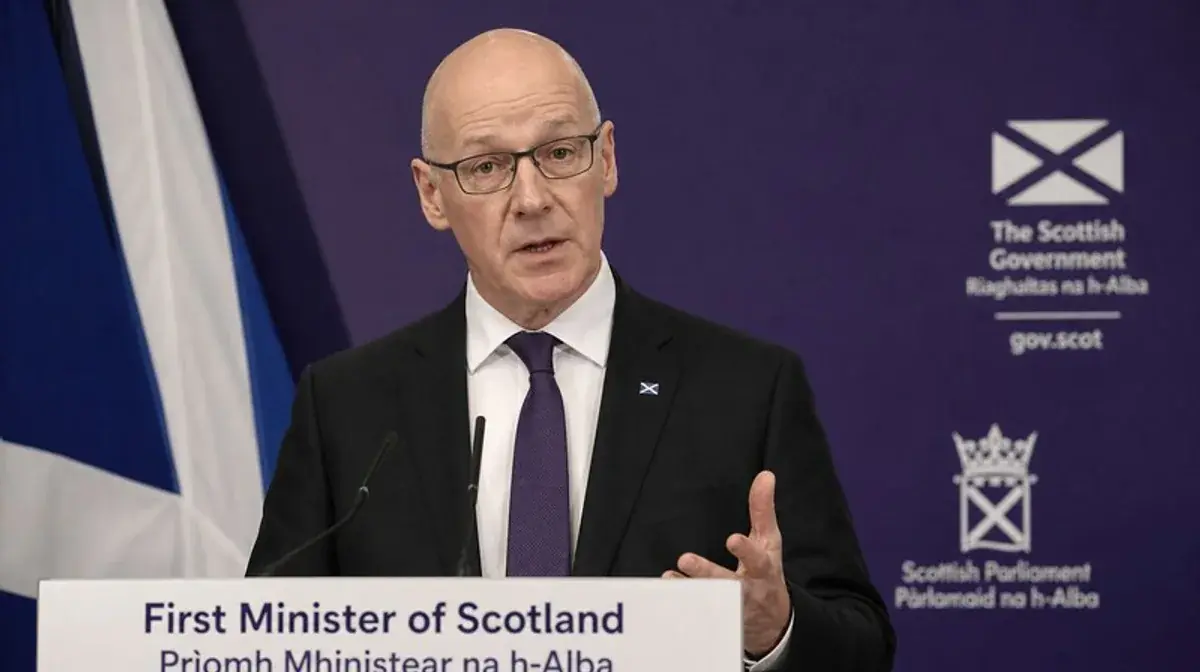
John Swinney became SNP leader and First Minister in May 2024. Rather than attempt a high-profile campaign for an immediate referendum, he adopted a stabilisation strategy built around competent Holyrood government and party rebuilding. The approach has yielded modest improvements in the polling but has not yet fully reversed the 2024 damage.
Phase 1: Stabilise (2024–25)
Avoid further Holyrood crises, repair party finances, rebuild activist base. Focus entirely on devolved government rather than UK-level confrontation with Westminster.
Phase 2: Holyrood 2026
Win a credible Holyrood election result in May 2026 — ideally retaining a majority or forming a stable minority government. A strong Holyrood result resets the narrative and creates a Westminster recovery platform.
Phase 3: Westminster 2029
Convert Holyrood credibility into Westminster seat recovery. With Scotland polling 31% SNP for Westminster in May 2026, models project 18–25 recovered seats under plausible swing scenarios.
| Polling Indicator | Jul 2024 (GE) | Jan 2025 | May 2026 | Trend |
|---|---|---|---|---|
| Scotland Westminster VI | 29% | 29% | 31% | ▲ Modest recovery |
| Holyrood Constituency VI | 31% | 33% | 36% | ▲ Recovering |
| Swinney Scottish net approval | −12 | −8 | −4 | ▲ Improving |
| Scottish independence Yes | 44% | 45% | 45% | ▬ Stable |
Scottish Independence: The Polling Picture
Despite the SNP’s catastrophic Westminster losses and three years of party crisis, support for Scottish independence has remained stubbornly stable. Consistent polling across 2024–2026 places Yes at 44–46% and No at 54–56% on a straight referendum question.
The stability of this figure through the Sturgeon arrest, the Yousaf collapse, the Labour surge, and two years of Swinney rebuilding demonstrates that independence support is structurally embedded in Scottish political identity and is not simply a proxy for approval or disapproval of the SNP government. Many voters who do not intend to vote SNP in current polls still support independence in principle.
| Poll / Source | Yes | No | Date |
|---|---|---|---|
| Survation (Scotland) | 46% | 54% | Mar 2026 |
| Panelbase (Scotland) | 45% | 55% | Feb 2026 |
| YouGov (Scotland cross-break) | 44% | 56% | Jan 2026 |
| BMG (Scotland) | 46% | 54% | Nov 2025 |
| Ipsos (Scotland) | 45% | 55% | Sep 2025 |
Excludes don’t know. Figures are rounded. Sources: Survation, Panelbase, YouGov, BMG, Ipsos.
SNP vs Other Party Manifestos
| Issue | SNP | Labour | Conservatives | Lib Dems |
|---|---|---|---|---|
| Independence / Union | Referendum demand | United Kingdom | United Kingdom | United Kingdom |
| Child benefit cap | Abolish | Partial reform | Maintain | Abolish |
| Net Zero timeline | 2045 (SNP target) | 2050 | Flexible | 2045 |
| New oil & gas | Ban new licences | No new licences | Allow exploration | No new licences |
| Trident nuclear | Scrap | Maintain & upgrade | Maintain | Maintain (review) |
| Electoral reform | Proportional representation | No commitment | No change | PR for Westminster |
| Drug policy | Decriminalise personal use | No change | Tougher enforcement | Review sentencing |
Based on 2024 General Election manifestos. Lib Dem and Green manifesto comparison: Lib Dem manifesto | Greens manifesto.
2029 Outlook: Can the SNP Recover?
Current Scottish Westminster polling of 31% for the SNP translates, under standard uniform swing modelling, into approximately 18–25 recovered seats at the 2029 General Election — assuming the Labour Scotland surge partially recedes as the Starmer government faces continued headwinds.
The key variables are: (1) whether John Swinney can deliver a credible Holyrood 2026 result that resets the party’s competence narrative; (2) whether Scottish Labour under Anas Sarwar can maintain 2024’s extraordinary seat haul or whether the natural logic of FPTP and Scottish political gravity eventually reasserts itself; and (3) whether the independence question — currently blocked by Westminster — creates a mobilisation effect around the 2029 election.
The SNP remains the dominant party in Scottish politics by vote share. Their 2024 result was an FPTP artefact as much as a genuine political collapse. The underlying question — Scotland’s constitutional future — remains unresolved and will continue to generate the party’s core support base regardless of short-term approval ratings.
Frequently Asked Questions
What was the SNP 2024 manifesto?
The SNP 2024 manifesto was titled “Independence for Scotland.” The central ask was a second independence referendum, but the manifesto also included a range of specific UK policy demands: abolishing the two-child benefit cap, scrapping Rwanda, keeping the triple lock pension, free school meals for all primary pupils, banning new North Sea licences, drugs decriminalisation, and proportional representation.
How many seats did the SNP win in 2024?
The SNP won 9 Westminster seats, down from 48 in 2019 — a loss of 39 seats and the party’s worst Westminster result since 2010. Their Scotland vote share fell from 45% to 29%. The collapse was driven by the Sturgeon resignation crisis, the Yousaf leadership failure, and a highly effective Labour campaign targeting SNP marginals.
What is the SNP independence position in 2026?
The SNP remains committed to independence but the UK Labour government has refused to grant a Section 30 order for a legally binding referendum in this parliament. Scottish independence polls at 44–46% Yes in Scotland. The SNP’s immediate focus for 2026 is the Holyrood election, where they aim to retain government as a platform for a future independence campaign.
Who leads the SNP in 2026?
John Swinney has led the SNP since May 2024 and serves as First Minister of Scotland. His Scottish net approval of −4% outperforms Keir Starmer (−28% in Scotland) and Anas Sarwar (−18% among Scottish voters), making him a relative stabiliser for the party despite the ongoing recovery challenge.
Can the SNP recover its seats in 2029?
Current Scottish Westminster polling of 31% projects 18–25 recovered seats under standard swing models — assuming Labour’s 2024 Scotland surge partially recedes. A strong Holyrood 2026 result under John Swinney would provide the platform for this recovery.
How did individual SNP manifesto pledges poll with UK voters?
Most specific SNP pledges had broad national support. Abolishing the two-child benefit cap had 68% national backing. Triple lock pension protection had 72% support. Free school meals for all primary pupils had 63% support. Scrapping the Rwanda deportation scheme was more mixed at 44% support nationally. Banning new North Sea licences was split 43% to 40%. Scrapping Trident had only 28% national support. The pledges with the strongest national support were largely adopted by the Labour government; those that were not tended to be the least popular with the wider electorate outside Scotland.
Explore More
SNP Polling Tracker
Full SNP voting intention data, Scottish polls vs GB, and John Swinney approval trend.
Labour Manifesto 2024
Compare the SNP’s pledges against what Labour actually delivered in government.
Greens Manifesto 2024
Another progressive 2024 manifesto — the Greens on climate, PR, wealth tax and 4 seats won.
Lib Dem Manifesto 2024
“For a Fair Deal” — the Blue Wall strategy that produced 72 seats.
Conservative Manifesto 2024
“Our Plan for Change” — what Sunak promised and why voters rejected it.
General Election 2029
Full seat projections for all parties — can the SNP recover to 20+ Westminster seats?
Video: The SNP Collapse Explained
Video: The dramatic shifts in UK political support since July 2024 — context for understanding the SNP’s Westminster collapse and the broader realignment underway in British politics.