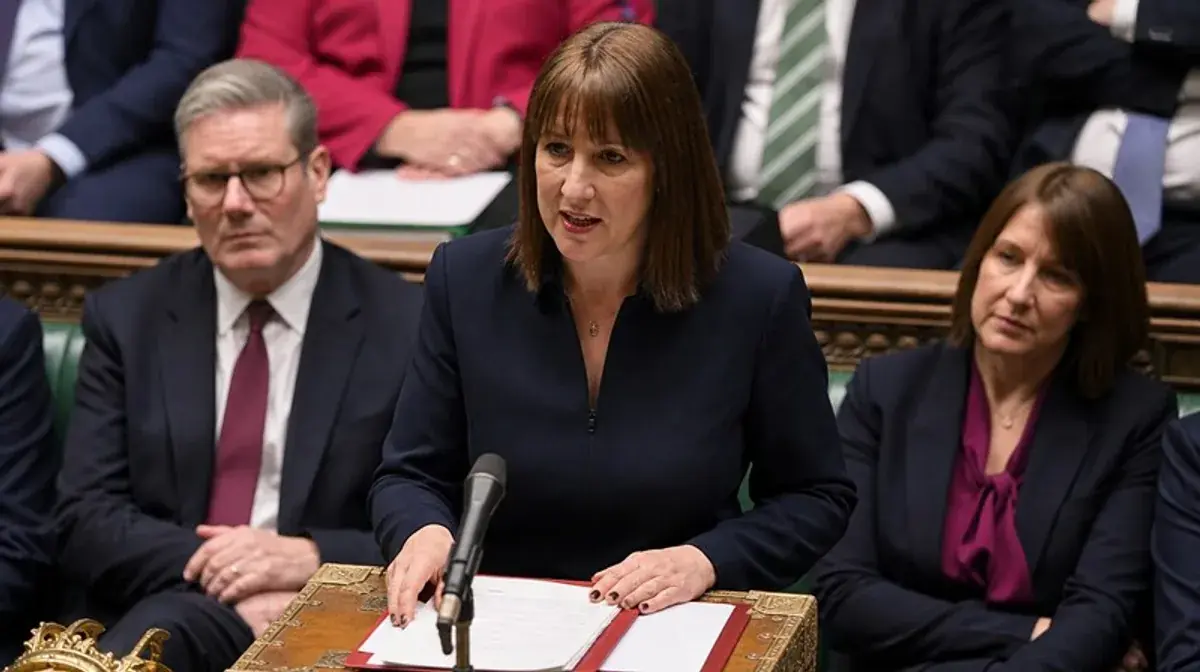
Rachel Reeves became Chancellor of the Exchequer in July 2024 as the first woman to hold the office, with polling approval significantly higher than her eventual government trajectory would suggest. By spring 2026, her net approval stands at approximately −22%, the Conservatives lead Labour on economic trust by 17 points, and Reform UK — a party without a Treasury team or a detailed economic programme — is polling within 2 points of Labour on economic credibility. This is the story of how that happened, what the data actually shows, and whether there is a path back.
The Approval Trajectory: From Cautious Optimism to -22%
Reeves entered the Treasury at around −4% net approval among those with a view — negative, but within the range of what opposition economists who have not yet held office typically achieve. Voters willing to give Labour the benefit of the doubt were extending that courtesy to its Chancellor too. The first six weeks of government were quiet by political standards; the Budget had not yet arrived and the inheritance rhetoric was still generating sympathetic media coverage.
The October 2024 Budget changed the trajectory permanently. The employer National Insurance rise, the change to agricultural inheritance tax, and the admission that the fiscal inheritance was worse than Labour had publicly acknowledged combined to produce a rapid deterioration. By December 2024, Reeves was at −14%. By February 2025, following the publication of growth figures showing the economy had barely expanded, she was at −18%. The Spring Statement in March 2026 — which delivered no significant household-level relief — drove the figure to its current −22%.
The comparison with Gordon Brown is illuminating. Brown entered the Treasury in 1997 at approximately −2% and reached peak approval of around +22% during his first two years, driven by the perceived competence of the independence of the Bank of England decision and a period of genuine economic growth. Reeves has had no equivalent “clear win” moment — a visible, easily understood decision that voters associate with economic improvement. The decisions she has made are either widely seen as harmful (the NI rise) or too structural to produce immediate perceptible change (planning reform, National Wealth Fund investment frameworks).
Economic Trust Breakdown: The Conservatives Ahead, Reform UK Rising
The economic trust polling is the most politically consequential data point in the current environment. In the 2024 general election, Labour led the Conservatives on economic management by 12 points — a lead that was unusual in British political history and reflected the specific circumstances of the post-Truss period. By April 2026, the Conservatives lead Labour on economic trust by 17 points: 41% to 24%. That is a 29-point swing in two years.
The Reform UK figure at 22% is in some ways more alarming for Labour than the Conservative recovery. The Conservatives regaining economic trust is a predictable function of time and opposition; Reform UK gaining economic credibility without a coherent economic programme suggests that voters are choosing it as a vehicle for economic dissatisfaction rather than because they believe Farage has better answers. Techne polling from April 2026 found that among voters who cite the economy as their primary concern, 39% back Reform UK — a higher proportion than those citing immigration (34%) as their primary motivation for supporting the party. Economic protest voting has become Reform’s primary driver.
For Reeves, the implication is that her economic credibility problem is not primarily a policy design problem — it is a perception and attribution problem. Voters are not evaluating Labour’s specific economic measures and finding them wanting on their merits; they are experiencing cost-of-living pressure and attributing it to whoever is in power. The full UK economy polling analysis examines how this attribution dynamic has developed across the two-year government period.
Why the “10 Years of Tory Damage” Narrative Is Not Working
The Labour government’s central political defence on the economy is the inheritance argument: that 14 years of Conservative government left a broken public finances, a depleted public sector, and structural economic weaknesses that cannot be fixed in a single Parliament. The argument has genuine evidential support. The OBR confirmed in its October 2024 report that the fiscal position was materially worse than the Conservative government had publicly indicated. Public sector net investment had been declining in real terms for years. NHS waiting lists had been building since 2012.
But polling data shows the argument is losing effectiveness over time, and doing so faster than the government appears to have anticipated. When voters were asked in July 2024 who bore primary responsibility for current economic problems, 67% said the previous Conservative government and 18% said Labour was not fixing it fast enough. By spring 2026, those figures had moved to 53% and 39% respectively. The “it was their fault” attribution has fallen 14 points; the “you are not fixing it” attribution has risen 21 points, in less than two years of government.
The specific Labour decisions that have accelerated this shift are identifiable. The winter fuel payment restriction in August 2024 was the first own-goal: a policy with defensible fiscal logic but poor political optics, and one that directly contradicted Labour’s campaign positioning on protecting pensioners. The employer NI rise reinforced the narrative that the government was taking money from working people to fund public services. Both decisions, in voters’ minds, belonged to Labour — not to the Conservative inheritance. They were active choices made by the current government, and polling consistently shows voters distinguish between inherited problems and self-inflicted ones.
The Spring Statement: A Lost Opportunity
The March 2026 Spring Statement was widely anticipated as an opportunity for Reeves to reframe the economic narrative. With inflation running at approximately 3.2%, slower than the 2022–23 peak but still above the Bank of England’s 2% target, and with the NHS waiting list showing early signs of marginal improvement, the backdrop was more favourable than it had been at the October 2024 Budget. The question was whether Reeves could translate modest macroeconomic stability into a voter-perceptible story about improving household circumstances.
The answer, according to post-statement polling, was no. Only 19% of voters believed the economic plan announced in the Spring Statement was working; 52% said it was not. Among voters under 45, the proportion saying it was working fell to 14%. The statement’s announcement of further adjustments to public sector spending projections drew criticism from trade unions and Labour backbenchers, reinforcing a narrative of a government continuing to make difficult choices without the political credit that usually attaches to fiscal responsibility.
The optics problem was compounded by the cost-of-living context. Energy price cap increases in April 2026, running ahead of wage growth for lower-income households, landed in the weeks immediately following the statement and dominated the economic news cycle. Voters experiencing rising bills did not hear in the Spring Statement an answer to their immediate financial concerns. The gap between the macroeconomic narrative Reeves is attempting to construct and the microeconomic reality voters are living is the central challenge she faces.
Cost of Living: The Polling on Personal Economic Experience
The distinction between general economic perception and personal financial experience is important in polling analysis, and in the current period both are negative for Labour. Ipsos polling from March 2026 found that 74% of voters cite cost of living as a major personal concern — a figure that has not fallen below 68% since November 2022. Among households with a net monthly income below £2,500, the proportion is 84%.
When asked whether their personal financial situation has improved or deteriorated since July 2024, only 11% of voters say improved; 48% say deteriorated; 38% say about the same; and 3% don’t know. The 48% deterioration figure is politically severe: it means that approaching half the electorate directly associates the period of Labour government with a personal financial worsening. Even if this association is partly driven by factors outside the government’s control — global energy prices, post-Covid inflation persistence — the political attribution is clear.
The demographic profile of economic dissatisfaction is instructive. The groups showing the strongest personal financial deterioration in polling are: renters under 40 (62% saying worse off), households with mortgages renewed since 2022 (58% saying worse off), pensioners who lost winter fuel payment (71% saying worse off), and small business owners facing employer NI increases (66% saying worse off). These are not Reform UK voters by background; they are the specific groups Labour needed to retain from its 2024 coalition. Their economic dissatisfaction is the direct mechanism by which the voting intention collapse to 18% has occurred.
Is There a Path Back for Reeves?
The political question is whether Reeves can recover her personal economic credibility and Labour’s broader economic trust before the 2029 election. Polling analysis suggests the path exists but is narrow and requires specific conditions. First, and most importantly, voters need to experience a real-terms improvement in disposable income that they can attribute to government policy rather than to external factors. This requires either significant real wage growth or visible household-level interventions such as energy bill relief or childcare cost reductions that voters feel directly.
Second, Reeves needs a defining “good decision” moment — an action that can be presented as economically competent and is perceived positively by a significant cross-section of voters. Brown had Bank of England independence; Darling had the 2009 fiscal stimulus. Reeves has not yet had an equivalent moment, and the Budget has been coded as negative by polling majorities. The National Wealth Fund and clean energy investment framework have potential as such a moment if they begin to generate visible private sector investment and job creation before 2029.
Third, and least within the government’s control, economic conditions need to improve. Inflation needs to fall to 2% and remain there; the Bank of England needs room to cut interest rates in a way that mortgage holders feel directly; and real household disposable income needs to grow. None of these outcomes is guaranteed, and all of them are partly dependent on global economic conditions beyond UK government influence. Reeves’ approval will follow economic conditions more closely than almost any other ministerial metric. See also the Labour two-year verdict and the Starmer approval analysis for context on how Reeves’ position fits within the broader government polling picture.
Frequently Asked Questions
What is Rachel Reeves’s approval rating in 2026?
Approximately −22% net approval in spring 2026, with around 24% approving and 46% disapproving of her performance as Chancellor. Among those who cite the economy as their most important issue, disapproval runs at around 58%.
Which party leads on economic trust in 2026?
The Conservatives lead at 41%, followed by Labour at 24% and Reform UK at 22%. This is a 29-point swing from the 2024 general election when Labour held a 12-point economic trust lead over the Conservatives.
Why is the Conservative inheritance argument losing effectiveness?
The proportion of voters attributing economic problems primarily to the previous Conservative government has fallen from 67% in July 2024 to 53% by spring 2026. The winter fuel cut and employer NI rise are specific Labour decisions that voters attribute to the current government rather than the Conservative inheritance, accelerating this shift.
How did the Spring Statement affect Reeves’s polling?
It produced no polling improvement. Only 19% of voters believed the economic plan was working after the statement; 52% said it was not. Energy bill increases in April 2026 further undermined the economic narrative in the weeks following the announcement.