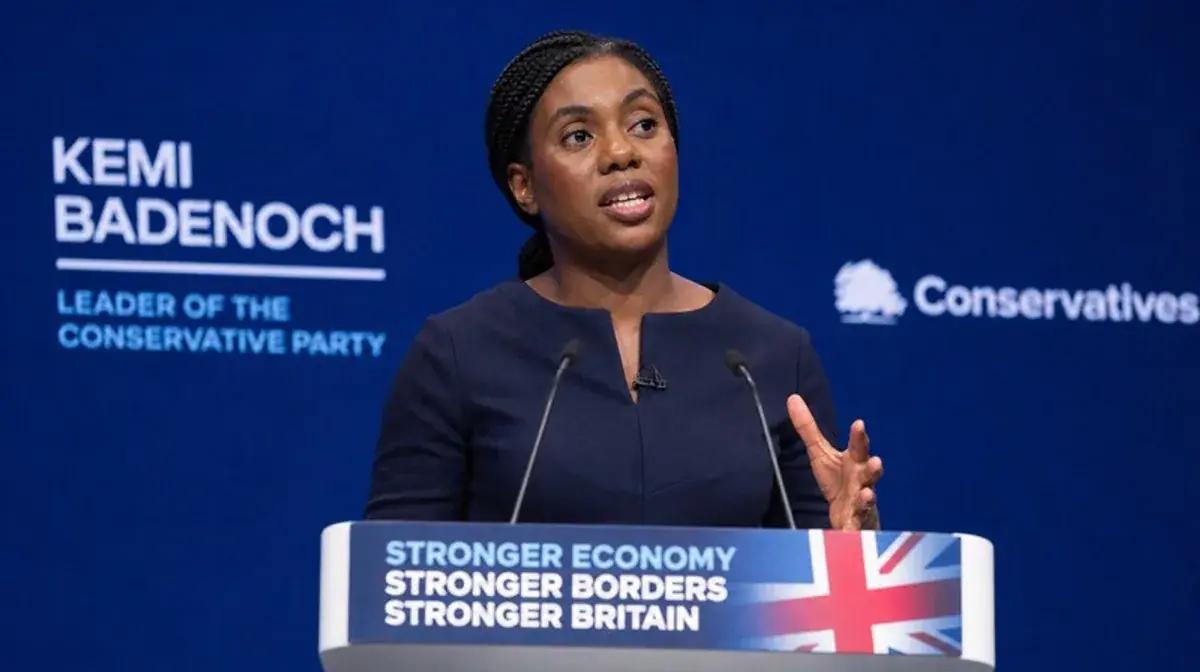
Kemi Badenoch leads the Conservative Party with a net public approval of approximately -15% — tied with Farage and considerably better than Keir Starmer (-44%), but not a comfort when your party is polling at 19% and losing council seats to all sides simultaneously. The question of whether Badenoch is the right person to rebuild the Conservatives is now openly asked in the Westminster conversation. Here is what the polling actually shows.
Public Approval Numbers: The Raw Data
YouGov's monthly leader approval tracker puts Badenoch at 23% positive, 38% negative, and 39% “don't know enough to say” as of May 2026. The net figure of -15% looks relatively manageable compared to Starmer and Farage, but the “don't know” proportion is the hidden problem: after 18 months as opposition leader, nearly two in five GB adults still cannot assess her performance. This suggests a penetration failure — not enough people are forming an opinion about her, which is almost as problematic for an aspiring Prime Minister as forming a negative one.
The approval split varies dramatically by party ID. Among 2024 Conservative voters, Badenoch scores +42% net approval. Among all voters, the -15% net. The challenge for any Conservative leader is bridging that gap: the party base thinks she is doing well, the broader public is largely undecided or mildly negative. At the equivalent stage of William Hague's leadership (early 2000, 18 months in), YouGov's predecessor tracking puts his net approval at approximately -18% among all voters. Badenoch is marginally ahead of that benchmark.
Her specific policy positions poll better than the overall approval figure. On fiscal responsibility (should the government cut spending to reduce debt?), Badenoch's position polls at 41% support. On immigration (should net migration be reduced to the tens of thousands?), her position polls at 52% — higher than the national Reform figure on the same question. The issue is converting policy agreement into personal support, a challenge every opposition leader faces but which feels particularly acute given the Reform competition on the right. See full leader approval tracker.
Internal Conservative Party Polling
Conservative member satisfaction is harder to track precisely than public polling, but a series of surveys commissioned by ConservativeHome — the party's main membership-facing website — provides the closest available data. In the most recent wave (April 2026), Badenoch's satisfaction score among responding Conservative members was 58%, down from 74% in October 2025 and 81% when she was first elected leader in November 2024.
The decline in member satisfaction tracks the party's continued polling underperformance rather than any single controversy. Conservative members expected the party to recover from its 2024 wipeout more rapidly under Badenoch's leadership, and the persistence of sub-20% polling — particularly with Reform eating into the right flank rather than the party taking votes back from Labour — has generated frustration. Multiple anonymous Conservative MPs have briefed political journalists that the party needs to see improvement before the 2027 local elections or leadership questions will become unavoidable.
Badenoch's strongest suit among members is ideological: she is seen as genuinely right-of-centre on economic and social policy, not a moderate performing conservatism for tactical reasons. This ideological authenticity was central to her leadership victory over Robert Jenrick and James Cleverly. Members who backed her on this basis remain largely supportive; those who hoped she would translate ideological clarity into polling momentum are more restive.
Can She Win Back Votes from Reform UK?
The core strategic question for any Conservative leader in this Parliament is whether to attempt to win back the voters who have moved from Conservative to Reform, or to focus on consolidating the remaining Conservative base and targeting Labour switchers. Polling data provides a clear answer: the voters who moved from Conservative to Reform are substantially more right-wing than those who stayed with the Conservatives, and they list immigration and law and order as their top priorities by a large margin.
Badenoch has largely declined to compete directly with Reform on immigration rhetoric, instead focusing on economic policy, public sector reform, and anti-woke cultural messaging. This positioning may be tactically correct for the general electorate — competing with Farage on his strongest ground is rarely a winning strategy — but it means the Conservatives are not recapturing former voters who left specifically over immigration concerns. Those voters, currently at 19% Reform, are unlikely to return to the Conservatives unless the Conservatives offer something Reform does not.
The alternative view, held by a significant faction within Conservative think-tanks and commentators, is that the 2029 election will not primarily be fought between Conservative and Reform on the right, but between Conservative and Labour on economic competence. If Labour's economic record deteriorates further, moderate voters who switched from Conservative to Labour or Lib Dem in 2024 may be available to recapture. Badenoch's economic messaging is better positioned for this scenario. Track Conservative polling at the party profile.
The Conservative Existential Question
The deeper question behind the Badenoch polling discussion is whether the Conservative Party can survive as a major force in British politics given the structural changes in its voter coalition. The party has now lost its working-class vote to Reform and significant parts of its professional southern vote to the Liberal Democrats. What remains is a smaller, older, and more ideologically homogeneous base — enough to sustain a parliamentary presence but perhaps not enough to form a government.
MRP models on current polling suggest the Conservatives could retain as few as 80–100 seats at the 2029 election, their worst result since the party's founding in the 1830s. Whether Badenoch or any leader can arrest this decline depends partly on political skill and partly on factors outside her control: the performance of the Labour government, the trajectory of Reform's polling, and whether the British public's appetite for political disruption continues or moderates in the run-up to the next vote.
The historical comparison that Conservative strategists most fear is not UKIP but the Canadian Conservative Party, which collapsed from governing majority to two seats in 1993 when voters split between the Progressive Conservatives and the Reform Party of Canada. That outcome took the Canadian Conservative movement 12 years to reverse. Whether the same fate awaits the British Conservatives — and whether Badenoch is the leader to prevent it — is the defining question hanging over the party's polling performance. Full analysis at the MRP projections → • Marginal seats → • 2029 election forecast.
The Historical Comparison: Hague, IDS, Howard, Cameron
Badenoch is the fourth Conservative opposition leader since 2010 — and the party's trajectory in opposition varies dramatically between her predecessors. William Hague (1997–2001) led the party from 165 seats back to 166 seats, a failure to make progress. Iain Duncan Smith (2001–2003) was removed before an election. Michael Howard (2003–2005) stabilised the party and gained 33 seats in 2005. David Cameron (2005–2010) rebuilt to 306 seats and then formed a coalition government in 2010.
The Cameron model is the most relevant precedent: he inherited a party on 198 seats with a divided base and a credibility deficit, and systematically rebuilt it over five years through policy review, modernisation, and careful positioning on the centre-right. Badenoch is pursuing a different strategy — less modernisation and more ideological clarification — but the structural challenge is similar. The test is whether her approach can deliver comparable results by 2029, starting from a lower base of 121 seats and with a more formidable competitor on the right flank. Track her approval ratings weekly at leader approval.