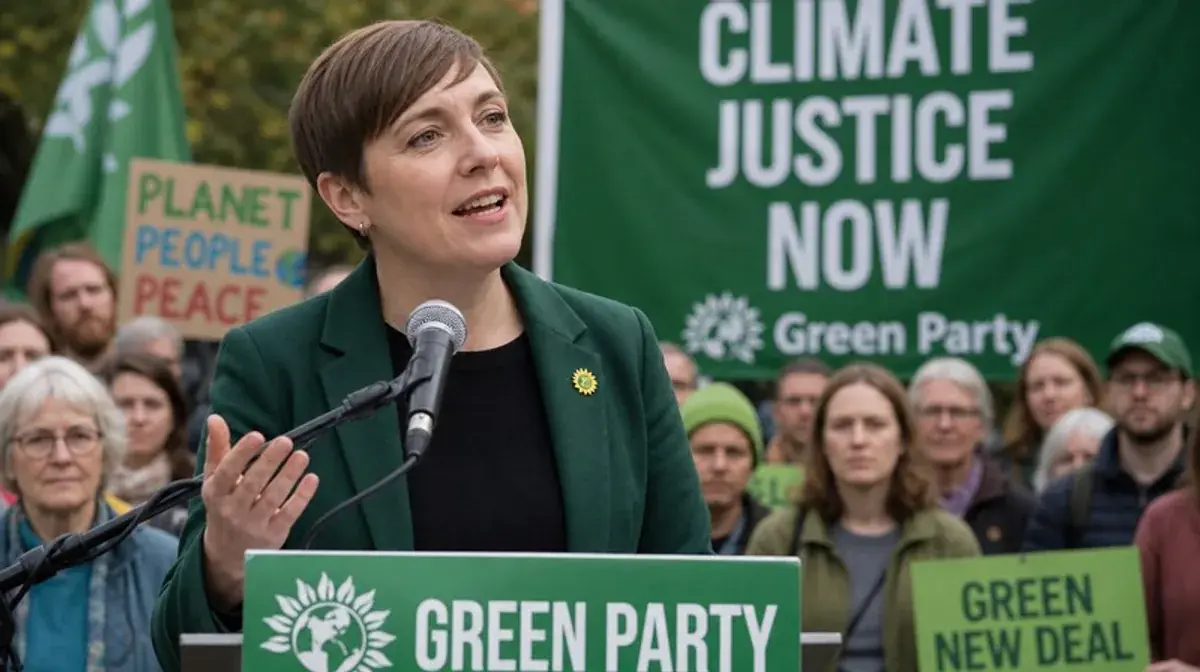
The Green Party of England and Wales is polling at 15% in May 2026 — more than double their 7% vote share at the 2024 general election. Led by Carla Denyer and Adrian Ramsay under the party's distinctive co-leadership model, the Greens have become the second-largest party among under-35s and the primary receptacle for progressive voters disillusioned with Labour. Here is what the polling shows about who is backing them and why.
The 15% Number: What Drove the Green Surge
The Green Party's rise from 7% at GE2024 to 15% by May 2026 is one of the most significant sub-narratives in British polling, often overshadowed by the larger Reform UK story. The surge began in earnest in late 2024, as Labour's first budget disappointed progressive voters who had supported the party on a platform of greater public investment and redistribution. The winter fuel allowance cut, seen by many left-leaning voters as a betrayal of the party's social democratic commitments, triggered an immediate five-point jump in Green polling.
Subsequent policy decisions — particularly Labour's approach to Gaza, its continuation of Conservative planning reforms without significant redistribution measures, and the government's refusal to consider wealth taxes to fund public services — each pushed more progressive voters toward the Greens. The party has benefited from being the only major left-of-centre party that voted against the government on key Commons divisions, giving it a clear identity as Labour's opposition on the left while Reform occupied the same position on the right.
The YouGov cross-tabs show that 11% of 2024 Labour voters have moved to the Greens by May 2026 — the single largest source of Green growth. A further segment has come from non-voters and first-time voters (particularly 18–24s) who are politically engaged on climate and economic justice issues but had not previously backed the Greens. The result is a party whose voter coalition is younger, more educated, and more urban than any other in the UK. See all party polling comparisons on the tracker.
Carla Denyer: Personal Polling and Public Profile
Carla Denyer, who has represented Bristol Central since winning the seat at the 2024 general election, is the more publicly visible of the two co-leaders. YouGov's leader approval tracker puts her at +8% net approval among all GB adults — positive territory, and the only major party leader currently in positive net approval. However, the caveat is the “don't know” proportion: 54% of GB adults say they don't know enough about Denyer to assess her. For comparison, Starmer's “don't know” share is just 12% — the problem with being unknown is you cannot drive a national poll lead on personal approval.
Among Green voters, Denyer's satisfaction rating is 71% — strong, though down from 81% in early 2025 when the party's honeymoon period was at its peak. Her public appearances have been consistently well-received in media coverage: she is articulate, calm under questioning, and capable of translating Green policy positions into accessible language for mainstream audiences. Political journalists across ideological lines have noted her as one of the more effective parliamentary performers among the smaller party leaders.
Her approval is highest among 18–34 voters (+18% net) and university graduates (+12% net). It is negative among over-65s (-14%) and among non-graduates (-8%) — groups the party is not targeting anyway. The alignment between Denyer's strongest demographics and the party's target voter base suggests a good strategic fit between leader and electoral positioning. Track all politician profiles and approval ratings here.
Adrian Ramsay: The Less-Visible Co-Leader
Adrian Ramsay won Waveney Valley in the 2024 general election, one of the biggest upsets of that election night, defeating a Conservative incumbent in a rural Norfolk and Suffolk constituency that had never returned a Green MP. His win was largely attributed to intensive local campaigning rather than national swing, though the collapse of the Conservative vote played a significant role. Ramsay is a less prominent national figure than Denyer, with a higher “don't know” proportion in polling (62% of GB adults).
Among those who have an opinion, Ramsay nets +5% approval nationally. His function within the co-leadership is partly a deliberate division of labour: Denyer handles most national media and parliamentary performance work; Ramsay focuses on party organisation, membership engagement, and the strategy of building Green support in non-urban constituencies. Waveney Valley demonstrated that Green candidates can win in rural and coastal areas given the right local conditions — and Ramsay's experience of that campaign is directly relevant to the party's 2029 targeting strategy.
The co-leadership model itself is relatively uncontroversial among the public. YouGov asked in March 2026 whether people thought co-leadership was “a good model for a political party”: 31% said yes, 22% said no, and 47% said they had no view. Among Green voters, 68% viewed co-leadership positively. The model creates occasional coordination issues in media appearances — who speaks first, who handles which question — but these are minor compared to the internal cohesion benefits of having two popular figures jointly leading a party with a strong tradition of internal democracy.
The Seat Conversion Problem
The Greens' most significant structural challenge is converting 15% national polling into parliamentary seats under first-past-the-post. With four sitting Green MPs following the 2024 election (Denyer, Ramsay, and two others), the party has a small but real parliamentary presence. MRP models on current polling suggest they could win between 5 and 12 seats in 2029 — a potential doubling or tripling of their parliamentary group, but a fraction of what their 15% national share would produce under proportional representation (approximately 97 seats in a 650-seat House).
The geographic concentration problem is the mirror image of Reform UK's: both parties are polling strongly nationally but struggle to convert votes into seats because their support is distributed in ways that disadvantage them under first-past-the-post. The Greens are particularly strong in university cities (Bristol, Brighton, Sheffield, Oxford, Cambridge) but these are also cities where Labour retains a majority of votes. The party's realistic seat targets in 2029 are constituencies where they ran second in 2024 or where a candidate has built a strong local profile over three years of council work.
The 2026 local elections provided a modest but useful base: the Greens gained approximately 150 council seats, giving them local elected officials in more constituencies than before. But their local footprint remains concentrated in the same urban areas where they already have parliamentary seats, limiting the candidate pipeline for genuinely new target constituencies. Electoral reform — a Green core policy demand — would transform the party's parliamentary prospects entirely, which is why the Greens have made proportional representation a non-negotiable condition of any confidence and supply arrangement. See full Green Party polling data.
Green Polling by Issue: Where the Party Leads
The Greens lead all parties on climate policy trust (39% of GB adults trust the Greens most on climate, versus 8% for Labour and 4% for the Conservatives). They also lead on environmental regulation (35%), animal welfare (28%), and foreign aid (24%). These are meaningful leads but they reflect a set of issues that rank lower on most voters' priority hierarchies than immigration, the NHS, and the cost of living — where the Greens are not competitive with the major parties.
On economic policy, where Denyer has made a significant push to position the Greens as the party of working people on wealth and redistribution, polling is more mixed. The Greens lead Labour slightly (22% vs 19%) on “would do most to reduce inequality” — a remarkable shift from just two years ago when Labour led on this metric by 15 points. However, on “economic competence” in the traditional sense (managing the budget, fiscal responsibility), the Greens score just 9% versus Labour's 24% and the Conservatives' 22%.
The challenge for Denyer and Ramsay is to shift the Greens from being seen as a single-issue environmental party to a credible broad-based progressive alternative. Polling suggests they are making progress on redistribution and inequality but have not yet overcome the “economic incompetence” perception that has historically constrained Green growth in national elections. How far they can shift this by 2029 will determine whether 15% national polling translates into genuine electoral breakthrough or remains another case of votes without seats. Full party polling comparisons are on the tracker.