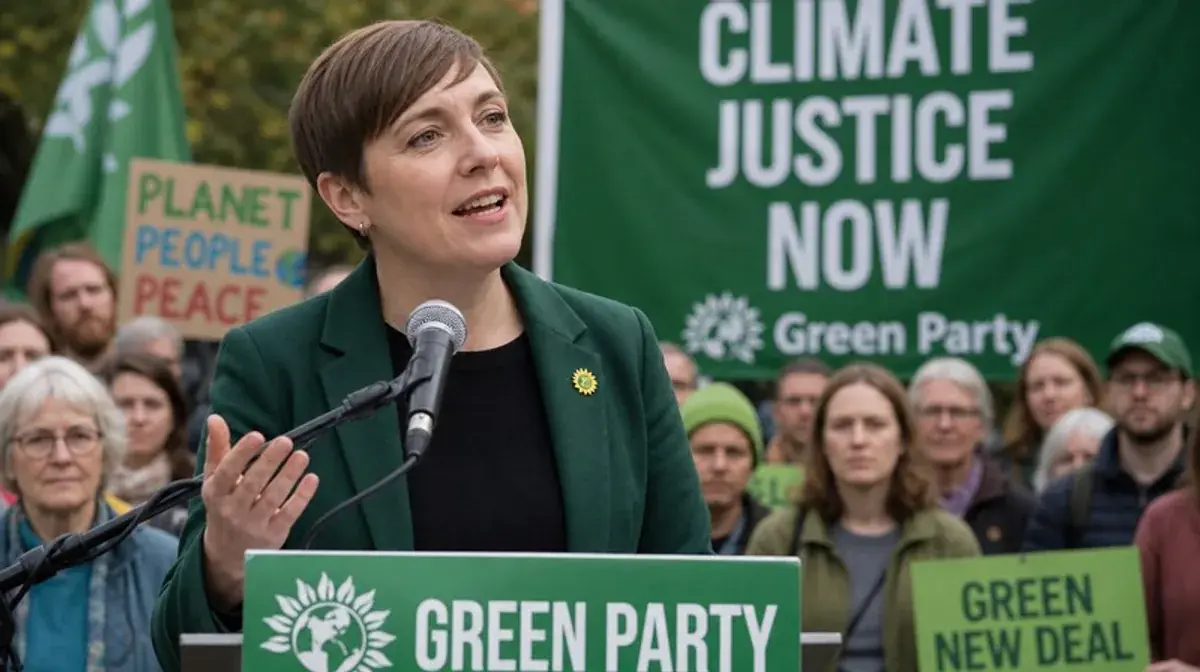
The Green Party of England and Wales is polling at 15% in May 2026 — an historic high in modern national polling. When the party won 7.0% of the vote and four seats at the July 2024 general election, it was already its best-ever result. To be double that vote share less than two years later suggests a structural shift rather than a temporary surge. The question is who is switching, why, and what it means for a party still constrained by the first-past-the-post system.
The Numbers: 15% in Context
The poll-of-polls tracker for May 2026 places the Greens at 15.0%, making them the fourth-largest party by national vote share, ahead of the Liberal Democrats at 12.6%, SNP at 3.0%, and several smaller parties. This 15% is more than double the party’s 7.0% result at the July 2024 general election, and it is far above the 2.7% the party achieved in 2019.
Individual polls confirm the scale. YouGov recorded the Greens at 14% in April 2026. Savanta had them at 16% in the same period. Techne’s large-sample poll showed 15%. The consistency across pollsters with different methodologies suggests this is not a house effect or methodological artefact — it is a genuine reflection of public opinion.
Who Is Switching to the Greens: Demographics
The demographic profile of Green switchers is remarkably consistent across polling firms’ cross-breaks. The largest group, comprising approximately 55% of the Greens’ new support, are former Labour voters aged 18–35. These are disproportionately degree-educated, urban, and female. They voted Labour in 2024 either as first-time voters or as tactical voters returning to Labour from the Greens specifically to remove the Conservatives, and they have concluded that the Starmer government has not delivered on the issues they care about most.
The second group, approximately 20% of Green gains, are voters who backed Labour specifically on climate and environment grounds in 2024 and feel that Labour’s watering down of its climate investment agenda — particularly the decision to reduce the speed of transition away from fossil fuel licensing — represents a betrayal. This group spans age ranges but is concentrated in university cities and coastal areas with visible environmental concerns.
A third group, approximately 15% of Green new support, comes from former Liberal Democrat voters in university towns such as Oxford, Cambridge, and Bristol who feel the Lib Dems are too centrist and too focused on southern suburban tactical politics to represent their values. This group has found the Greens a more natural home in specific local contexts.
Issue Drivers: Why They’re Switching
Issue-tracking data helps explain the Green surge more precisely. Climate and the environment, predictably, is the top issue for current Green voters, with 78% citing it as their primary motivation. But the second issue — at 41% — is Gaza and foreign policy. The Starmer government’s handling of arms sales to Israel generated sustained protest and a long-term polling penalty among Muslim voters, Arab-British communities, and younger progressive voters. Many of these voters, who backed Labour in 2024, have shifted to the Greens as the most prominent anti-war, anti-arms-sales party in English politics.
The third driver is housing. Polling shows that among 18–34 renters who say housing affordability is the most important issue, the Greens lead Labour by 12 points. This is a historically unusual position for a party more associated with environmental than economic issues, and it reflects the Greens’ consistent positioning in favour of rent controls and genuinely affordable housing targets that Labour has not matched.
The fourth driver is NHS privatisation anxiety. Among voters who say they fear NHS privatisation is a risk under the current government, 34% now prefer the Greens as the party most committed to a fully public health service — above Labour at 29% among this specific group.
Local Elections: Real Gains, Not Just Polling
The Green surge is not merely a polling phenomenon. In the May 2026 local elections, the party had its best-ever result in terms of raw seat numbers. Gains in Bristol, Brighton, Norwich, Oxford, Cambridge, and inner London boroughs demonstrate the party can convert national support into wins under the first-past-the-post system when its vote is sufficiently concentrated geographically.
The party now controls multiple councils outright and has moved into administration in partnership with other parties in several more. This local government experience is critical for the 2029 general election: Green candidates in cities where the party has council records can point to tangible governance rather than purely protest positioning. The contrast with the party’s position at the 2010 election, when Caroline Lucas’s win in Brighton Pavilion was a genuine surprise, is stark.
The FPTP Ceiling: What 15% Can Buy in Seats
The fundamental constraint on the Greens remains the electoral system. The party’s 15% is nationally distributed in ways that make it extremely difficult to convert into proportional seat gains. Current MRP projections suggest the Greens could win between 8 and 18 seats at the next general election if current polling holds, mostly in Bristol, Brighton, Oxford, Cambridge, and similar cities. Some optimistic Green scenarios place them at 20–25 seats.
For comparison: in Germany, a party at 15% would win approximately 105 Bundestag seats. In the UK at 15%, the Greens would win fewer than 20 Commons seats. This asymmetry is precisely why the party has made electoral reform central to its political platform, and why its 15% polling has translated into significant pressure for proportional representation from a part of the political spectrum previously uninterested in electoral mechanics.
Can the Greens Sustain 15%?
The sustainability of 15% Green support is genuinely uncertain. Historical Green polling shows the party surges during periods of Labour disappointment and can fall sharply when the political focus shifts from climate or progressive social issues toward economic anxiety or immigration. If Labour makes a leftward shift in policy or changes its leader before 2029, some Green voters may return — particularly those who are primarily anti-Tory rather than positively Green.
The factors that could sustain 15% include a continued Labour failure to address climate commitments, further Gaza policy controversy, and the deepening of the housing crisis. The factors that could undermine it include an economic downturn that focuses voter attention on economic competence rather than values, a Reform UK dominance of the political agenda around immigration, or a Green governance failure in a major council that attracts negative media scrutiny. The party leadership is acutely aware that 15% in May 2026 is an opportunity that requires both careful management and continued policy credibility to be translated into genuine electoral power.
Frequently Asked Questions
Why are the Green Party polling so high in 2026?
The Greens are at 15% because Labour has abandoned progressive climate commitments, because younger voters are disillusioned with Starmer government performance, and because the Greens now have credible local government presence in cities that makes them feel like a viable option rather than a protest vote.
Who is switching to the Greens in 2026?
The largest group switching to the Greens are former Labour voters aged 18–35, particularly degree-educated urban residents. The second largest group backed Labour in 2024 specifically on climate grounds and feel betrayed. A smaller number of former Lib Dem voters in university towns have also moved to the Greens.
How many seats could the Greens win at 15%?
Current MRP projections suggest the Greens could win between 8 and 18 seats at the next general election at current polling levels, mostly in Bristol, Brighton, Oxford, and similar university and coastal cities. The first-past-the-post system severely limits seat gains despite 15% vote share.
Could the Greens sustain 15% until 2029?
Sustaining 15% to 2029 is possible but uncertain. Green polling historically spikes during Labour disappointment and can fall when political focus shifts from climate to economy or immigration. If Labour shifts left or changes leader before 2029, some Green voters may return.