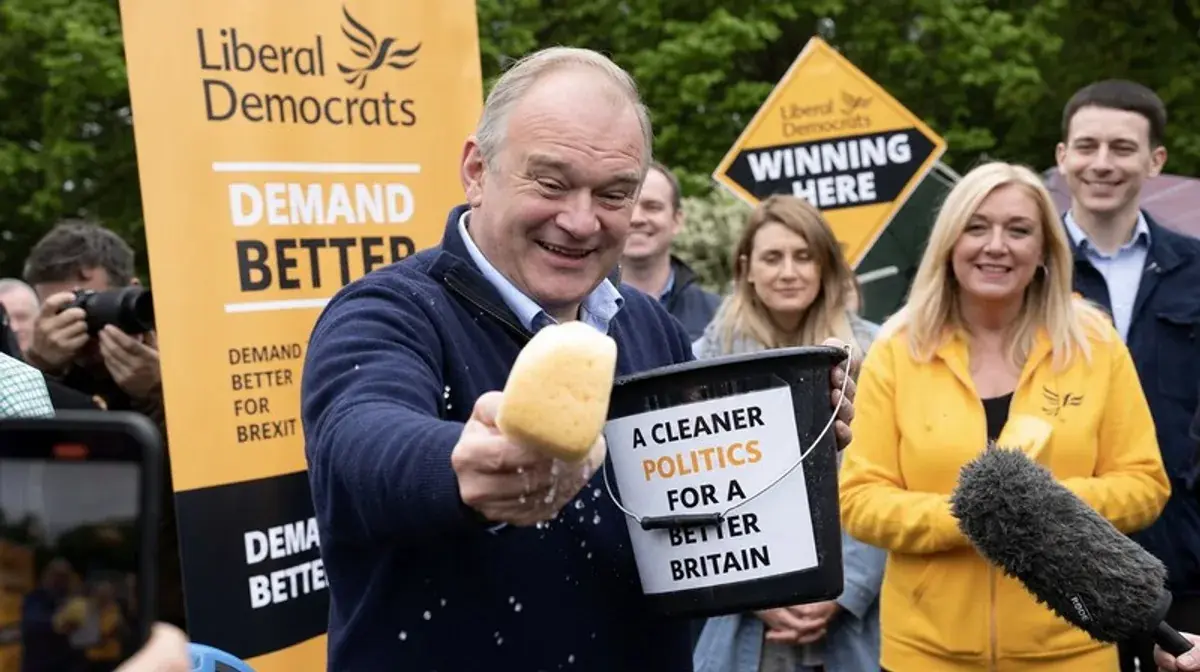
The Liberal Democrats enter the second half of 2026 with a national voting intention figure of 13% — broadly matching their 2024 general election result of 12.2% and their best sustained reading since the coalition years. That headline figure obscures a growing strategic tension: the Greens at 15% have overtaken them nationally, yet the Lib Dems remain far better placed in the seats that matter most.
The National Picture: 13% and What It Means
May 2026 polling from YouGov, Techne and Savanta consistently places the Liberal Democrats at 12–14%, with a central estimate of 13%. This represents a marginal improvement on their 2024 election night result of 12.2%, which delivered 72 Commons seats — the party’s best total since 1923 — due to the exceptional efficiency of their vote in suburban and rural southern England.
The Lib Dems’ current national figure is being held down by two competing forces. From the right, Conservative vote recovery under Kemi Badenoch has clawed back some of the blue wall switchers who backed the Lib Dems in 2024 as an anti-chaos vote. From the left, a meaningful share of progressive 2024 Lib Dem supporters have migrated to the Green Party, drawn by stronger climate messaging and a more confrontational stance towards the Labour government.
The Green Squeeze: 15% vs 13%
For the first time in modern British political polling, the Green Party is consistently polling above the Liberal Democrats nationally. Greens at 15% represent a genuinely new dynamic — driven by younger, urban, highly educated voters who feel Labour has not moved quickly enough on climate, housing, or electoral reform.
Cross-break analysis from YouGov’s weekly tracker shows that among 18–34 year olds, the Greens now poll at approximately 24% compared to the Lib Dems’ 9%. Among university graduates, the Green share is 19% versus the Lib Dems’ 15%. The geographic overlap is, however, limited: the Greens are strong in Bristol, Brighton, Sheffield, and university towns where they can win under FPTP. The Lib Dems’ strength remains in the very different terrain of rural Devon, Somerset, the Cotswolds, and the outer London commuter belt.
The result is two parties with similar national numbers but almost no overlap in target seats, which reduces the political damage to the Lib Dems of the Greens’ surge. In the seats that matter for Ed Davey’s party, Green competition is minimal.
South West: The Lib Dem Heartland Holds
Regional sub-samples consistently show the Liberal Democrats outperforming their national figure in the South West of England. Weighted regional polling from Q1 2026 puts the party at 21–24% in the South West, ahead of Labour at 16–18% and broadly level with the Conservatives at 22–25% in the region. This makes the South West one of the very few areas of England where three parties are genuinely competitive.
The seats the Lib Dems hold across Devon, Somerset, Cornwall, and Dorset were won in 2024 by margins ranging from a few hundred votes in Glastonbury and Somerton to several thousand in Tiverton and Honiton. In each of these seats, the party’s local councillor base, established MP incumbency effects, and community campaign infrastructure make the polling picture more favourable than the national number suggests.
Labour, despite its national performance, has struggled to build credibility in most South West seats. The party’s metropolitan associations and its record on rural issues — particularly farming policy following the inheritance tax changes — have made it structurally uncompetitive in constituencies that once housed safe Tory MPs.
Blue Wall: Mixed Signals
The blue wall seats across Surrey, Hampshire, Buckinghamshire, and the Home Counties that the Lib Dems captured in 2024 present a more complicated picture. In some of these seats — Guildford, Godalming and Ash, Chichester — the Conservative recovery under Badenoch is meaningful enough to appear in sub-national polling. The incumbency advantage for the Lib Dem MPs elected in 2024 is a counterbalancing factor, but takes time to establish.
MRP modelling from early 2026 suggests the Lib Dems might lose 8–15 seats in a 2029 election held on current polling, while winning 3–6 new ones in areas where anti-Conservative sentiment remains high. Net, this would still leave them with the largest Lib Dem parliamentary group in a century.
Ed Davey Approval and the Road to 2029
Ed Davey’s personal approval rating sits at approximately −6% nationally — far better than Starmer’s −44% and considerably better than Badenoch’s −15%. The leader’s profile remains strongest in the party’s core geographies and among older, home-owning, socially liberal voters. For a party polling at 13%, holding its 2024 gains and positioning for 2029 without a dramatic surge or collapse, the current trajectory is considered internally satisfactory. Full Lib Dem party profile and polling data →