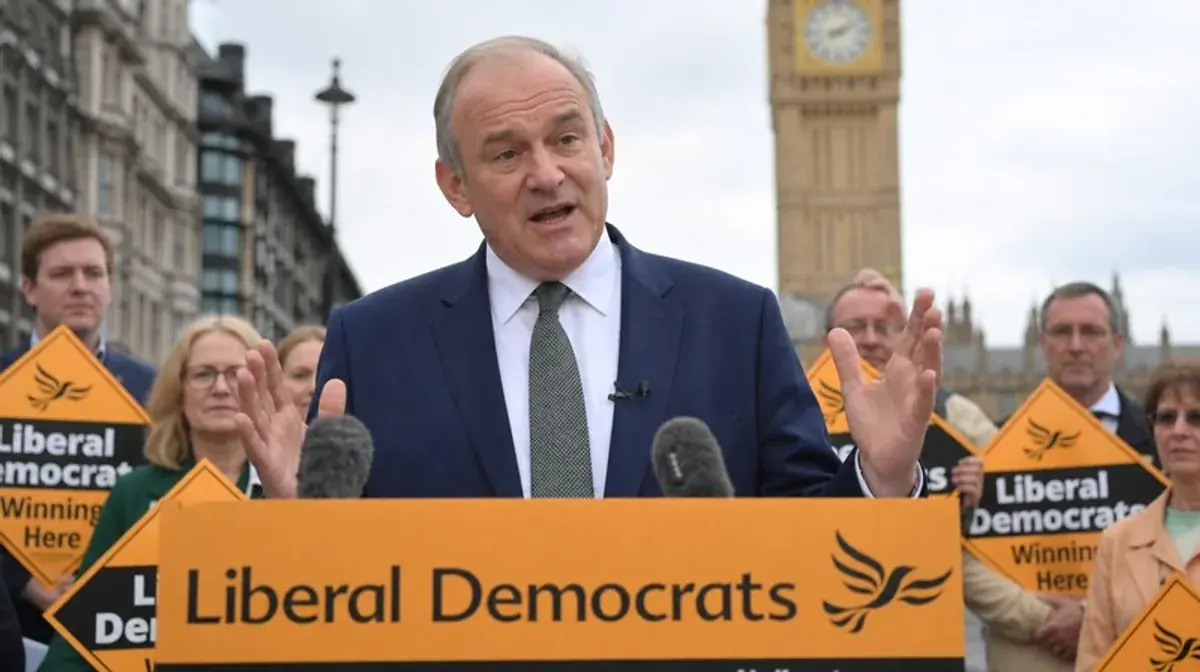
The Liberal Democrats achieved one of the most remarkable electoral turnarounds in modern British history at the 2024 general election, winning 72 seats on 12.2% of the national vote. Under Ed Davey, the party rebuilt from the catastrophic 8 seats of 2015 to a 72-seat parliamentary group with positive leader approval numbers and a clear geographic base. Here is what the polling shows about the Lib Dems' current position and their 2029 prospects.
The Polling Journey: 2019 to 2026
The Liberal Democrat polling trajectory since 2019 is more complex than simple growth. At the 2019 general election, the party won 11.6% of the vote under Jo Swinson but only 11 seats, their worst seat-to-vote ratio since the 1950s. The 2019 campaign was widely regarded as a failure: the “Revoke Article 50” position on Brexit was seen as undemocratic by many swing voters, Swinson's “Prime Minister candidate” framing was poorly received, and the party lost seats in Scotland while failing to make gains in England.
Ed Davey succeeded Swinson in 2020 and pursued a radically different strategy: abandoning grand national positioning in favour of intensive local campaigning in specific target constituencies, primarily former Conservative-held seats in the South of England where professional, homeowning, pro-Remain voters were disillusioned with the Johnson and Sunak governments. By-election wins in North Shropshire (2021), Tiverton and Honiton (2022), and several others throughout 2022–24 tested and refined this strategy, and the 2024 general election delivered the scale victory the strategy had been designed to produce.
Since the 2024 election, Lib Dem national polling has held at 12–14%, consistent with their actual vote share. The party has not experienced the dramatic swings of Labour or the surge of Reform. This stability partly reflects the nature of Lib Dem support — concentrated, locally-rooted, and less responsive to national political events — and partly reflects a deliberate strategic decision to focus on consolidating the 72 new seats rather than attempting to grow the national vote share. Track the full voting intention history.
Ed Davey: The Approval Numbers
Ed Davey is one of only two party leaders currently in positive net approval territory in national polling (alongside Carla Denyer of the Greens). YouGov's May 2026 approval tracker puts Davey at 24% positive, 19% negative, and 57% “don't know enough to say” — a net of +5%. The high “don't know” proportion is structurally inevitable for the leader of the third-largest party: he receives far less media coverage than the Prime Minister or the main opposition leader.
Among voters in constituencies the Lib Dems hold, Davey's approval is significantly higher: +22% net in seats where the party is the incumbent MP, according to constituency-level polling. This local approval advantage is core to the party's strategy — rather than trying to win national approval battles against Starmer and Badenoch, Davey invests in local presence, constituency casework, and by-election performance to build approval where it directly converts into seat retention.
His public persona — famous for the intentionally self-deprecating campaign videos involving paddleboarding, go-karts, and other lighthearted activities — polarises opinion but achieves its purpose: it generates social media engagement and free media coverage for a party that cannot rely on traditional media gravitas to compete with the two main parties. Whether this approach would serve the party well if it ever needed to present itself as a credible governing partner (as it will need to in a hung parliament scenario) is the unanswered question about Davey's leadership. See full leader approval comparisons.
The Blue Wall: Holding What They Won
The Liberal Democrats' 72 seats are heavily concentrated in what political analysts call the “Blue Wall” — former Conservative strongholds in the South and South West of England, the Home Counties, and some parts of the South East. These are constituencies with high homeownership rates, above-average household incomes, high proportions of degree-holders, and historically strong Conservative majorities that eroded sharply between 2019 and 2024 as voters reacted against the Brexit and culture-war positioning of successive Conservative governments.
Constituency-level polling in the 72 Lib Dem seats suggests the party is on average holding approximately 70% of its 2024 vote in these seats as of May 2026. Conservative recovery in these areas — which could occur if Badenoch's repositioning appeals to the professional southern moderate voter — represents the primary threat to the Lib Dem parliamentary group. Reform UK is not a significant factor in most Lib Dem-held seats, where the party polls in the single digits.
The risk for the Lib Dems is that national political dynamics outside their control — particularly a Conservative recovery driven by broader anti-Labour sentiment — could bring back tactical Conservative voters in Blue Wall seats. In 2024, many voters in these seats gave the Lib Dems a “lend” of their vote to remove the local Conservative MP, without being strongly committed Lib Dem supporters. Whether those voters stay Lib Dem or return Conservative in 2029 depends heavily on how the Lib Dem incumbents have performed locally over five years. Track the Lib Dem party profile for all polling data.
Lib Dems and a Potential Hung Parliament
In the hung parliament that current polling projects for 2029, the Liberal Democrats' 70–85 projected seats give them significant leverage. MRP models suggest the most likely government formation scenario involves Labour as the largest party in the Commons requiring Lib Dem support to govern. The Lib Dems' price for that support — either formal coalition or confidence and supply — would almost certainly include electoral reform (proportional representation), which the party has championed for its entire existence and which would transform its long-term parliamentary position.
Labour's reluctance to support PR is well-documented: the party benefits significantly from first-past-the-post when it wins (as the 411 seats on 34% in 2024 demonstrated) and fears that PR would permanently embed a multi-party system that constrains future Labour governments. Whether a Labour Party with 200–250 seats (rather than 411) in a hung parliament would maintain that resistance is far less certain. The political calculation changes dramatically when FPTP stops working in Labour's favour.
Davey has been careful not to rule out any government formation scenario explicitly, maintaining strategic ambiguity that keeps the Lib Dems' options open. He has, however, been clear that electoral reform is a “red line” in any formal coalition negotiation — a position that enjoys strong support within the Lib Dem membership and parliamentary party. Whether this is a genuine negotiating position or tactical posturing will become clear only when actual government formation discussions begin after the 2029 election. Full 2029 scenario modelling at MRP projections → • Marginal seats → • elections/general-2029/.
What 13% Nationally Means in Seats
The remarkable efficiency of Lib Dem vote-to-seat conversion deserves emphasis. At 13% national polling, MRP models project 70–85 Lib Dem seats. By comparison, the Greens at 15% are projected to win just 5–12 seats, and Reform UK at 28% is projected to win 60–120 seats. The Lib Dems achieve their seat efficiency by concentrating campaigning and resources in a defined set of target constituencies rather than spreading effort nationwide.
The party's internal target list for 2029 reportedly includes approximately 40 Conservative-held seats beyond their current 72, primarily in the suburban South and the Chilterns-Oxford corridor. If the Conservatives continue to be squeezed by both Reform (on the right) and the Lib Dems (on the left flank), the party could fall below 80 seats nationally — handing the Lib Dems gains even without a significant national swing in their favour. The local dynamic of individual constituency campaigning remains the primary driver of Lib Dem seat projections, which is why national polling at 13% is less important to the party's prospects than the performance of its local candidate infrastructure.
The 2019–2026 Lib Dem story is ultimately one of strategic discipline rewarded: a party that identified a specific electoral opportunity, pursued it consistently through multiple elections and by-elections, built local candidate strength, and delivered a breakthrough that national polling would never have predicted from the raw numbers. Whether the party can repeat that disciplined execution to grow further, or whether 72–85 seats represents the ceiling of what its geographic model can deliver, is the central question for Lib Dem strategists between now and 2029. Track all party positions at parties overview.