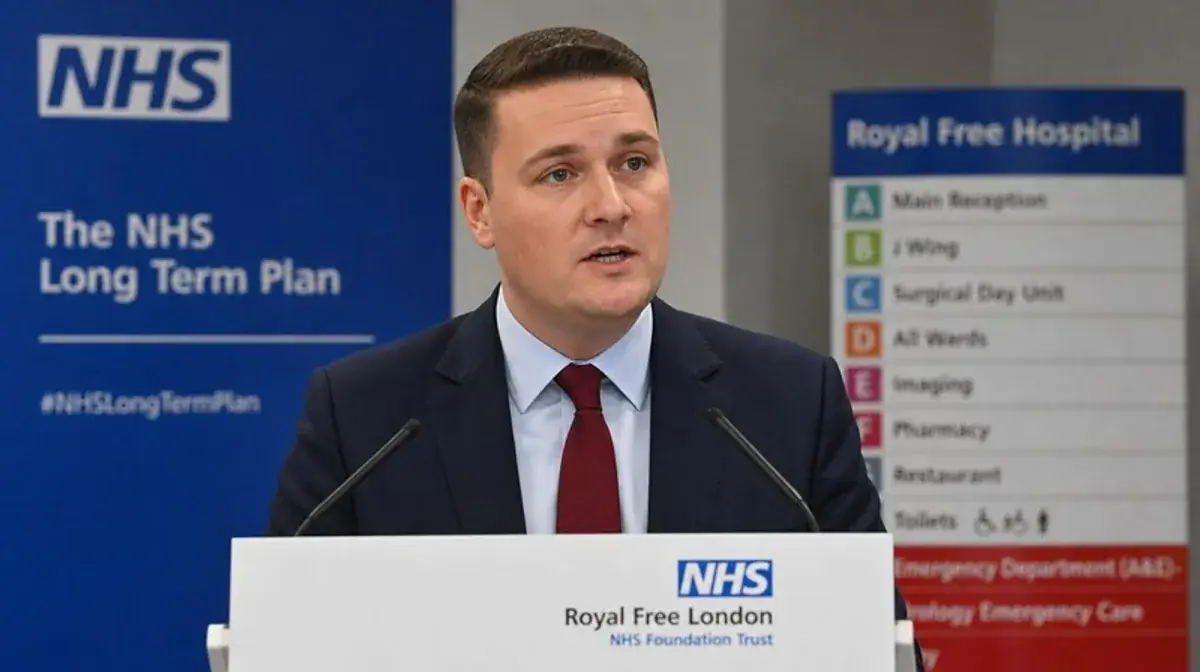
Public satisfaction with the NHS has fallen to its lowest level since Ipsos began tracking it in 1983. Seventy-eight per cent of GB adults now describe the health service as “struggling” or “in crisis,” and for the first time in decades, Labour no longer holds a commanding lead as the party most trusted to manage it.
The Waiting List Reality
The headline statistic that defines the NHS debate is the elective waiting list. At its peak in September 2023, 7.77 million patients were waiting for treatment in England. By March 2026, NHS England data shows that figure has declined to 7.2 million — progress, but well below the trajectory implied by Labour’s pre-election commitments. At the current rate of reduction, the waiting list will not return to its 2019 level (4.4 million) until well into the 2030s.
Beyond the headline number, the composition of the waiting list matters. The number of patients waiting more than 52 weeks for treatment stood at 290,000 in March 2026 — down from a peak of 400,000 in 2022 but still vastly higher than the near-zero figure recorded before the pandemic. Patients awaiting orthopaedic procedures, ophthalmology, and diagnostic tests account for the bulk of the longest waits.
Public Satisfaction: A 40-Year Low
The British Social Attitudes (BSA) survey, published in February 2026, recorded overall NHS satisfaction at 24% — down from 29% in 2024 and 36% in 2022. The 2025 figure of 24% is the lowest in the survey’s 40-year history, surpassing the previous low of 26% set in 1997. Ipsos’ monthly tracker, which uses a slightly different question, shows 41% satisfaction as of April 2026 — also a record low on that series.
Dissatisfaction is not evenly distributed. Among those who have used NHS services in the past 12 months — a group that includes the oldest and sickest patients — satisfaction is higher (38%) than among those who have not used the NHS recently (19%). The latter group may be forming their views based on media coverage and secondhand accounts rather than direct experience, which tends to amplify negative perceptions.
Party Trust on the NHS: Labour’s Lead Has Collapsed
The structural political consequence of the NHS crisis is the erosion of Labour’s ownership of the issue. In the 2024 general election, YouGov found Labour leading the Conservatives on NHS trust by 34 points. In a May 2026 Savanta poll, that lead has narrowed to 17 points (Labour 29%, Conservatives 12%) — still a lead, but roughly half of what it was at the point of Labour’s election victory.
More troublingly for the government, 23% of respondents in the same poll said “none of the parties” could be trusted to improve the NHS. This “none of the above” response is a proxy for deep disillusionment and has risen by eight percentage points since GE2024. Among over-65s — the cohort most dependent on NHS services — Labour’s NHS trust lead is now just nine points, compared to 28 points two years ago.
How Labour Is Blamed
A specific polling question asked who bears the most responsibility for the current state of the NHS. The results: the previous Conservative government (44%), the current Labour government (28%), NHS management (17%), underfunding over multiple decades (8%), other (3%). While the Conservatives still absorb the largest share of blame, Labour’s figure of 28% is strikingly high for a government that has been in office less than two years.
This finding reflects the high expectations Labour set for itself in opposition. When a party spends years promising to “fix the NHS in five years,” its voters apply that standard rigorously. The 28% who blame the current government are disproportionately drawn from Labour’s 2024 voter coalition, suggesting a degree of self-criticism among the party’s own support base.
What the Public Wants: Reform Appetite
Polling on NHS reform suggests the public is willing to countenance structural change. When asked whether they would support allowing patients to use NHS funding to access private treatment (a form of voucher system), 54% expressed support in principle, with 29% opposed and 17% unsure. This is a significant shift: in 2019, the same question produced 41% support and 42% opposition.
The growing openness to private-sector involvement is not yet translating into support for any specific party’s reform plans — partly because no party has yet proposed a detailed reform programme. But it represents a potential political opening for whichever party credibly addresses waiting lists first. For now, the data shows a health service in distress, a public dissatisfied, and a government that has not yet found the messaging or the policies to turn the story around. Track NHS-related polling at our issues tracker.
Related: NHS polling tracker → • Labour party profile →