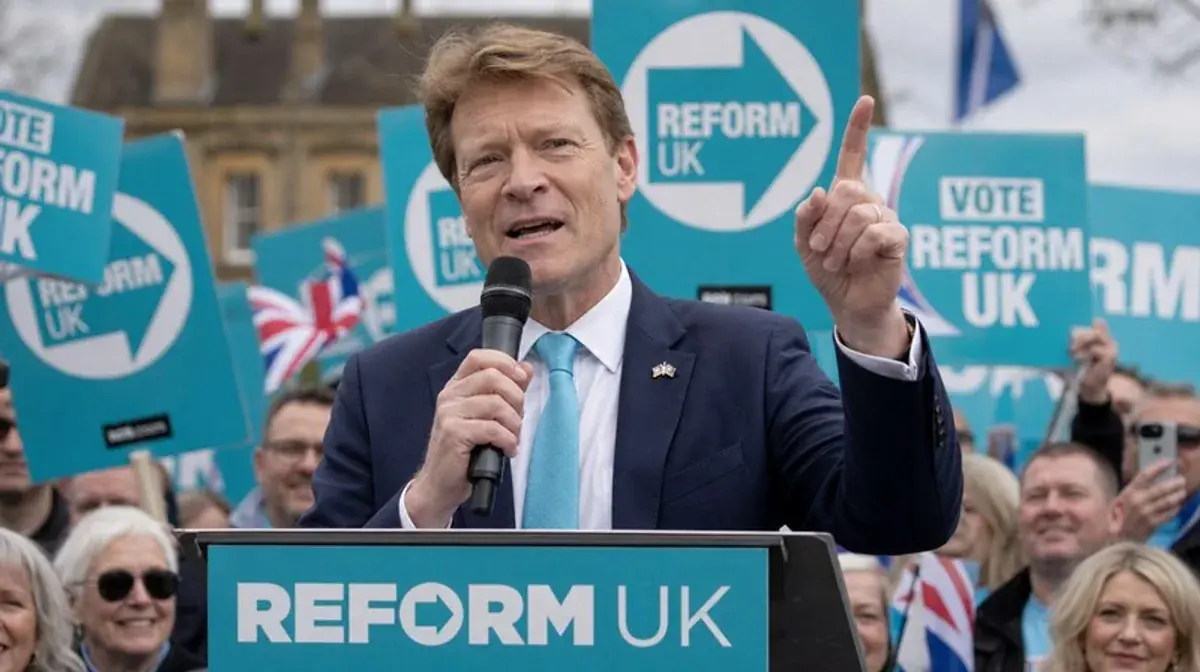
The 1 May 2026 local elections delivered a seismic shift in English local government. Reform UK gained over 1,000 council seats across England, taking the party from near-zero local representation to a genuine local government force with more than 200 councillors. For context, UKIP — which polled 12.6% at the 2015 general election — never controlled a single English council and entered the 2017 election with fewer than 150 local councillors nationwide.
The Scale of the May 2026 Local Gains
The May 2026 local elections covered county councils, district councils, and unitary authorities across large parts of England. Approximately 4,400 council seats were contested. Reform UK fielded candidates in over 3,000 wards — a significant organisational achievement for a party that barely had a local branch structure two years ago — and won approximately 1,050 of them. This equates to a local election vote share of approximately 30%, higher even than Reform's already elevated national polling.
Labour lost over 800 council seats, its worst local election performance since the party was founded. The Conservatives lost approximately 400 seats, having already suffered heavily in the 2022 and 2023 local elections under Boris Johnson and Rishi Sunak respectively. The Liberal Democrats gained approximately 300 seats and the Greens gained around 150, both largely at Conservative expense in their respective strongholds. The net result was a radical reshaping of English local government.
The most striking outcomes were in councils that Labour had held since the 1990s. In several East Midlands districts, Reform UK took outright control — becoming the first party other than Labour or the Conservatives to govern these councils in living memory. In Yorkshire and the Humber, Reform went from zero representation on several councils to becoming the largest single group, though not always with outright control. Full local elections 2026 data is here.
Where Reform Won — The Geographic Pattern
Reform UK's local election success was geographically concentrated but not uniformly distributed. The party performed strongest in rural and semi-rural English councils with high proportions of non-graduate voters, particularly in Lincolnshire, Nottinghamshire, Derbyshire, County Durham, and parts of Essex. These are areas where traditional working-class communities voted Labour into the 1990s or 2000s, then began moving Conservative from 2010 onward, and have now moved further right to Reform.
Reform performed relatively weakly in major urban centres. In Manchester, Leeds, Sheffield, and Birmingham, the party gained individual wards but failed to mount serious challenges for council control. London was the weakest region for Reform, where the party polled around 12–15% in local contests, well below its national average. This urban-rural split in Reform's local performance mirrors the demographic profile of its national polling support and confirms that the party's path to Westminster seats lies through specific types of English constituency.
One notable exception to the urban pattern was in coastal towns and dormitory suburbs — places like Thanet in Kent, Great Yarmouth in Norfolk, and parts of Essex just outside London — where Reform polled strongly even in areas with higher owner-occupier rates and less traditional industrial working-class identity. These are voters motivated by different concerns (cost of living, housing, cultural change) than the Midlands/Northern Reform voter but arriving at the same political destination.
Reform in Power: What Happens When They Actually Govern
Reform's new councillors now face the hardest challenge any insurgent political movement encounters: governing. Local councils in England have limited fiscal powers — they do not control immigration, welfare, or national economic policy, which are the issues driving Reform's national support. What they do control is planning decisions, local services, bin collections, social care commissioning, and housing development approvals. These are areas where ideological positioning is often less important than operational competence.
Early signals from newly Reformed-controlled councils have been mixed. Several have moved quickly on planning decisions to approve housing development that previous Labour-controlled councils had blocked, winning some local approval. Others have attracted controversy over social media statements by individual councillors and disputes about meeting procedures. The learning curve for a party that has never administered anything is steep, and local government officers — professional civil servants who serve whatever administration wins control — report varying levels of preparedness among the new Reform intake.
Whether Reform's local government performance helps or hurts its national polling over the next three years is genuinely uncertain. Competent local delivery would provide a “proof of concept” that the party can govern responsibly, addressing the electability doubts that shadow it at Westminster level. Poor local government performance — financial mismanagement, internal splits, or failed policy experiments — could become the ammunition Labour needs for a national recovery narrative. The full local elections analysis page tracks council control changes.
Building the 2029 Candidate Pipeline
Perhaps the most strategically significant consequence of Reform's 2026 local breakthrough is structural rather than symbolic: the party now has a pool of 200+ elected officials who can be trained, profiled, and selected as parliamentary candidates for 2029. This matters enormously. UKIP's repeated failure to convert polling leads into Westminster seats was substantially attributed to candidate quality — in a first-past-the-post system where local name recognition and campaigning competence matters, fielding a previously unknown candidate in a key marginal is a significant disadvantage.
Reform's national leadership has been explicit about using the 2026 local elections as a candidate identification exercise. Councillors who perform well locally over the next three years — staying out of controversy, building community profiles, attending local events — will be prioritised as parliamentary candidates in the constituencies most likely to return a Reform MP in 2029. This is exactly the strategy the Conservatives used in the 1990s under William Hague and Michael Howard to rebuild their candidate infrastructure after the 1997 landslide wipeout.
The party's internal training programme for new councillors, reportedly led by a team with Conservative central office experience, runs monthly sessions on council procedure, media handling, and constituency work. Whether this professionalisation effort is sufficient to prevent the kind of individual councillor controversies that have damaged UKIP, the Brexit Party, and other populist movements in their early phases remains to be seen. Track Reform's national polling trajectory at the Reform UK party page.
The National Polling Bounce from Local Success
Reform's national polling moved sharply upward in the two weeks following the 1 May local elections. YouGov's tracker, running at 25% immediately before polling day, rose to 28% in the 5–7 May wave — a three-point jump that represents the direct bounce from media coverage of the local results and the legitimising effect of widespread electoral success. Winning councillors normalises a party in the public eye in a way that protest polling alone cannot.
Whether the bounce is sustained beyond the initial media cycle is the critical question. Historical precedent from UKIP in 2013–14 (when the party won over 150 council seats and saw a similar bounce in national polling) is instructive: the boost lasted approximately three months before fading as the party disappeared from front pages and governing realities asserted themselves. Reform's position is stronger than UKIP's was — it has more seats, more media presence, and a better-known leader — but the structural dynamic of mid-term protest polling is similar.
The most important metric to watch is whether Reform can maintain 28%+ through the autumn and winter of 2026 without a specific external event driving coverage. If it can, that would suggest the party has reached a durable new base rather than a temporary protest peak. The voting intention tracker is updated weekly and will capture this trajectory in real time.