The Scottish Parliament election in May 2026 is the most significant Scottish vote since the 2014 independence referendum. Polls show an SNP on course for a minority government, a resurgent Scottish Labour, and independence support hovering either side of 50%.
The Polling Picture: SNP Lead Under Pressure
Scottish Parliament polling for the constituency vote shows the SNP averaging 33–35%, Labour at 26–28%, Conservatives at 14%, Greens at 9%, and Lib Dems at 7%. In the regional list vote, the SNP averages 29%, Labour 24%, Greens 12%, Conservatives 13%, Alba 4%. The mixed-member proportional system at Holyrood means these figures translate differently into seats than a straight FPTP calculation.
Most seat projection models give the SNP approximately 55–65 MSPs (down from 64 at the 2021 election), Labour 35–45 MSPs, the Conservatives 22–28, Greens 7–10, Lib Dems 4–6, and Alba 2–4. On these projections no party reaches 65 — the majority threshold — and an SNP minority government becomes the most likely outcome.
Labour’s Scottish Revival
Scottish Labour’s surge is one of the most significant polling stories in British politics. The party was almost obliterated in Scotland between 2015 and 2021, winning just 22 and 24 Holyrood seats in successive elections as the SNP dominated. The 2024 Westminster election provided the first evidence of a Labour recovery: the party won 37 Scottish seats, more than in any election since 1997.
Anas Sarwar’s leadership of Scottish Labour has been credited with the recovery. His positioning is deliberately focused on public service delivery — NHS waiting lists, school standards, poverty — rather than constitutional politics. By refusing to make the election a referendum on independence, he has made it easier for Scottish voters to consider Labour on policy grounds.
Independence: Still 50/50
Independence polling is the most closely watched metric in Scottish political analysis. The latest aggregates show Yes at approximately 48–51% and No at 49–52% — well within the margin of error and consistent with the deadlock that has persisted since 2021. There is no polling evidence of a sustained Yes majority, and equally no evidence that No is opening up a comfortable lead.
Younger voters (under 40) support independence by around 58–62%; older voters (over 65) oppose it by 62–66%. This age gradient is the structural fact that both sides monitor closely. See full Scottish independence polling →
The SNP Under Swinney
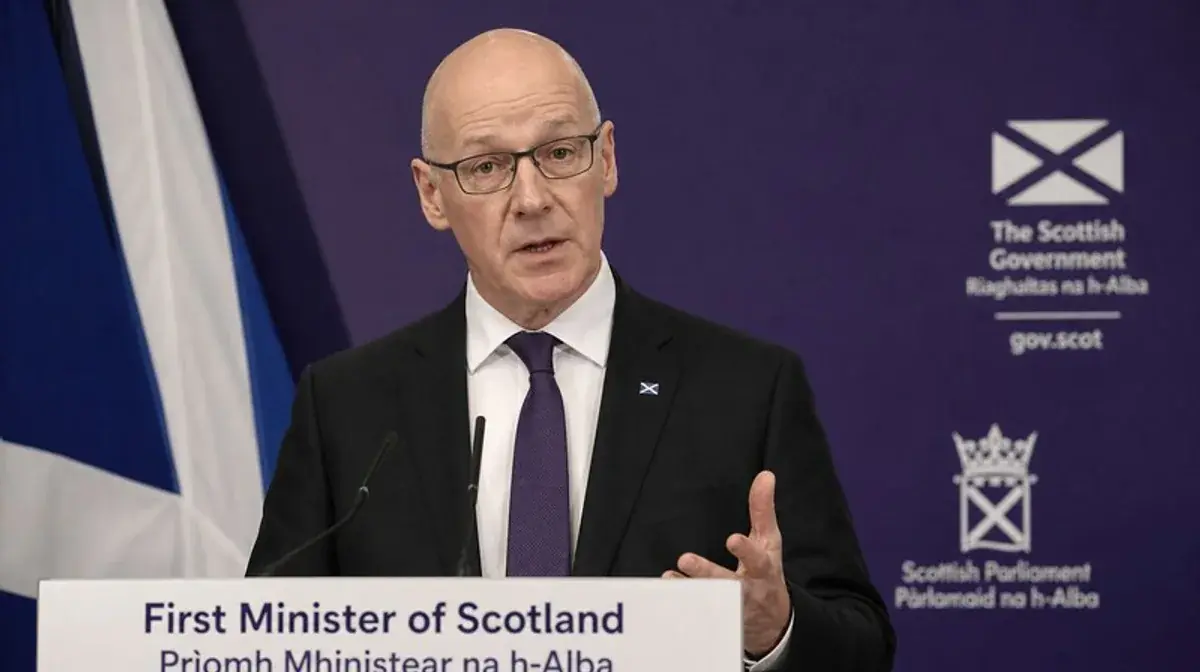
John Swinney’s return to the SNP leadership in 2024 was a stability play after a turbulent period: Nicola Sturgeon’s resignation, Humza Yousaf’s short and difficult tenure, and the police investigation into SNP finances. Swinney’s approval rating in Scotland is mildly positive (+4% in Holyrood-focused polling), benefiting from his experience and steady-state reputation.
But the SNP’s policy record in government — particularly on the NHS and education, where Scotland has underperformed England on some metrics despite higher per-capita spending — gives Labour attack lines that Sarwar has used effectively.
What the Result Means for Westminster 2029
The Holyrood 2026 result will have direct implications for the 2029 Westminster general election. An SNP minority government that struggles to govern effectively could further erode the party’s Westminster vote, consolidating Labour’s 2024 gains in Scottish constituencies. In a hung parliament at Westminster, even the difference of 5–10 Scottish SNP seats could determine who forms the government. Track GB-wide voting intention →