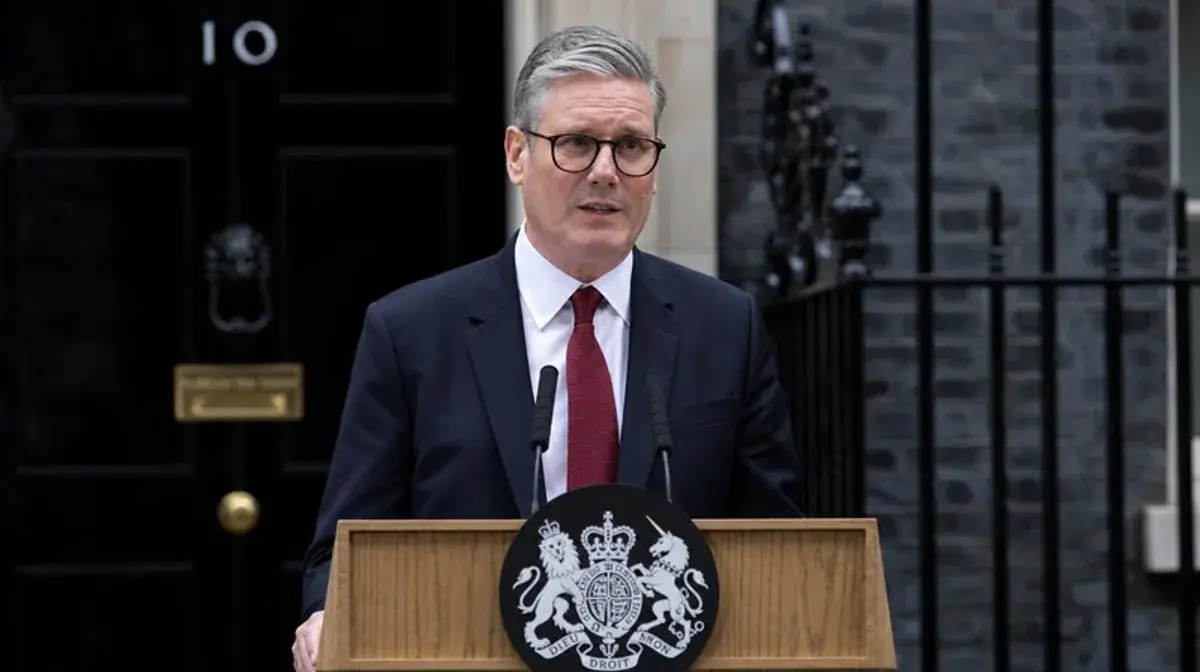
When Keir Starmer entered Downing Street in July 2024 with a landslide majority, his personal approval rating stood at approximately −3% — low for a new prime minister but not alarming. By May 2026 it has deteriorated to −44%, making him, paradoxically, the least popular of the three main party leaders despite holding the largest parliamentary majority in decades.
The Approval Trajectory: A Steady Decline
Starmer’s approval ratings followed a pattern familiar from modern prime ministers: a brief plateau, then a sustained fall. Unlike Tony Blair in 1997 or Boris Johnson briefly in 2019, there was no meaningful honeymoon. By September 2024, with the government’s decision to means-test the winter fuel payment already generating significant backlash, his net approval had fallen to −12%.
The autumn 2024 Budget accelerated the decline. Employer National Insurance rises and the reduction in the inheritance tax agricultural relief proved deeply unpopular in focus groups and were reflected almost immediately in tracker polling. By January 2025, Starmer sat at −22%. By the summer of 2025, as NHS waiting lists showed no signs of falling, he was at −28%. The latest YouGov data, collected in the first week of May 2026, puts him at −44% (23% approve, 67% disapprove). The Peter Mandelson ambassadorship affair, which broke shortly after this data was collected, would go on to compound the damage further.
The Winter Fuel Payment: A Defining Controversy
The decision to restrict the winter fuel payment to pensioners already receiving pension credit — removing it from approximately 10 million households — was the first major moment of political damage. The policy was defensible on fiscal grounds, but its announcement came without adequate preparation or messaging, and the image of a new Labour government immediately cutting a benefit associated with pensioner welfare proved lasting.
Polling from Ipsos conducted in October 2024 found 62% of the public opposed the cut, including 49% of Labour’s own 2024 voters. Among over-65s, the group most likely to vote, opposition ran at 74%.
NHS Waiting Lists: The Promise That Has Not Materialised
Labour’s central pitch at GE2024 was built substantially on NHS performance: the waiting list of 7.5 million would be tackled, elective care would recover, and the health service would be put on a sustainable footing. Eighteen months into the government, the waiting list has not fallen materially. Data from NHS England for March 2026 shows 7.2 million patients on the elective waiting list — a modest improvement from the peak but far from the implied trajectory.
Polling consistently shows the NHS as the most important issue for voters, and on that issue trust has not shifted in Labour’s favour. A May 2026 Savanta poll found that only 28% of the public trusted Labour to improve the NHS — a deeply disappointing number given the party’s historical ownership of the issue.
Cost of Living: The Persistent Drag
Food prices remain approximately 28% above their 2021 level in nominal terms. Energy bills, while below the 2022 peak, have not returned to pre-crisis levels. For most households, the experience of the cost of living crisis has not resolved — it has simply stopped getting worse. This is politically very different from recovery: 58% of voters in a March 2026 YouGov poll said they were “worse off than when Labour took office,” against 14% who said better off.
Comparisons: Badenoch at −15%, Farage at −15%
The counterintuitive aspect of Starmer’s position is that both main opposition leaders are significantly more popular than the sitting prime minister. Kemi Badenoch, who took over the Conservative leadership in November 2024, polls at a net approval of approximately −15% — unusually strong for a new opposition leader — driven by the perception that she is authentic and ideologically coherent even among voters who disagree with her.
Nigel Farage also polls at −15% net approval nationally, with 35% approving and 50% disapproving. This number conceals a deeply polarised picture: among Reform voters his approval is +78%; among Labour and Conservative voters it is deeply negative. Starmer’s −44% is more evenly spread, suggesting generalised disenchantment rather than purely tribal opposition.
Does It Matter? Approval vs Vote Share
Leader approval ratings are correlated with, but not determinative of, voting intention. Labour remains on 18% in national polls despite Starmer’s deeply negative numbers, partly because voters distinguish between party and leader, and partly because there is no obvious alternative destination for traditional Labour voters not prepared to back Reform. However, leaders polling below −30% rarely recover without a major policy change or external event — and with 2029 approximately three years away, the window is narrowing.