In 2019, Boris Johnson’s Conservatives won 43.6% of the vote and an 80-seat majority. Seven years later, roughly one in three of the 14 million voters who backed that historic result have transferred their allegiance to Reform UK. It is the most consequential right-flank defection in British political history.
The Scale of the Collapse
In May 2026 polls, the Conservatives average 19% nationally. Cross-tab analysis of 2019 vote recall shows that approximately 35% of 2019 Tory voters now identify with Reform, 22% have moved to Labour, 12% to the Lib Dems, and 8% to the Greens. Only around 45% remain with the Conservatives — a party retention rate that is historically unusual outside of electoral disasters.
Translated into raw numbers: of the approximately 13.9 million people who voted Conservative in 2019, around 4.9 million are now backing Reform in polls. Around 3 million have moved left to Labour, and around 1.7 million to the Lib Dems. Fewer than 6.5 million 2019 Tory voters remain with the party.
Who Are the 2019-to-Reform Switchers?
Demographic profiling of 2019-to-Reform switchers reveals a consistent picture. They are disproportionately older (over-55), male, non-graduate, and located in non-metropolitan England. They voted Leave in 2016 and feel that the Conservative governments of 2019–2024 failed to deliver on the promise of Brexit — specifically on immigration, which they name as their primary concern.
A secondary but significant group are younger male voters who are new to right-wing politics and were attracted to Reform by Farage’s online presence and the party’s anti-establishment positioning. This group overlaps with young working-class men who have shifted sharply rightward in polling across multiple countries.
The Badenoch Factor
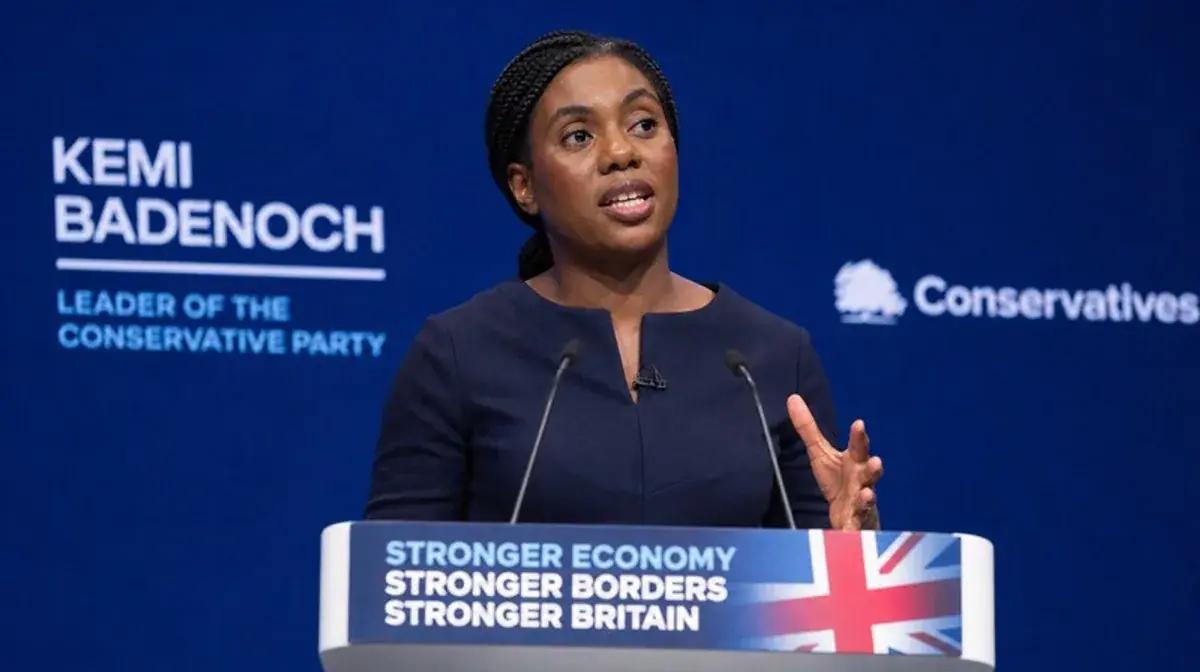
Kemi Badenoch became Conservative leader in November 2024 with a brief to renew the party and draw a sharp line under the Johnson-Truss-Sunak era. Her early months produced a modest improvement in Conservative polling, rising briefly to 22% in January 2025. But the improvement was not sustained: by spring 2026 the party had fallen back to 18–20% as Reform’s local election strength demonstrated the party was a credible governing force rather than a protest movement.
Polling shows Badenoch has a negative net approval (−15%) but is considerably better regarded than her immediate predecessors among those who still identify as Conservative. Her challenge is a vicious circle: to win back Reform voters she must move right, but moving right validates Reform’s pitch that the Conservatives are merely following where Farage leads. The scale of that pull was underlined when Robert Jenrick, once seen as a Conservative who could hold the party’s right flank, defected outright and became one of Reform’s most prominent frontline defenders — a shift tested directly in a combative Sky News interview over whether Farage had become a liability.
Are These Voters Recoverable?
When pollsters ask 2019-to-Reform switchers whether they could vote Conservative again, the results are discouraging for CCHQ. Around 22% say they would consider switching back if the Conservatives adopted stronger policies on immigration; 58% say they would not switch back regardless of policy. The share who say policy changes could bring them back has fallen steadily since 2024, suggesting that brand damage is compounding over time.
More in Common analysis identifies this as a values-identity problem rather than a policy problem. Many switched voters have adopted “Reform voter” as a political identity, not just a voting preference. Changing their vote requires changing their self-conception — a much harder political task than shifting on a single issue.
What This Means for 2029
If 1 in 3 2019 Tory voters remain with Reform through to polling day in 2029, the Conservatives face an existential arithmetic problem. Their path to being the largest party requires winning back votes from at least two directions simultaneously — from Labour in seats they need to regain, and from Reform on their right. MRP modelling suggests that at 19%, the party is on course to win fewer than 100 seats — a number that would make a Conservative-led government mathematically impossible even with coalition partners. See hung parliament scenarios →