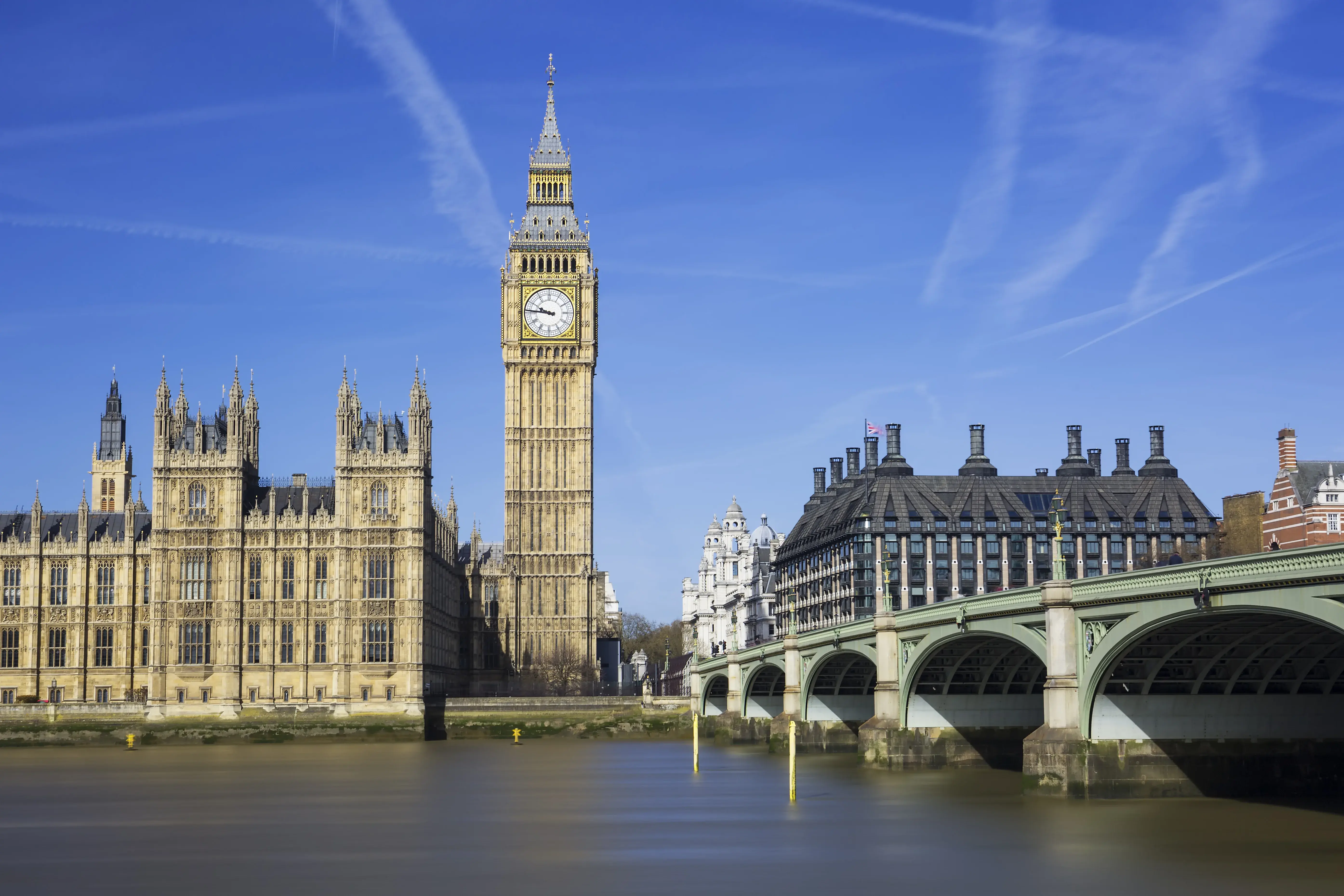
With three years still to run until the next scheduled UK general election in May 2029, the current polling landscape points toward an extraordinary outcome: a hung parliament, a fragmented right, and a Labour Party defending an almost indefensible majority. Here is what the best available models say — and what they cannot yet tell us.
The Raw Polling Numbers in May 2026
The May 2026 polling average — taken across YouGov, Ipsos, Survation, Redfield & Wilton, and More in Common — puts Reform UK on 28%, the Conservatives on 19%, Labour on 18%, the Greens on 15%, the Lib Dems on 13%, and the SNP on 3%. These are the most fragmented UK polling numbers on record. No single party reaches even 30%, and the combined centre-left bloc (Labour + Greens + Lib Dems) sits at 46% compared to the combined right (Reform + Conservatives) at 47%.
The headline figures represent a collapse from Labour's 34% vote share at the 2024 general election and a transformation for Reform, which won just 14% of votes in 2024 and five seats. The Greens have doubled from around 7% at GE2024 to 15% now, reflecting both the collapse of Labour and a shift among young, urban progressive voters who see the Greens as a more authentic left-wing option.
Context matters: mid-term polling has historically over-stated protest vote and under-stated incumbent recovery. At this stage of the 1997–2001 cycle, Labour was polling around 40% and still won a landslide. The 2010 election saw Conservative leads of 17 points in 2008 compress to just seven by polling day. Still, the scale of Labour's decline — from majority to third place in under two years — is historically unprecedented. See the full voting intention tracker.
From Votes to Seats: The MRP Picture
Translating vote shares into seats under first-past-the-post requires MRP (Multilevel Regression and Poststratification) modelling, which adjusts national uniform swing for local demographic and geographic variation. The three leading MRP models currently available — from YouGov, More in Common, and Electoral Calculus — differ in their assumptions but converge on a similar broad picture: a hung parliament with no party close to a majority of 326 seats.
On the current polling averages, the central estimate puts Reform UK on 85–110 seats, Labour on 210–245, the Conservatives on 95–120, the Lib Dems on 70–85, the Greens on 5–12, and the SNP on 18–24. The seat gap between Labour and Reform, despite Reform leading on votes by ten percentage points, reflects the geographic concentration problem: Reform's vote is spread evenly across England, giving it large minorities in hundreds of seats but majorities in few. Labour's vote is concentrated in urban constituencies where it piles up massive majorities that contribute nothing to additional seats.
The Lib Dems are the quiet winners of these models. Their vote is concentrated in a specific type of constituency — affluent, southern, formerly Conservative — allowing them to convert 13% of the national vote into 70–85 seats. By comparison, the Greens, with 15% nationally, might win just 5–12 seats because their support is spread across urban constituencies where they run second or third to Labour. Full MRP analysis here.
Government Formation Scenarios
In a hung parliament on these seat projections, government formation becomes complex. A Labour–Lib Dem coalition would require roughly 300 seats combined — achievable on current models but giving Labour a weak negotiating position given the disparity in vote loss. The Lib Dems might demand proportional representation as their price, which Labour has historically refused. A Labour minority government, relying on Green and SNP confidence and supply, is also modelled but would be institutionally unstable.
A Reform–Conservative arrangement is mathematically possible if their combined seat totals reach 326. However, Kemi Badenoch has repeatedly ruled out any formal arrangement with Nigel Farage. Whether that position survives the arithmetic of a real hung parliament — particularly if Farage is no longer Reform leader by 2029 — is a genuine open question. Informal confidence and supply, as the DUP provided to Theresa May in 2017, without a formal coalition, is the most plausible right-of-centre scenario if the numbers require it.
A further scenario is an early election called by Labour if the government's position becomes untenable. Labour's large majority means it can lose over 80 seats and still govern; the polling at this stage suggests it might lose 150–180. An early election would only make sense for Labour if a dramatic polling recovery precedes it, which cannot be ruled out but is not the central forecast. Track government approval ratings on the leader approval page.
The Three-Year Recovery Question
The most important unknown in any 2029 forecast is whether Labour can recover. The historical base rate for governing party recovery is genuinely encouraging: in 18 of the last 20 UK elections, the governing party's final vote share was higher than their worst mid-term poll. The average mid-term to polling-day swing back to the government is approximately eight percentage points. For Labour, that would put them at around 26% — still a historic low, but closer to the Conservatives and Reform.
The pessimistic case for Labour is structural rather than cyclical: if the working-class, non-graduate voter who backed Labour from 1945 to 2019 has permanently realigned toward Reform — as the non-graduate polling cross-tabs suggest — then there is no mid-term bounce available. Labour would need to win back those voters by delivering tangible economic improvements in communities that were sceptical of the party before the 2024 win. The window for that delivery is narrowing with each quarter of disappointing growth figures.
For Reform, the challenge is the inverse: maintaining support through three more years of parliamentary scrutiny and by-election performance, while transitioning from a protest vehicle to a credible governing alternative. Historical parallels with UKIP — which also led briefly in national polls in 2014–15 before collapsing — are the counter-evidence. But Reform has Nigel Farage as a figure without parallel in post-war British politics. Track all party numbers on the parties overview.
Key Seats and Battlegrounds to Watch
The 2029 battleground is already taking shape. MRP models identify approximately 120 seats where the contest is effectively between Reform UK and Labour — constituencies in the East Midlands, Yorkshire, the North East, and parts of the North West where Reform is running second on 30–35% and Labour is defending with 35–40%. These seats will determine whether Labour loses its majority or suffers a wipeout comparable to the Conservatives in 1997.
A second battleground involves around 80 seats where the Conservatives are defending against Liberal Democrat challengers — the “Blue Wall” that partially crumbled in 2024 and where the Lib Dems are strongly placed to complete the demolition job. These seats matter enormously for the Conservatives' survival as a parliamentary force of significance. If they lose another 30–40 of these on top of their 2024 losses, they could fall below 80 seats.
Scotland adds further complexity via the SNP, which could recover Scottish seats if its current polling decline reverses. A second independence referendum, if called before 2029, would scramble all Scottish VI figures and seat projections entirely. The current polling snapshot is a starting point, not a destination. The full 2029 forecast page with seat-by-seat projections is at Marginal seats → • elections/general-2029/.
Related: 2029 election page → • MRP seat projections → • VI tracker → • All parties →