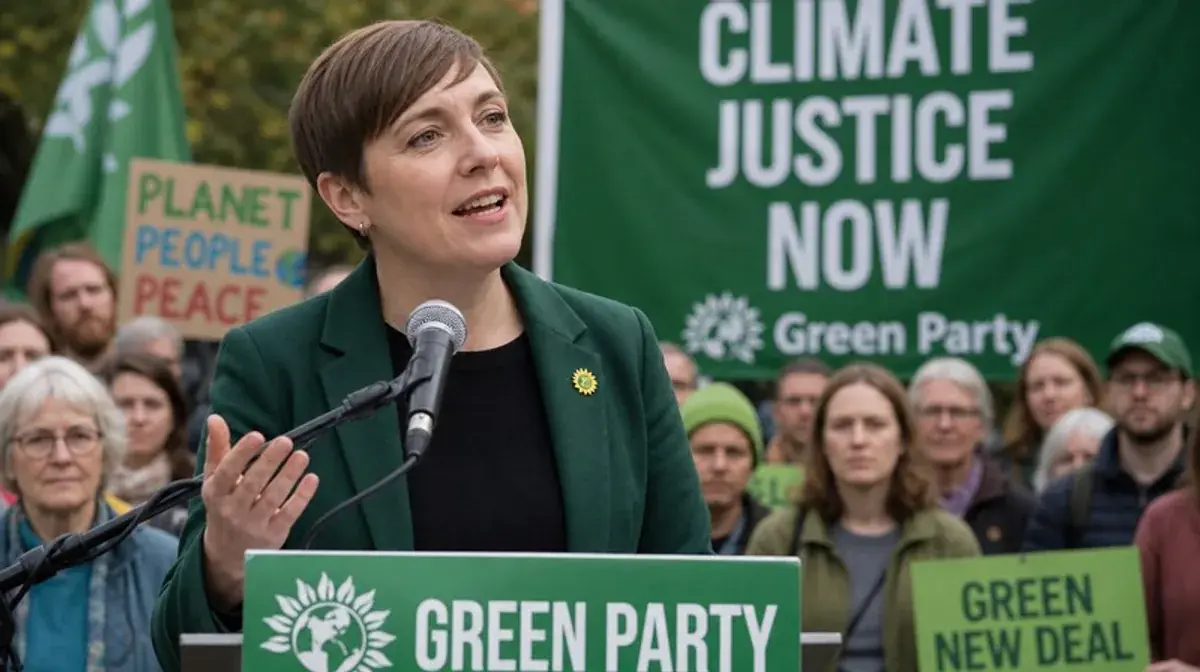
In July 2024, the Green Party achieved its best-ever general election result: 6.7% of the vote and four MPs, including co-leaders Carla Denyer and Adrian Ramsay. It was a historic breakthrough. Yet by May 2026, that already impressive figure looks like a floor rather than a ceiling. The party is now polling at 15% in GB-wide voting intention surveys, making it the fourth-largest party by support and creating genuine pressure on Labour from its left flank for the first time in a generation.
The 2024 Baseline and What Made It Possible
The Greens’ 2024 result was built on a decade of patient local campaigning, particularly in Bristol, Brighton, and Norwich. The party had won its first council majority in Bristol in 2021 and built a substantial councillor base that gave it the organisational infrastructure and name recognition to convert national support into local votes. Denyer’s victory in Bristol Central, and Ramsay’s in Waveney Valley, demonstrated that the party could win in different types of seat: an urban university constituency and a rural/semi-rural Norfolk seat respectively.
The national 6.7% was significantly driven by tactical de-mobilisation: Labour-leaning voters in unwinnable Labour seats chose to lend their vote to the Greens as a signal of protest. The key question after 2024 was whether those lent votes would come back to Labour once Labour was in government. The answer, as of 2026, is emphatically no.
By October 2024, the Greens were already polling at 9%, reflecting the immediate disillusionment of the Labour left with the winter fuel payment cut and the continuation of policies on Gaza that Green voters found unconscionable. That 9% itself felt like a high-water mark to many analysts. The climb to 15% over the following 18 months was driven by a different and more structural dynamic.
The Labour Left Migration: Issue by Issue
The Green surge since early 2025 is almost entirely accounted for by former Labour voters. Cross-breaks in YouGov and Savanta polling from April 2026 show that approximately 62% of current Green voters backed Labour in 2024. The issues driving their switch follow a consistent pattern: climate policy, Gaza, public service spending priorities, and a sense that Labour in office is indistinguishable from a centrist Conservative government.
On climate, the disappointment is specific. Labour’s Clean Power 2030 target has slipped to a projected 2031–32 delivery, and planning delays on offshore wind have attracted substantial criticism from the climate movement. The Greens have been explicit and uncompromising in their criticism, arguing that Labour’s planning reforms prioritise developer interests over environmental protection. Among voters who rank climate as their top issue, the Greens now lead Labour by 24 points.
On Gaza, the Green Party’s consistent and explicit advocacy has made it the natural home for voters who were politically mobilised by the conflict and found Labour’s position inadequate. This is a particularly significant driver among younger Muslim voters in urban areas, who in 2024 had been expected to return to Labour but have instead consolidated behind the Greens and independent candidates. In polling sub-samples covering British Muslims, the Greens score above 30%.
Demographics: The 15% Coalition
The demographic profile of Green support in 2026 is sharply defined. Among under-35 voters, the party polls at 22%, making it the second-largest party in that age group behind only Reform UK. Among university-educated women aged 25–45, it scores 19%. Among urban renters, 24%. These are not niche demographics; they represent large portions of the electorate in precisely the urban and university constituencies where many of the most marginal seats are located.
Conversely, the Greens remain weak among over-50 voters (6%), working-class voters without a degree (7%), and voters in rural and semi-rural non-university seats (8%). This demographic concentration is both a strength and a strategic constraint: it generates high vote shares in specific areas but creates exactly the kind of geographic dispersion that first-past-the-post punishes.
How Many Seats? The MRP Problem
Converting 15% of the national vote into Commons seats under FPTP is the central strategic challenge for the Green Party. Current MRP seat projections suggest the Greens could win between 8 and 18 seats at a 2029 election held on current polling. That is a significant improvement on their current four, but it means that at least 85% of their national support generates no representation whatsoever.
The seats most likely to fall to the Greens are those where they already have strong local government bases and a 2024 near-miss: several Bristol constituencies, parts of East London, Norwich South, Sheffield Hallam, and potentially two or three South Coast seats. In each case, the path to victory involves the Greens consolidating a coalition of Labour defectors, younger voters, and existing Green loyalists while Labour fails to recover enough to win outright.
The party is also now a serious factor in Labour-held marginals beyond its target seats. In seats where Labour holds a majority of 8,000 or fewer, Green candidacies running at 10–12% local share could be the difference between Labour holding or losing — not to the Greens but to other parties. This creates an interesting dynamic in which the Greens have indirect power over the 2029 result well beyond their own seat count.
Can the Surge Last? Risks to Green Polling
Three factors could deflate the Green surge before 2029. First, a Labour policy pivot on climate or public spending that reabsorbs disillusioned left-leaning voters. Second, a general election campaign in which tactical voting calculations pull Green-leaning voters back to Labour out of fear of a Reform or Conservative win. Third, internal Green disunity if the party struggles to manage the expectations of a much larger support base.
Against these risks, the Greens have a structural asset they have not previously enjoyed: 15% polling before an election is above the threshold at which the party can credibly claim to be a governing proposition and expect media scrutiny to be proportionate to actual support. If that coverage is handled well — and Denyer and Ramsay have so far managed their profile more effectively than most Green leaders — the party may be able to sustain a floor above 12% even through a squeeze campaign. The question is whether a floor of 12–15% translates into 8–18 seats or just a historic moral victory in vote share terms.
Frequently Asked Questions
What is the Green Party polling at in 2026?
Approximately 15% in GB-wide voting intention surveys as of June 2026, more than double their 6.7% at the July 2024 general election. This represents one of the most rapid rises in the party’s history.
Why are the Greens rising in the polls?
Primarily disillusioned Labour voters on the left, especially younger voters and university-educated urbanites who feel Labour has abandoned commitments on climate, Gaza, and public services. 62% of current Green voters backed Labour in 2024.
How many seats could the Greens win in 2029?
Current MRP projections suggest between 8 and 18 seats. Their strongest prospects are in Bristol, parts of East London, Norwich South, Sheffield Hallam, and several South Coast constituencies where they have existing local government strength.
Which demographics drive Green support?
Under-35 voters (22%), university-educated women aged 25–45 (19%), and urban renters (24%). The Greens are the primary vehicle for left-of-Labour protest in metropolitan areas in 2026.