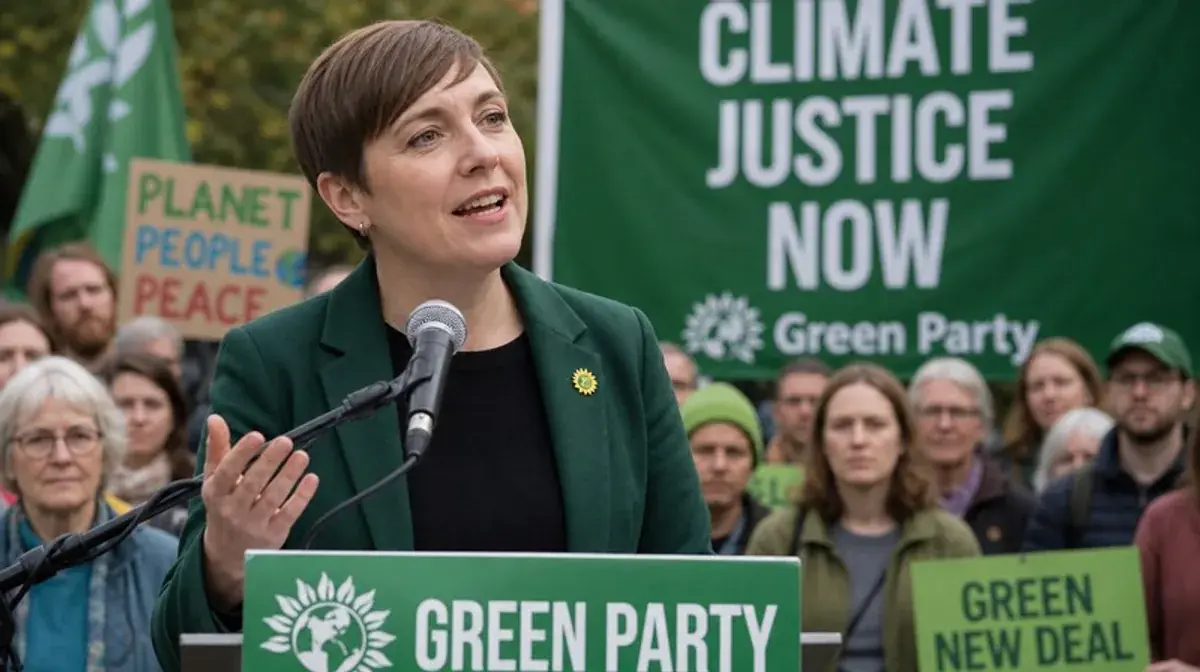
The Green Party of England and Wales is polling at 15% — the highest in its history and double its GE2024 result. Yet under Britain’s first-past-the-post system, electoral modellers project the party winning just 12 to 25 seats in 2029. The contrast encapsulates everything that is wrong, from a Green perspective, with the British electoral system.
The Conversion Problem: Why 15% Does Not Mean 95 Seats
Under a pure proportional representation system applied to the 650-seat House of Commons, 15% of the national vote would yield approximately 97 seats. Under FPTP, the relationship between vote share and seats depends entirely on where votes are concentrated. The Greens’ 15% is spread thinly: in most constituencies they are third or fourth, meaning their votes accumulate without winning seats.
In 2024 the Greens won 6.7% of the national vote for four seats. Reform UK won 14.3% for five seats. The Lib Dems won 12.2% for 72 seats. The difference: Lib Dem votes are geographically efficient, concentrated in winnable southern seats. The Green Party’s urban concentration is better than Reform’s rural spread, but not nearly as efficient as the Lib Dems’ target-seat machine.
The Target Seat Strategy
The Greens have identified 35 target seats for 2029, concentrating resources where their 15% is enough to compete for first or second. The clearest holds and gains look like this: Bristol Central (held by Carla Denyer, safe), Brighton Kemptown (marginal, currently Labour), Norwich South (marginal), Sheffield Central (target, strong Green second), Islington North (vacated by Corbyn, Green-Labour contest), and Bristol East (marginal Labour).
Beyond these 10–15 strongest targets, the Greens have a second tier of 15–20 seats where their vote share could reach 25–35% but might not translate to victory unless Labour also collapses locally. The total plausible range is 12 seats (if only the clearest targets win) to 25 seats (if Labour’s weakness enables more Green breakthroughs).
The Electoral Reform Imperative
No party has a stronger incentive to campaign for proportional representation than the Greens. Their public position — supporting a PR referendum as a condition of any post-election confidence and supply arrangement — is consistent with both their stated values and their electoral self-interest. Polling shows 54% of current Green voters name electoral reform as one of their top-three priorities.
In any 2029 hung parliament scenario, the Greens will demand a PR referendum as their price for supporting a Labour government. Whether Labour would concede a referendum on electoral reform to stay in power is the central coalition negotiation scenario of the next parliament.
Can Local Elections Help?
The Greens used the May 2026 local elections to build council presence in their target parliamentary seats. The party gained seats in Bristol, Brighton, Norwich, and Sheffield — exactly the cities where their parliamentary ambitions are highest. Each councillor elected represents a local organiser, a name on leaflets, and evidence of governing credibility. The Lib Dem model of winning Westminster seats from a solid local government base is one the Greens are consciously trying to replicate.
The party’s membership has grown to over 60,000 since 2024, and its fundraising has improved substantially. Whether this resource base is sufficient to contest 35 seats seriously will be tested across the next three years of by-elections and local contests.
The 2029 Green Ceiling
The honest answer for Green supporters is that 15% in national polls is likely to produce between 12 and 25 seats in 2029, whatever the party does. The system was not designed for five-party competition. A Green Party that wins 20 seats on 15% of the vote would nonetheless be a significant force in a hung parliament — enough to be a meaningful partner and to extract concessions on climate, housing, and electoral reform. See current polling →