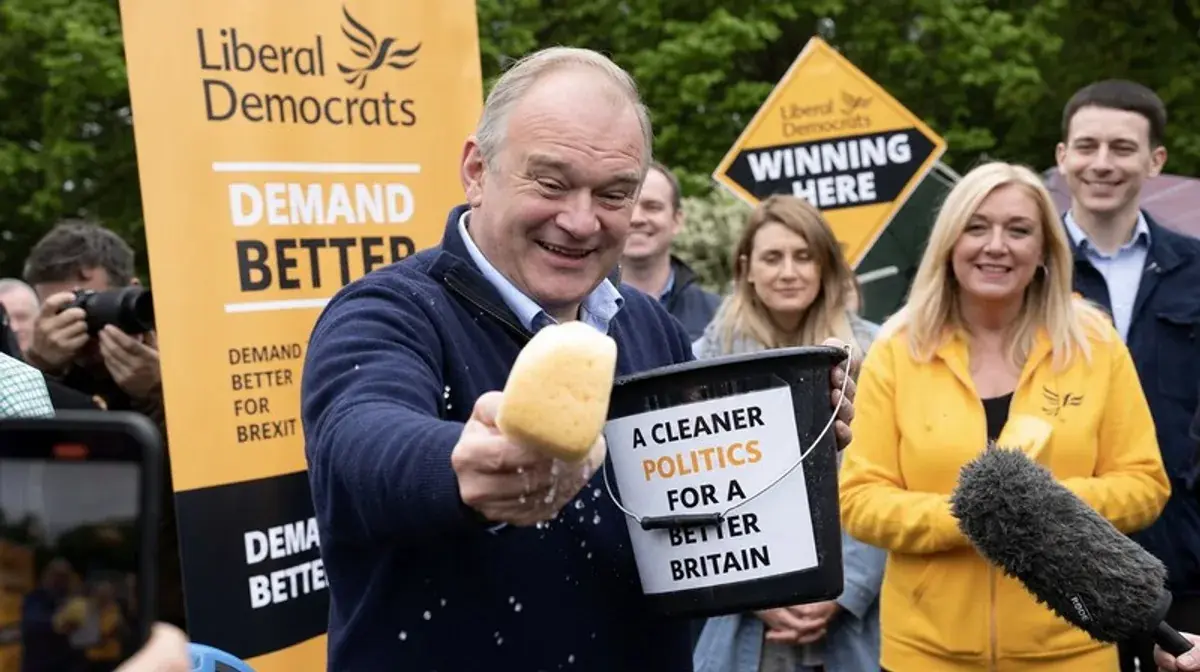
Liberal Democrat leaders rarely enjoy positive approval ratings. The party’s coalition government experience, various policy reversals, and perennial positioning challenges have made its leaders easy targets. Ed Davey’s +5% is therefore a statistical outlier — and understanding why he has achieved it reveals something important about the current political landscape.
The Historical Baseline
The YouGov net approval tracker for Lib Dem leaders tells a sobering story. Tim Farron, who led the party from 2015 to 2017, averaged −12% in his tracker score and faced persistent controversies about his personal religious views. He resigned the night after the 2017 election result, stating he could not reconcile being a faithful Christian with leading a liberal party.
Vince Cable, who led from 2017 to 2019, was respected as an economic sage but averaged −5% and struggled to generate media cut-through outside of his own expertise. Jo Swinson, who took over in 2019, started well (−3% on taking the leadership) but saw her rating collapse to −18% by election day 2019 after a bruising campaign in which her “revoke Article 50” position alienated many potential Remain-voter recruits.
What Davey Does Differently
Davey’s approach diverges from recent predecessors in three observable ways. First, he has largely avoided positioning the party on divisive culture war issues — the type of controversy that gave Farron his worst press. The Lib Dems under Davey campaign on local cost-of-living issues, NHS access, and housing in their target southern seats, making the party seem practical rather than ideological.
Second, Davey has systematically deployed personal storytelling. His accounts of caring for his disabled son John and his terminally ill mother give him a human dimension that policy documents cannot. Audience research consistently shows voters finding him “relatable” and “decent” — words rarely associated with politicians in the current era.
The Swinson Lesson: Overreach
Swinson’s collapse is the cautionary tale Davey’s team keeps visible. Her mistake was confusing high topline poll ratings (the Lib Dems briefly reached 23% under her leadership) with a mandate to make radical demands. The “revoke without referendum” policy alienated voters who supported Remain but felt the 2016 vote should be respected. Her own approval went from −3% on taking over to −18% in six months of heightened scrutiny.
Davey has explicitly learned from this. He has kept the party’s post-Brexit positioning deliberately vague, focusing instead on specific, granular issues that resonate in target seats: NHS dentistry access, planning reform, pothole-fixing, local GP availability.
The Farron Lesson: Identity Controversies
Farron’s difficulties stemmed from a mismatch between his personal beliefs and his party’s values — a tension that ultimately forced his resignation. Davey has avoided any equivalent controversy. His public persona is consistently liberal on social issues, warm on diversity, and focused on policy substance rather than personal conviction.
This careful positioning is partly structural: the political moment of 2026 focuses attention on immigration, the economy, and the NHS rather than social liberalism. But it also reflects a deliberate communications strategy to keep him on his strongest ground.
Can +5% Last Until 2029?
Three years of opposition carry their own risks. Davey’s +5% is partly a function of being less scrutinised than the governing party; as 2029 approaches and the Lib Dems’ 72 seats make them a genuinely significant political force, pressure on their positions will increase. The most likely threat to his approval is a hung parliament scenario in which he must make difficult coalition decisions publicly. How he handles that moment — with Clegg’s broken promises in recent memory — will determine whether the Davey bounce becomes a lasting Lib Dem renaissance. Full leader approval tracker →