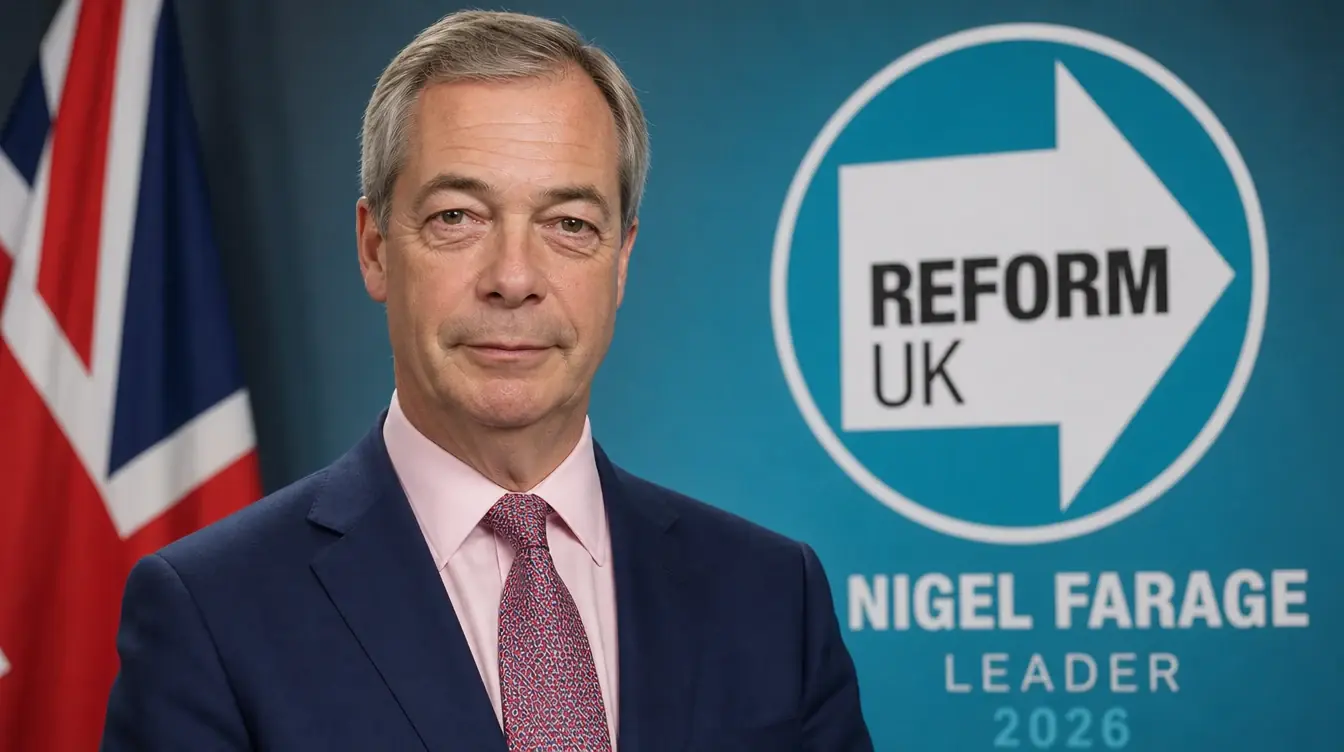
Reform UK is polling at 28% — first or joint-first in most surveys — and Nigel Farage is openly talking about Downing Street. But vote share and seats are very different things under Britain’s first-past-the-post system. We modelled the scenarios, ran the numbers, and asked the question that matters: what would it actually take for Reform to govern?
The Brutal Arithmetic of FPTP
The starting point is the 2024 election result. Reform won 14.3% of votes — 4.1 million people — and returned five seats. Labour won 33.7% and returned 412 seats. That disparity reflects the fundamental nature of first-past-the-post: votes that do not pile up in specific constituencies are mathematically worthless in terms of parliamentary representation.
Reform’s vote in 2024 was both enormous and geographically dispersed. The party came second in 98 constituencies but won only five, because its vote was spread thinly across hundreds of seats rather than concentrated to winning levels in any of them. To win seats, a party needs to reach 35–45% in specific constituencies, not average 28% nationally.
Current MRP projections based on 28% national polling suggest Reform could win between 70 and 120 seats in 2029. That is a massive increase from five seats and would make Reform the second-largest party. But it is still far short of the 326 needed for a majority in the 650-seat Commons.
What the MRP Models Actually Show
The most detailed seat-level modelling available, using May 2026 polling data, places Reform on approximately 95 seats at 28% national support — with a wide confidence interval of 60–130. The seats most at risk to Reform are Labour-held marginals in the East Midlands, Yorkshire, and the North East, plus Conservative seats in East Anglia and coastal England.
Under the most optimistic Reform scenario — 32% nationally with votes concentrated in target seats — models suggest the party could reach 150–180 seats. That would still leave it well short of a majority. Under the pessimistic scenario, Reform ends up with 50–70 seats despite its high national share.
The seat projection tracker currently shows Labour on approximately 280 seats, Reform on 95, Conservatives on 115, Lib Dems on 70, Greens on 12, and SNP on 28. No party is close to a majority. The 2029 election looks likely to produce another hung parliament.
Coalition Scenarios: Who Would Deal with Whom?
For Reform to enter government, it would need either to win a majority outright or to form a coalition. The only arithmetically plausible coalition partner is the Conservative Party. A Reform-Conservative bloc at current polling — 28% plus 19% — would command roughly 210–220 seats, still short of a majority but potentially enough to form a minority government if no other combination is viable.
The political obstacles to a Reform-Conservative coalition are substantial. Farage and Conservative leader Kemi Badenoch have a relationship characterised by mutual contempt. Reform’s base regards the Conservatives as traitors who failed on Brexit; the Conservative base regards Reform as vandals who split the right-wing vote.
There is also a formal merger scenario that some on the right discuss: Reform absorbing what remains of the Conservative Party, creating a single right-wing party that could potentially reach 35–40% in a single voting bloc. Badenoch has categorically ruled this out. But if the Conservatives sink below 100 seats in 2029, the pressure for some formal arrangement will be very hard to resist.
The Electoral Reform Wild Card
Labour’s 2024 manifesto contained a commitment to a citizens’ assembly on electoral reform. In a hung 2029 parliament, the Liberal Democrats could make PR a condition of any confidence-and-supply arrangement with Labour. Proportional representation would give Reform far more seats at current vote share — 28% under pure PR would translate to approximately 180 seats. But it would also create a left-liberal bloc that could shut Reform out of government permanently.
Reform’s official position opposes PR, for obvious reasons: the party believes it can win under FPTP if it concentrates its vote effectively. But some Reform strategists privately acknowledge that their long-term interest may be better served by a PR system that locks in their vote share as seats, rather than risking another FPTP disparity that gives 28% of votes but only 5–10% of seats.
The Path to 10 Downing Street
For Reform to form a government in 2029, the most plausible path involves: a national vote share above 32%; a well-targeted ground campaign that concentrates votes in 150+ winnable seats; a Conservative collapse to below 15% that gifts Reform those seats; and either a formal or informal post-election arrangement with remaining Conservative MPs.
None of these conditions are impossible. Equally, none are guaranteed. The current polling places Reform in a strong opposition position but not yet in governing territory. The gap between “most popular party by share” and “party with enough seats to govern” remains wide, and it is the second figure, not the first, that determines who enters Downing Street.