The Conservative Party is the most successful electoral machine in the democratic world. From Disraeli to Thatcher to Johnson, it has won more general elections than any comparable centre-right party in any comparable democracy. But in May 2026, the party is polling at 19% — behind Reform, behind Labour, and in some surveys behind the Greens. Is this a temporary correction or the beginning of the end?
The Scale of the Collapse
The 2024 general election result was the worst in Conservative history. The party won 23.7% of votes and 121 seats — down from 365 seats in 2019 and 317 in 2017. Casualties included numerous Cabinet ministers and figures who had seemed safe for decades. The scale of the defeat eclipsed even the 1997 disaster under John Major.
Since GE2024, the decline has continued. The party averaged 25–27% in autumn 2024 and fell to 20–22% when Kemi Badenoch took over in November 2024. By May 2026, the polling average sits at 19%. The party has lost voters to both directions: right-leaning voters have moved to Reform, while more moderate one-nation Conservatives have moved to the Liberal Democrats or Labour.
The geographical concentration of Conservative support has also shifted. The party remains strongest in rural Home Counties constituencies, small market towns, and coastal retirement areas. It has lost almost all urban presence and much of its suburban vote. The voting intention tracker shows the Conservatives running fourth or fifth in most urban and suburban sub-regions.
Badenoch’s Strategy: Right Turn or Repositioning?
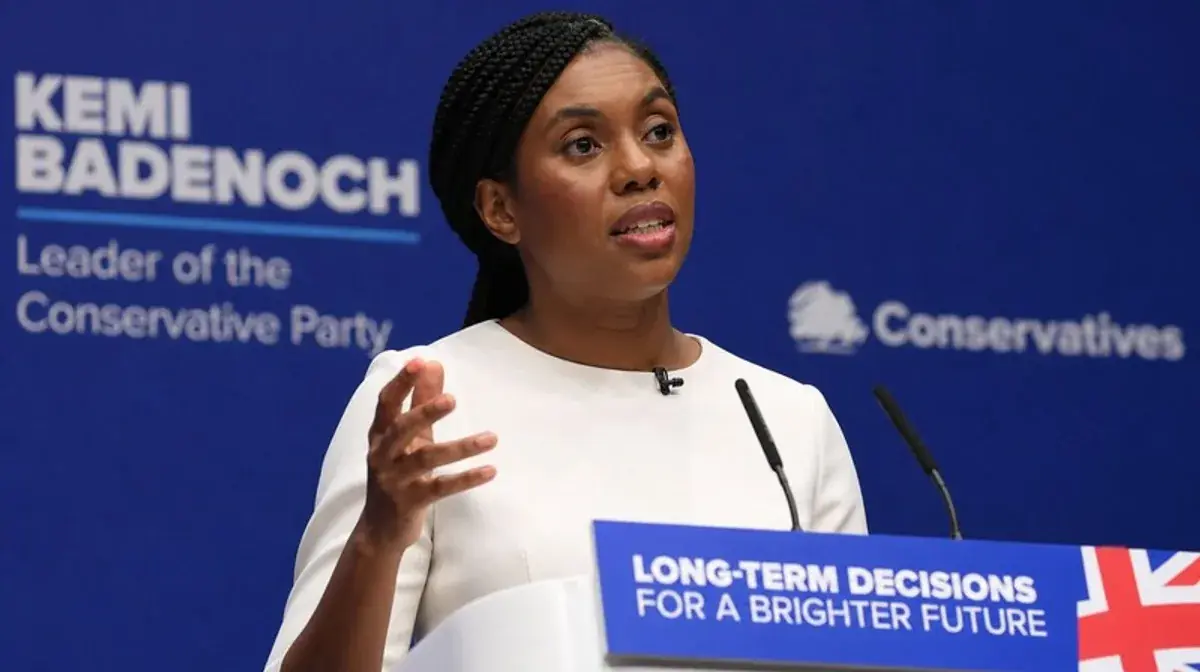
Kemi Badenoch has pursued a strategy of cultural conservatism combined with economic liberalism: sceptical of diversity and inclusion policies, strongly anti-woke, but committed to free markets and reduced state intervention. In policy terms, she has attempted to position the Conservatives to the right of Labour on social issues while being more economically liberal than Reform.
The polling verdict on this strategy is equivocal. Badenoch’s personal ratings have improved since a disastrous start — she was polling at net -22% in January 2025 but has recovered to -12% in May 2026. However, the party’s overall vote share has continued to drift downward. The right-wing cultural positioning appears to be winning back very few Reform voters while continuing to alienate moderate Conservatives.
Badenoch’s supporters argue that the party must complete its ideological repositioning before it can start winning votes back, and that 2026 is too early to judge the strategy. Critics within the party argue that continued rightward drift is a dead end — that the party is competing with Reform on Reform’s strongest terrain and losing, while abandoning the centre ground that wins general elections.
Historical Precedents: How Parties Recover
The most instructive historical precedent is Labour between 1983 and 1997. After the 1983 landslide defeat, Labour polled as low as 27% and was widely described as facing permanent decline. It took 14 years, four leadership changes, and a complete ideological transformation under Tony Blair to return to government. The Conservatives may need a similar process.
A more alarming precedent is the Progressive Conservative Party of Canada, which was reduced to two seats in the 1993 federal election and subsequently merged with the Reform Party of Canada. British Conservatives are acutely aware of this precedent and its potential applicability to their situation.
The most optimistic precedent — from the Conservatives’ own history — is the party between 1945 and 1951. After a landslide defeat, the party reinvented itself and returned to government six years later. The structural resilience of the Conservative brand was real. Whether it remains so in 2026, facing an adversary on its right flank that did not exist in 1945, is the open question.
The Reform Merger Question
The question that haunts every Conservative strategy discussion is whether the party should seek some form of alliance or merger with Reform UK. There is a mathematical case: the combined Reform-Conservative poll share of 47% would, under most MRP models, translate to a very large parliamentary majority if unified behind a single party.
Badenoch has categorically rejected merger. Her argument is that the Conservative Party is a broad church that has governed Britain for most of the past two centuries, and that it should not subordinate itself to a single-issue protest movement led by Nigel Farage. But if 2029 produces another catastrophic Conservative result — below 100 seats — the pressure for some formal arrangement with Reform will be very hard to resist.
What Survival Actually Requires
For the Conservative Party to survive as a major force, it needs to accomplish several things simultaneously. It needs to hold its remaining seats in 2029 against both Labour and Reform. It needs to build a convincing narrative about what it would do differently from both Starmer and Farage. It needs to reconnect with voters in suburban and small-town England who moved away in 2024.
None of these tasks is impossible. But at 19% in May 2026, with three years to the next election, the Conservative Party faces the most serious challenge in its two-century existence. The polling trend will determine whether Badenoch’s strategy is working, or whether more radical change is required.