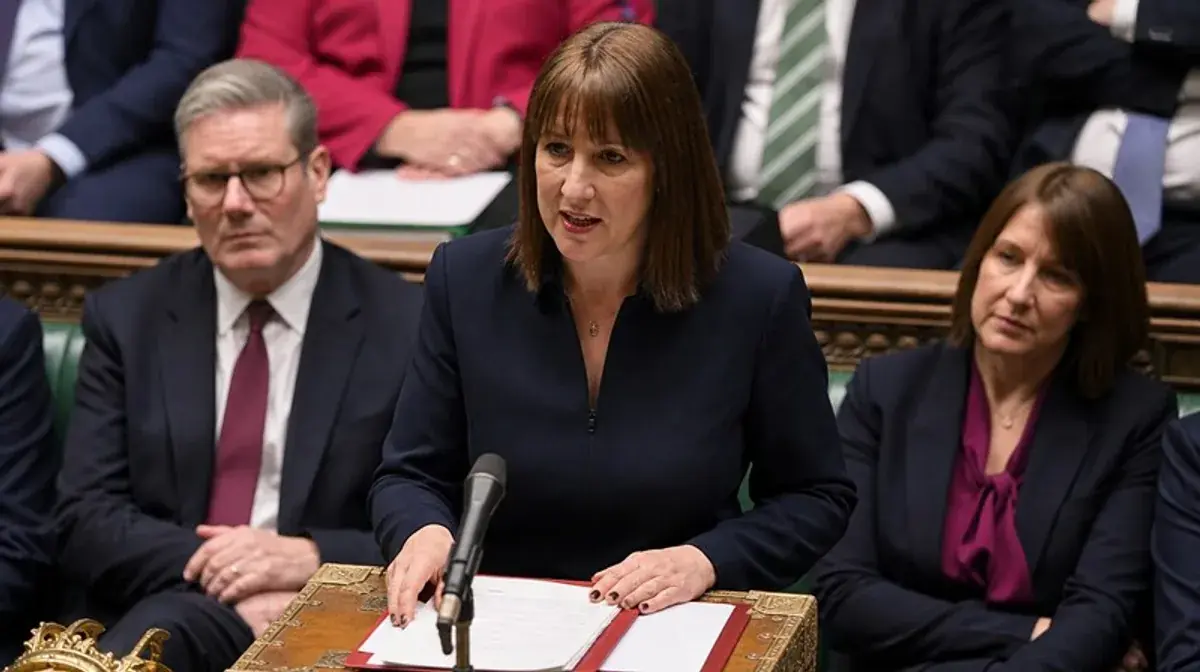
When Labour won the July 2024 general election, polling suggested that Rachel Reeves was one of the party’s strongest assets: a credible, serious Chancellor-in-waiting who polled better on economic trust than any Labour shadow chancellor since Gordon Brown. Less than two years later, her net approval stands at approximately −28%, and her economic credibility scores have deteriorated sharply. The data behind that shift tells the story of a government that lost its foundational advantage at the worst possible time.
The Starting Point: Reeves in Summer 2024
In the weeks immediately after the general election, Reeves had a net approval rating of approximately +4% — positive territory for a Chancellor, reflecting the electoral goodwill of a new government. Crucially, she led the Conservatives on economic trust by 12 points: 38% of voters said they trusted Labour more on managing the economy compared to 26% for the Tories. That economic trust advantage was one of the central pillars of Labour’s 2024 majority.
The inheritance narrative Reeves deployed throughout the summer — arguing the Conservatives had left a £22bn “black hole” in the public finances — initially polled reasonably well. Roughly 44% of voters said they believed the claim; only 28% actively disbelieved it. But the window for that narrative to do political work was narrow, and it closed faster than the Treasury anticipated.
By October 2024, with the Budget approaching, Reeves’ approval had already slipped to −6%, driven by anxiety about what the Budget would contain and early reports of the NI changes. The moment the Budget landed, the downward trajectory became structural.
The October 2024 Budget: Turning Point
The October 2024 Budget raised employer National Insurance contributions by 1.2 percentage points and lowered the secondary threshold, a combination described by business groups as a significant increase in the cost of employment. The Office for Budget Responsibility projected it would reduce employment by approximately 50,000 over the medium term. The hospitality, retail, and care sectors — which employ large numbers of low-wage workers — lobbied immediately and publicly against the change.
Post-Budget polling by Ipsos found that 54% of voters said the Budget made them personally worse off, against 18% who said better off. More damaging still, 61% said they believed business would pass the NI increase on to workers and consumers through lower wages and higher prices — a belief that eroded the “no tax on working people” line Reeves had used in opposition. Reeves’ personal approval fell 11 points in the fortnight following the Budget, the sharpest single-event drop she has experienced.
The decision to cut the winter fuel payment, though a spending decision rather than a tax one, was also attributed in public perception to Reeves. Among pensioners, Reeves’ approval fell from −8% in July 2024 to −31% by December 2024. That demographic shift has not recovered.
Economic Performance: The Real Context
Part of Reeves’ approval problem is structural: the economy has not provided the positive backdrop that could otherwise have softened political damage. UK GDP growth for 2025 came in at 0.6% annually — above the 2023 stagnation but below both the government’s own projections and the 1.5% average of comparable European economies. Inflation has fallen from its 2022–23 peaks but remains above 3%, meaning real wages for many workers have grown only marginally despite nominal increases.
The economic perception data is even bleaker than the performance data. A Savanta poll from April 2026 found 68% of voters saying the economy was getting worse — a figure that exceeds even the perception gap during the early months of the 2022 cost-of-living crisis. Only 11% said the economy was getting better. For a government that inherited a 12-point economic trust lead, this represents a catastrophic reversal of the foundational premise of its electoral coalition.
Reeves has pointed to the Planning and Infrastructure Bill and inward investment figures as evidence of longer-term structural improvement. But voters experience the present, not the future, and the present — characterised by high mortgage costs, persistent inflation, and rising bills — is not the picture her pre-election messaging had implied.
The Economic Trust Collapse: Who Voters Now Back
The most alarming poll figure for Labour is the current state of economic trust. Polling from May 2026 shows only 24% of voters trust Reeves and Labour to manage the economy well. The Conservatives under Badenoch score 41% — an extraordinary recovery for a party that presided over a cost-of-living crisis, a disastrous mini-Budget, and seven years of anaemic growth. Reform UK scores 22%, a figure that would have seemed absurd two years ago for a party with no governing experience.
The inversion of the economic trust variable is the single most structurally important polling shift in British politics since 2024. Labour’s long road back to power, from 2010 to 2024, was predicated on eventually being trusted on the economy again. The party achieved that in 2024 and has now squandered it in less than 24 months. Rebuilding economic credibility before 2029 is, according to internal Labour analysis, the central political challenge facing the government.
How Reform Benefits from Economic Pessimism
The direct electoral consequence of Reeves’ unpopularity and economic pessimism is that Reform UK has become the primary beneficiary. Among voters who cite the economy as their most important issue and say it is getting worse, Reform leads Labour by 18 points in voting intention. These are not natural Reform voters by cultural identity; they are disaffected centrists and traditional Labour supporters expressing economic frustration through an anti-establishment choice.
The political danger for Labour is that economic pessimism has become self-reinforcing. When 68% of voters believe the economy is getting worse, consumer confidence falls, investment decisions are deferred, and those effects themselves contribute to weaker actual economic performance. Reeves needs to break the cycle of perception before any genuine economic improvement can translate into political benefit ahead of the 2029 general election.
Frequently Asked Questions
What is Rachel Reeves’ approval rating in May 2026?
Approximately −28% net approval, with 25% of voters approving of her performance and 53% disapproving. One of the weakest ratings for a Chancellor at this stage of a Parliament in modern polling history.
Why has Reeves become so unpopular?
The October 2024 Budget (employer NI rise, winter fuel cut), persistent economic underperformance (GDP below 1% in 2025), and a widespread perception that economic promises have not been kept. 68% of voters say the economy is getting worse.
Do voters trust Reeves on the economy?
Only 24% trust Labour to manage the economy well, down from 38% at the 2024 election. The Conservatives now score 41% on economic trust — a near-complete reversal of the dynamic that powered Labour to victory.
Could Reeves be replaced as Chancellor?
No credible public campaign has emerged as of May 2026. She retains Starmer’s support. If growth remains below 1% through 2026, backbench pressure for a reshuffle is likely to intensify.